

18 Perfluorooctanesulfonate (PFOS), Its Occurrence, Fate …
411
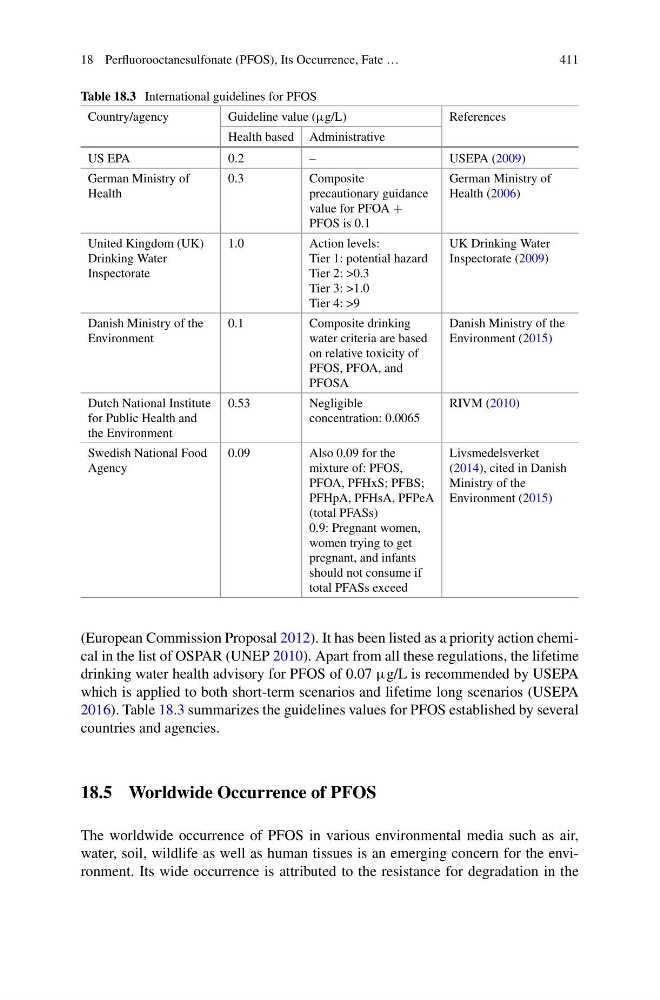
Table 18.3 International guidelines for PFOS
Country/agency
Guideline value (µg/L)
References
Health based Administrative
US EPA
0.2
–
USEPA (2009)
German Ministry of
Health
0.3
Composite
precautionary guidance
value for PFOA +
PFOS is 0.1
German Ministry of
Health (2006)
United Kingdom (UK)
Drinking Water
Inspectorate
1.0
Action levels:
Tier 1: potential hazard
Tier 2: >0.3
Tier 3: >1.0
Tier 4: >9
UK Drinking Water
Inspectorate (2009)
Danish Ministry of the
Environment
0.1
Composite drinking
water criteria are based
on relative toxicity of
PFOS, PFOA, and
PFOSA
Danish Ministry of the
Environment (2015)
Dutch National Institute
for Public Health and
the Environment
0.53
Negligible
concentration: 0.0065
RIVM (2010)
Swedish National Food
Agency
0.09
Also 0.09 for the
mixture of: PFOS,
PFOA, PFHxS; PFBS;
PFHpA, PFHsA, PFPeA
(total PFASs)
0.9: Pregnant women,
women trying to get
pregnant, and infants
should not consume if
total PFASs exceed
Livsmedelsverket
(2014), cited in Danish
Ministry of the
Environment (2015)
(European Commission Proposal 2012). It has been listed as a priority action chemical in the list of OSPAR (UNEP 2010). Apart from all these regulations, the lifetime
drinking water health advisory for PFOS of 0.07 µg/L is recommended by USEPA
which is applied to both short-term scenarios and lifetime long scenarios (USEPA
2016). Table 18.3 summarizes the guidelines values for PFOS established by several
countries and agencies.
18.5 Worldwide Occurrence of PFOS
The worldwide occurrence of PFOS in various environmental media such as air,
water, soil, wildlife as well as human tissues is an emerging concern for the environment. Its wide occurrence is attributed to the resistance for degradation in the
411
Table 18.3 International guidelines for PFOS
Country/agency
Guideline value (µg/L)
References
Health based Administrative
US EPA
0.2
–
USEPA (2009)
German Ministry of
Health
0.3
Composite
precautionary guidance
value for PFOA +
PFOS is 0.1
German Ministry of
Health (2006)
United Kingdom (UK)
Drinking Water
Inspectorate
1.0
Action levels:
Tier 1: potential hazard
Tier 2: >0.3
Tier 3: >1.0
Tier 4: >9
UK Drinking Water
Inspectorate (2009)
Danish Ministry of the
Environment
0.1
Composite drinking
water criteria are based
on relative toxicity of
PFOS, PFOA, and
PFOSA
Danish Ministry of the
Environment (2015)
Dutch National Institute
for Public Health and
the Environment
0.53
Negligible
concentration: 0.0065
RIVM (2010)
Swedish National Food
Agency
0.09
Also 0.09 for the
mixture of: PFOS,
PFOA, PFHxS; PFBS;
PFHpA, PFHsA, PFPeA
(total PFASs)
0.9: Pregnant women,
women trying to get
pregnant, and infants
should not consume if
total PFASs exceed
Livsmedelsverket
(2014), cited in Danish
Ministry of the
Environment (2015)
(European Commission Proposal 2012). It has been listed as a priority action chemical in the list of OSPAR (UNEP 2010). Apart from all these regulations, the lifetime
drinking water health advisory for PFOS of 0.07 µg/L is recommended by USEPA
which is applied to both short-term scenarios and lifetime long scenarios (USEPA
2016). Table 18.3 summarizes the guidelines values for PFOS established by several
countries and agencies.
18.5 Worldwide Occurrence of PFOS
The worldwide occurrence of PFOS in various environmental media such as air,
water, soil, wildlife as well as human tissues is an emerging concern for the environment. Its wide occurrence is attributed to the resistance for degradation in the