

330
R. Kumar et al.
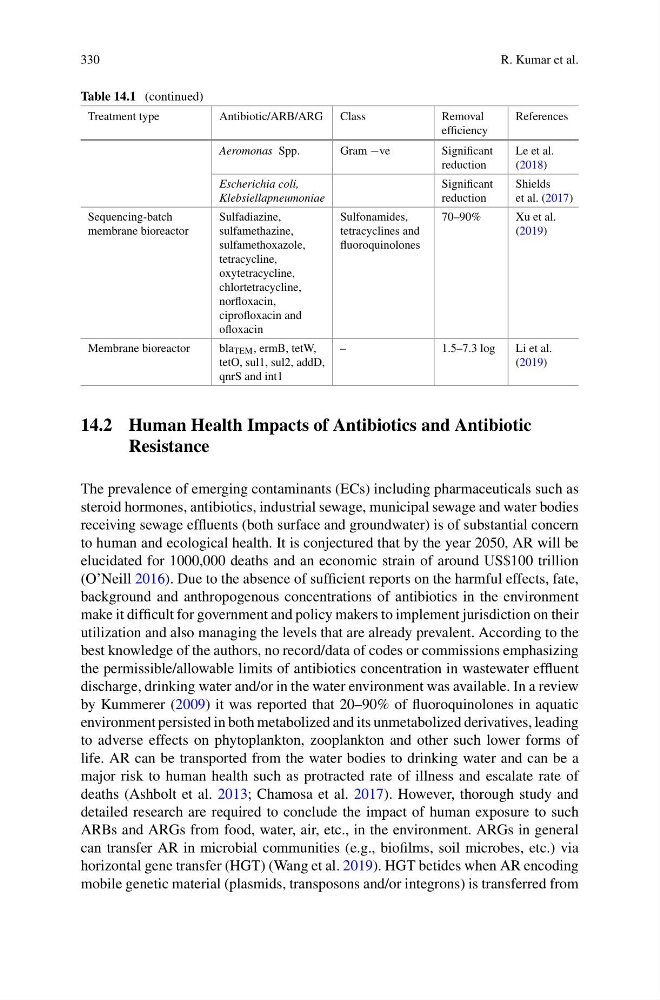
Table 14.1 (continued)
Treatment type
Antibiotic/ARB/ARG Class
Removal
efficiency
References
Aeromonas Spp.
Gram −ve
Significant
reduction
Le et al.
(2018)
Escherichia coli,
Klebsiellapneumoniae
Significant
reduction
Shields
et al. (2017)
Sequencing-batch
membrane bioreactor
Sulfadiazine,
sulfamethazine,
sulfamethoxazole,
tetracycline,
oxytetracycline,
chlortetracycline,
norfloxacin,
ciprofloxacin and
ofloxacin
Sulfonamides,
tetracyclines and
fluoroquinolones
70–90%
Xu et al.
(2019)
Membrane bioreactor
bla TEM , ermB, tetW,
tetO, sul1, sul2, addD,
qnrS and int1
–
1.5–7.3 log
Li et al.
(2019)
14.2 Human Health Impacts of Antibiotics and Antibiotic
Resistance
The prevalence of emerging contaminants (ECs) including pharmaceuticals such as
steroid hormones, antibiotics, industrial sewage, municipal sewage and water bodies
receiving sewage effluents (both surface and groundwater) is of substantial concern
to human and ecological health. It is conjectured that by the year 2050, AR will be
elucidated for 1000,000 deaths and an economic strain of around US$100 trillion
(O’Neill 2016). Due to the absence of sufficient reports on the harmful effects, fate,
background and anthropogenous concentrations of antibiotics in the environment
make it difficult for government and policy makers to implement jurisdiction on their
utilization and also managing the levels that are already prevalent. According to the
best knowledge of the authors, no record/data of codes or commissions emphasizing
the permissible/allowable limits of antibiotics concentration in wastewater effluent
discharge, drinking water and/or in the water environment was available. In a review
by Kummerer (2009) it was reported that 20–90% of fluoroquinolones in aquatic
environment persisted in both metabolized and its unmetabolized derivatives, leading
to adverse effects on phytoplankton, zooplankton and other such lower forms of
life. AR can be transported from the water bodies to drinking water and can be a
major risk to human health such as protracted rate of illness and escalate rate of
deaths (Ashbolt et al. 2013; Chamosa et al. 2017). However, thorough study and
detailed research are required to conclude the impact of human exposure to such
ARBs and ARGs from food, water, air, etc., in the environment. ARGs in general
can transfer AR in microbial communities (e.g., biofilms, soil microbes, etc.) via
horizontal gene transfer (HGT) (Wang et al. 2019). HGT betides when AR encoding
mobile genetic material (plasmids, transposons and/or integrons) is transferred from
R. Kumar et al.
Table 14.1 (continued)
Treatment type
Antibiotic/ARB/ARG Class
Removal
efficiency
References
Aeromonas Spp.
Gram −ve
Significant
reduction
Le et al.
(2018)
Escherichia coli,
Klebsiellapneumoniae
Significant
reduction
Shields
et al. (2017)
Sequencing-batch
membrane bioreactor
Sulfadiazine,
sulfamethazine,
sulfamethoxazole,
tetracycline,
oxytetracycline,
chlortetracycline,
norfloxacin,
ciprofloxacin and
ofloxacin
Sulfonamides,
tetracyclines and
fluoroquinolones
70–90%
Xu et al.
(2019)
Membrane bioreactor
bla TEM , ermB, tetW,
tetO, sul1, sul2, addD,
qnrS and int1
–
1.5–7.3 log
Li et al.
(2019)
14.2 Human Health Impacts of Antibiotics and Antibiotic
Resistance
The prevalence of emerging contaminants (ECs) including pharmaceuticals such as
steroid hormones, antibiotics, industrial sewage, municipal sewage and water bodies
receiving sewage effluents (both surface and groundwater) is of substantial concern
to human and ecological health. It is conjectured that by the year 2050, AR will be
elucidated for 1000,000 deaths and an economic strain of around US$100 trillion
(O’Neill 2016). Due to the absence of sufficient reports on the harmful effects, fate,
background and anthropogenous concentrations of antibiotics in the environment
make it difficult for government and policy makers to implement jurisdiction on their
utilization and also managing the levels that are already prevalent. According to the
best knowledge of the authors, no record/data of codes or commissions emphasizing
the permissible/allowable limits of antibiotics concentration in wastewater effluent
discharge, drinking water and/or in the water environment was available. In a review
by Kummerer (2009) it was reported that 20–90% of fluoroquinolones in aquatic
environment persisted in both metabolized and its unmetabolized derivatives, leading
to adverse effects on phytoplankton, zooplankton and other such lower forms of
life. AR can be transported from the water bodies to drinking water and can be a
major risk to human health such as protracted rate of illness and escalate rate of
deaths (Ashbolt et al. 2013; Chamosa et al. 2017). However, thorough study and
detailed research are required to conclude the impact of human exposure to such
ARBs and ARGs from food, water, air, etc., in the environment. ARGs in general
can transfer AR in microbial communities (e.g., biofilms, soil microbes, etc.) via
horizontal gene transfer (HGT) (Wang et al. 2019). HGT betides when AR encoding
mobile genetic material (plasmids, transposons and/or integrons) is transferred from