

314
C. Bhagat et al.
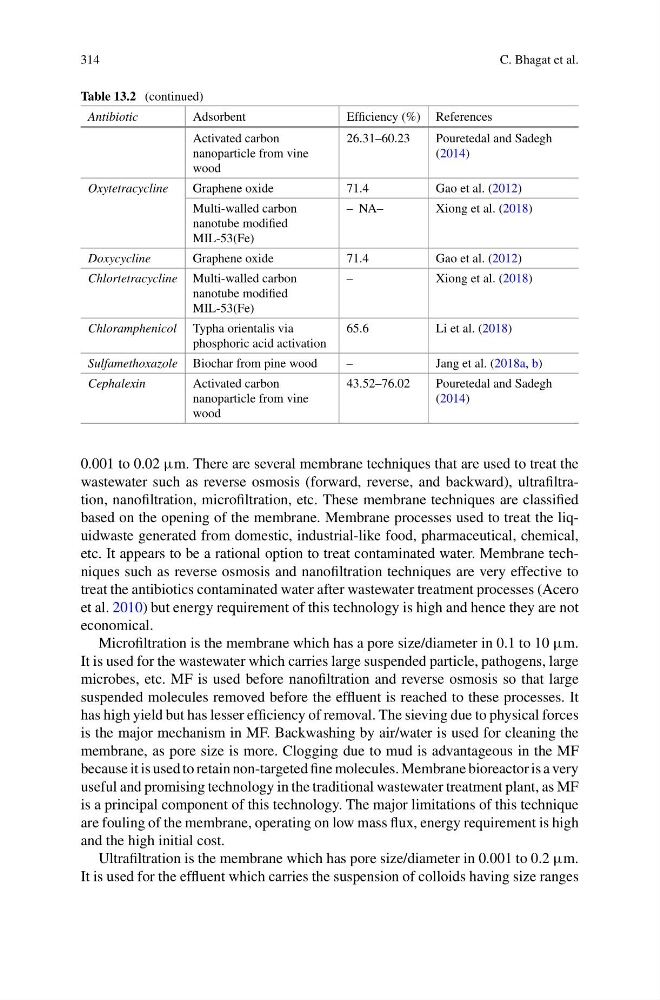
Table 13.2 (continued)
Antibiotic
Adsorbent
Efficiency (%) References
Activated carbon
nanoparticle from vine
wood
26.31–60.23
Pouretedal and Sadegh
(2014)
Oxytetracycline
Graphene oxide
71.4
Gao et al. (2012)
Multi-walled carbon
nanotube modified
MIL-53(Fe)
– NA–
Xiong et al. (2018)
Doxycycline
Graphene oxide
71.4
Gao et al. (2012)
Chlortetracycline Multi-walled carbon
nanotube modified
MIL-53(Fe)
–
Xiong et al. (2018)
Chloramphenicol Typha orientalis via
phosphoric acid activation
65.6
Li et al. (2018)
Sulfamethoxazole Biochar from pine wood
–
Jang et al. (2018a, b)
Cephalexin
Activated carbon
nanoparticle from vine
wood
43.52–76.02
Pouretedal and Sadegh
(2014)
0.001 to 0.02 μm. There are several membrane techniques that are used to treat the
wastewater such as reverse osmosis (forward, reverse, and backward), ultrafiltration, nanofiltration, microfiltration, etc. These membrane techniques are classified
based on the opening of the membrane. Membrane processes used to treat the liquidwaste generated from domestic, industrial-like food, pharmaceutical, chemical,
etc. It appears to be a rational option to treat contaminated water. Membrane techniques such as reverse osmosis and nanofiltration techniques are very effective to
treat the antibiotics contaminated water after wastewater treatment processes (Acero
et al. 2010) but energy requirement of this technology is high and hence they are not
economical.
Microfiltration is the membrane which has a pore size/diameter in 0.1 to 10 μm.
It is used for the wastewater which carries large suspended particle, pathogens, large
microbes, etc. MF is used before nanofiltration and reverse osmosis so that large
suspended molecules removed before the effluent is reached to these processes. It
has high yield but has lesser efficiency of removal. The sieving due to physical forces
is the major mechanism in MF. Backwashing by air/water is used for cleaning the
membrane, as pore size is more. Clogging due to mud is advantageous in the MF
because it is used to retain non-targeted fine molecules. Membrane bioreactor is a very
useful and promising technology in the traditional wastewater treatment plant, as MF
is a principal component of this technology. The major limitations of this technique
are fouling of the membrane, operating on low mass flux, energy requirement is high
and the high initial cost.
Ultrafiltration is the membrane which has pore size/diameter in 0.001 to 0.2 μm.
It is used for the effluent which carries the suspension of colloids having size ranges
C. Bhagat et al.
Table 13.2 (continued)
Antibiotic
Adsorbent
Efficiency (%) References
Activated carbon
nanoparticle from vine
wood
26.31–60.23
Pouretedal and Sadegh
(2014)
Oxytetracycline
Graphene oxide
71.4
Gao et al. (2012)
Multi-walled carbon
nanotube modified
MIL-53(Fe)
– NA–
Xiong et al. (2018)
Doxycycline
Graphene oxide
71.4
Gao et al. (2012)
Chlortetracycline Multi-walled carbon
nanotube modified
MIL-53(Fe)
–
Xiong et al. (2018)
Chloramphenicol Typha orientalis via
phosphoric acid activation
65.6
Li et al. (2018)
Sulfamethoxazole Biochar from pine wood
–
Jang et al. (2018a, b)
Cephalexin
Activated carbon
nanoparticle from vine
wood
43.52–76.02
Pouretedal and Sadegh
(2014)
0.001 to 0.02 μm. There are several membrane techniques that are used to treat the
wastewater such as reverse osmosis (forward, reverse, and backward), ultrafiltration, nanofiltration, microfiltration, etc. These membrane techniques are classified
based on the opening of the membrane. Membrane processes used to treat the liquidwaste generated from domestic, industrial-like food, pharmaceutical, chemical,
etc. It appears to be a rational option to treat contaminated water. Membrane techniques such as reverse osmosis and nanofiltration techniques are very effective to
treat the antibiotics contaminated water after wastewater treatment processes (Acero
et al. 2010) but energy requirement of this technology is high and hence they are not
economical.
Microfiltration is the membrane which has a pore size/diameter in 0.1 to 10 μm.
It is used for the wastewater which carries large suspended particle, pathogens, large
microbes, etc. MF is used before nanofiltration and reverse osmosis so that large
suspended molecules removed before the effluent is reached to these processes. It
has high yield but has lesser efficiency of removal. The sieving due to physical forces
is the major mechanism in MF. Backwashing by air/water is used for cleaning the
membrane, as pore size is more. Clogging due to mud is advantageous in the MF
because it is used to retain non-targeted fine molecules. Membrane bioreactor is a very
useful and promising technology in the traditional wastewater treatment plant, as MF
is a principal component of this technology. The major limitations of this technique
are fouling of the membrane, operating on low mass flux, energy requirement is high
and the high initial cost.
Ultrafiltration is the membrane which has pore size/diameter in 0.001 to 0.2 μm.
It is used for the effluent which carries the suspension of colloids having size ranges