

13 Reigning Technologies and Their Challenges for Antibiotics …
313
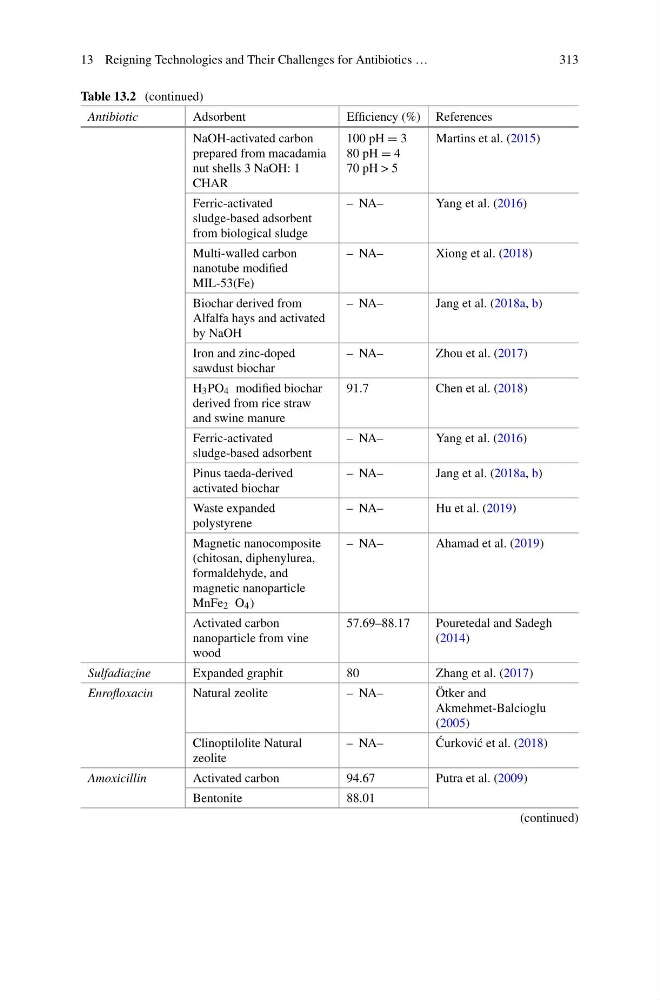
Table 13.2 (continued)
Antibiotic
Adsorbent
Efficiency (%) References
NaOH-activated carbon
prepared from macadamia
nut shells 3 NaOH: 1
CHAR
100 pH = 3
80 pH = 4
70 pH > 5
Martins et al. (2015)
Ferric-activated
sludge-based adsorbent
from biological sludge
– NA–
Yang et al. (2016)
Multi-walled carbon
nanotube modified
MIL-53(Fe)
– NA–
Xiong et al. (2018)
Biochar derived from
Alfalfa hays and activated
by NaOH
– NA–
Jang et al. (2018a, b)
Iron and zinc-doped
sawdust biochar
– NA–
Zhou et al. (2017)
H 3 PO 4 modified biochar
derived from rice straw
and swine manure
91.7
Chen et al. (2018)
Ferric-activated
sludge-based adsorbent
– NA–
Yang et al. (2016)
Pinus taeda-derived
activated biochar
– NA–
Jang et al. (2018a, b)
Waste expanded
polystyrene
– NA–
Hu et al. (2019)
Magnetic nanocomposite
(chitosan, diphenylurea,
formaldehyde, and
magnetic nanoparticle
MnFe 2 O 4 )
– NA–
Ahamad et al. (2019)
Activated carbon
nanoparticle from vine
wood
57.69–88.17
Pouretedal and Sadegh
(2014)
Sulfadiazine
Expanded graphit
80
Zhang et al. (2017)
Enrofloxacin
Natural zeolite
– NA–
Ötker and
Akmehmet-Balcioglu
(2005)
Clinoptilolite Natural
zeolite
– NA–
´
Curkovi´ c et al. (2018)
Amoxicillin
Activated carbon
94.67
Putra et al. (2009)
Bentonite
88.01
(continued)
313
Table 13.2 (continued)
Antibiotic
Adsorbent
Efficiency (%) References
NaOH-activated carbon
prepared from macadamia
nut shells 3 NaOH: 1
CHAR
100 pH = 3
80 pH = 4
70 pH > 5
Martins et al. (2015)
Ferric-activated
sludge-based adsorbent
from biological sludge
– NA–
Yang et al. (2016)
Multi-walled carbon
nanotube modified
MIL-53(Fe)
– NA–
Xiong et al. (2018)
Biochar derived from
Alfalfa hays and activated
by NaOH
– NA–
Jang et al. (2018a, b)
Iron and zinc-doped
sawdust biochar
– NA–
Zhou et al. (2017)
H 3 PO 4 modified biochar
derived from rice straw
and swine manure
91.7
Chen et al. (2018)
Ferric-activated
sludge-based adsorbent
– NA–
Yang et al. (2016)
Pinus taeda-derived
activated biochar
– NA–
Jang et al. (2018a, b)
Waste expanded
polystyrene
– NA–
Hu et al. (2019)
Magnetic nanocomposite
(chitosan, diphenylurea,
formaldehyde, and
magnetic nanoparticle
MnFe 2 O 4 )
– NA–
Ahamad et al. (2019)
Activated carbon
nanoparticle from vine
wood
57.69–88.17
Pouretedal and Sadegh
(2014)
Sulfadiazine
Expanded graphit
80
Zhang et al. (2017)
Enrofloxacin
Natural zeolite
– NA–
Ötker and
Akmehmet-Balcioglu
(2005)
Clinoptilolite Natural
zeolite
– NA–
´
Curkovi´ c et al. (2018)
Amoxicillin
Activated carbon
94.67
Putra et al. (2009)
Bentonite
88.01
(continued)