

284
B. Gunawardana et al.
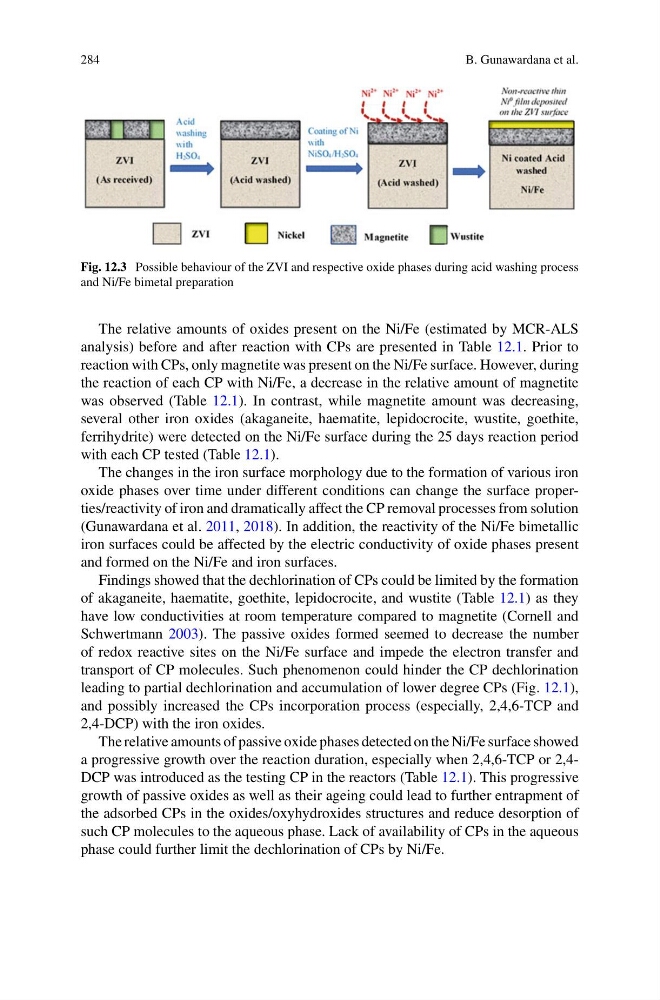
Fig. 12.3 Possible behaviour of the ZVI and respective oxide phases during acid washing process
and Ni/Fe bimetal preparation
The relative amounts of oxides present on the Ni/Fe (estimated by MCR-ALS
analysis) before and after reaction with CPs are presented in Table 12.1. Prior to
reaction with CPs, only magnetite was present on the Ni/Fe surface. However, during
the reaction of each CP with Ni/Fe, a decrease in the relative amount of magnetite
was observed (Table 12.1). In contrast, while magnetite amount was decreasing,
several other iron oxides (akaganeite, haematite, lepidocrocite, wustite, goethite,
ferrihydrite) were detected on the Ni/Fe surface during the 25 days reaction period
with each CP tested (Table 12.1).
The changes in the iron surface morphology due to the formation of various iron
oxide phases over time under different conditions can change the surface properties/reactivity of iron and dramatically affect the CP removal processes from solution
(Gunawardana et al. 2011, 2018). In addition, the reactivity of the Ni/Fe bimetallic
iron surfaces could be affected by the electric conductivity of oxide phases present
and formed on the Ni/Fe and iron surfaces.
Findings showed that the dechlorination of CPs could be limited by the formation
of akaganeite, haematite, goethite, lepidocrocite, and wustite (Table 12.1) as they
have low conductivities at room temperature compared to magnetite (Cornell and
Schwertmann 2003). The passive oxides formed seemed to decrease the number
of redox reactive sites on the Ni/Fe surface and impede the electron transfer and
transport of CP molecules. Such phenomenon could hinder the CP dechlorination
leading to partial dechlorination and accumulation of lower degree CPs (Fig. 12.1),
and possibly increased the CPs incorporation process (especially, 2,4,6-TCP and
2,4-DCP) with the iron oxides.
The relative amounts of passive oxide phases detected on the Ni/Fe surface showed
a progressive growth over the reaction duration, especially when 2,4,6-TCP or 2,4DCP was introduced as the testing CP in the reactors (Table 12.1). This progressive
growth of passive oxides as well as their ageing could lead to further entrapment of
the adsorbed CPs in the oxides/oxyhydroxides structures and reduce desorption of
such CP molecules to the aqueous phase. Lack of availability of CPs in the aqueous
phase could further limit the dechlorination of CPs by Ni/Fe.
B. Gunawardana et al.
Fig. 12.3 Possible behaviour of the ZVI and respective oxide phases during acid washing process
and Ni/Fe bimetal preparation
The relative amounts of oxides present on the Ni/Fe (estimated by MCR-ALS
analysis) before and after reaction with CPs are presented in Table 12.1. Prior to
reaction with CPs, only magnetite was present on the Ni/Fe surface. However, during
the reaction of each CP with Ni/Fe, a decrease in the relative amount of magnetite
was observed (Table 12.1). In contrast, while magnetite amount was decreasing,
several other iron oxides (akaganeite, haematite, lepidocrocite, wustite, goethite,
ferrihydrite) were detected on the Ni/Fe surface during the 25 days reaction period
with each CP tested (Table 12.1).
The changes in the iron surface morphology due to the formation of various iron
oxide phases over time under different conditions can change the surface properties/reactivity of iron and dramatically affect the CP removal processes from solution
(Gunawardana et al. 2011, 2018). In addition, the reactivity of the Ni/Fe bimetallic
iron surfaces could be affected by the electric conductivity of oxide phases present
and formed on the Ni/Fe and iron surfaces.
Findings showed that the dechlorination of CPs could be limited by the formation
of akaganeite, haematite, goethite, lepidocrocite, and wustite (Table 12.1) as they
have low conductivities at room temperature compared to magnetite (Cornell and
Schwertmann 2003). The passive oxides formed seemed to decrease the number
of redox reactive sites on the Ni/Fe surface and impede the electron transfer and
transport of CP molecules. Such phenomenon could hinder the CP dechlorination
leading to partial dechlorination and accumulation of lower degree CPs (Fig. 12.1),
and possibly increased the CPs incorporation process (especially, 2,4,6-TCP and
2,4-DCP) with the iron oxides.
The relative amounts of passive oxide phases detected on the Ni/Fe surface showed
a progressive growth over the reaction duration, especially when 2,4,6-TCP or 2,4DCP was introduced as the testing CP in the reactors (Table 12.1). This progressive
growth of passive oxides as well as their ageing could lead to further entrapment of
the adsorbed CPs in the oxides/oxyhydroxides structures and reduce desorption of
such CP molecules to the aqueous phase. Lack of availability of CPs in the aqueous
phase could further limit the dechlorination of CPs by Ni/Fe.