

8 Reappraisal of Permeable Reactive Barrier as a Sustainable …
201
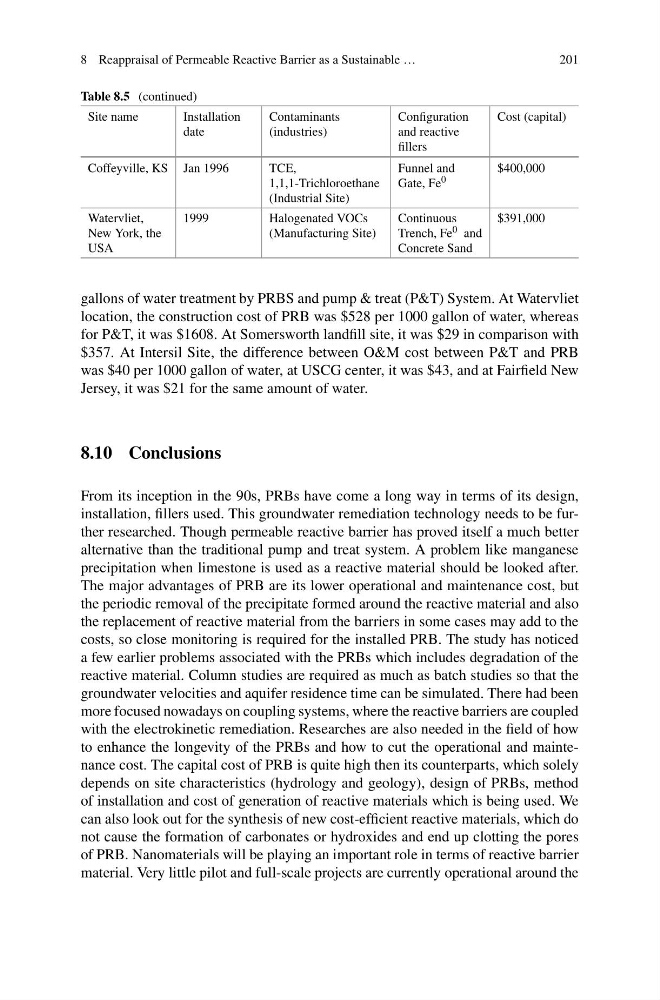
Table 8.5 (continued)
Site name
Installation
date
Contaminants
(industries)
Configuration
and reactive
fillers
Cost (capital)
Coffeyville, KS Jan 1996
TCE,
1,1,1-Trichloroethane
(Industrial Site)
Funnel and
Gate, Fe 0
$400,000
Watervliet,
New York, the
USA
1999
Halogenated VOCs
(Manufacturing Site)
Continuous
Trench, Fe 0 and
Concrete Sand
$391,000
gallons of water treatment by PRBS and pump & treat (P&T) System. At Watervliet
location, the construction cost of PRB was $528 per 1000 gallon of water, whereas
for P&T, it was $1608. At Somersworth landfill site, it was $29 in comparison with
$357. At Intersil Site, the difference between O&M cost between P&T and PRB
was $40 per 1000 gallon of water, at USCG center, it was $43, and at Fairfield New
Jersey, it was $21 for the same amount of water.
8.10 Conclusions
From its inception in the 90s, PRBs have come a long way in terms of its design,
installation, fillers used. This groundwater remediation technology needs to be further researched. Though permeable reactive barrier has proved itself a much better
alternative than the traditional pump and treat system. A problem like manganese
precipitation when limestone is used as a reactive material should be looked after.
The major advantages of PRB are its lower operational and maintenance cost, but
the periodic removal of the precipitate formed around the reactive material and also
the replacement of reactive material from the barriers in some cases may add to the
costs, so close monitoring is required for the installed PRB. The study has noticed
a few earlier problems associated with the PRBs which includes degradation of the
reactive material. Column studies are required as much as batch studies so that the
groundwater velocities and aquifer residence time can be simulated. There had been
more focused nowadays on coupling systems, where the reactive barriers are coupled
with the electrokinetic remediation. Researches are also needed in the field of how
to enhance the longevity of the PRBs and how to cut the operational and maintenance cost. The capital cost of PRB is quite high then its counterparts, which solely
depends on site characteristics (hydrology and geology), design of PRBs, method
of installation and cost of generation of reactive materials which is being used. We
can also look out for the synthesis of new cost-efficient reactive materials, which do
not cause the formation of carbonates or hydroxides and end up clotting the pores
of PRB. Nanomaterials will be playing an important role in terms of reactive barrier
material. Very little pilot and full-scale projects are currently operational around the
201
Table 8.5 (continued)
Site name
Installation
date
Contaminants
(industries)
Configuration
and reactive
fillers
Cost (capital)
Coffeyville, KS Jan 1996
TCE,
1,1,1-Trichloroethane
(Industrial Site)
Funnel and
Gate, Fe 0
$400,000
Watervliet,
New York, the
USA
1999
Halogenated VOCs
(Manufacturing Site)
Continuous
Trench, Fe 0 and
Concrete Sand
$391,000
gallons of water treatment by PRBS and pump & treat (P&T) System. At Watervliet
location, the construction cost of PRB was $528 per 1000 gallon of water, whereas
for P&T, it was $1608. At Somersworth landfill site, it was $29 in comparison with
$357. At Intersil Site, the difference between O&M cost between P&T and PRB
was $40 per 1000 gallon of water, at USCG center, it was $43, and at Fairfield New
Jersey, it was $21 for the same amount of water.
8.10 Conclusions
From its inception in the 90s, PRBs have come a long way in terms of its design,
installation, fillers used. This groundwater remediation technology needs to be further researched. Though permeable reactive barrier has proved itself a much better
alternative than the traditional pump and treat system. A problem like manganese
precipitation when limestone is used as a reactive material should be looked after.
The major advantages of PRB are its lower operational and maintenance cost, but
the periodic removal of the precipitate formed around the reactive material and also
the replacement of reactive material from the barriers in some cases may add to the
costs, so close monitoring is required for the installed PRB. The study has noticed
a few earlier problems associated with the PRBs which includes degradation of the
reactive material. Column studies are required as much as batch studies so that the
groundwater velocities and aquifer residence time can be simulated. There had been
more focused nowadays on coupling systems, where the reactive barriers are coupled
with the electrokinetic remediation. Researches are also needed in the field of how
to enhance the longevity of the PRBs and how to cut the operational and maintenance cost. The capital cost of PRB is quite high then its counterparts, which solely
depends on site characteristics (hydrology and geology), design of PRBs, method
of installation and cost of generation of reactive materials which is being used. We
can also look out for the synthesis of new cost-efficient reactive materials, which do
not cause the formation of carbonates or hydroxides and end up clotting the pores
of PRB. Nanomaterials will be playing an important role in terms of reactive barrier
material. Very little pilot and full-scale projects are currently operational around the