

6 Source and Fate of Perchlorate in the Environment: A Grave …
151
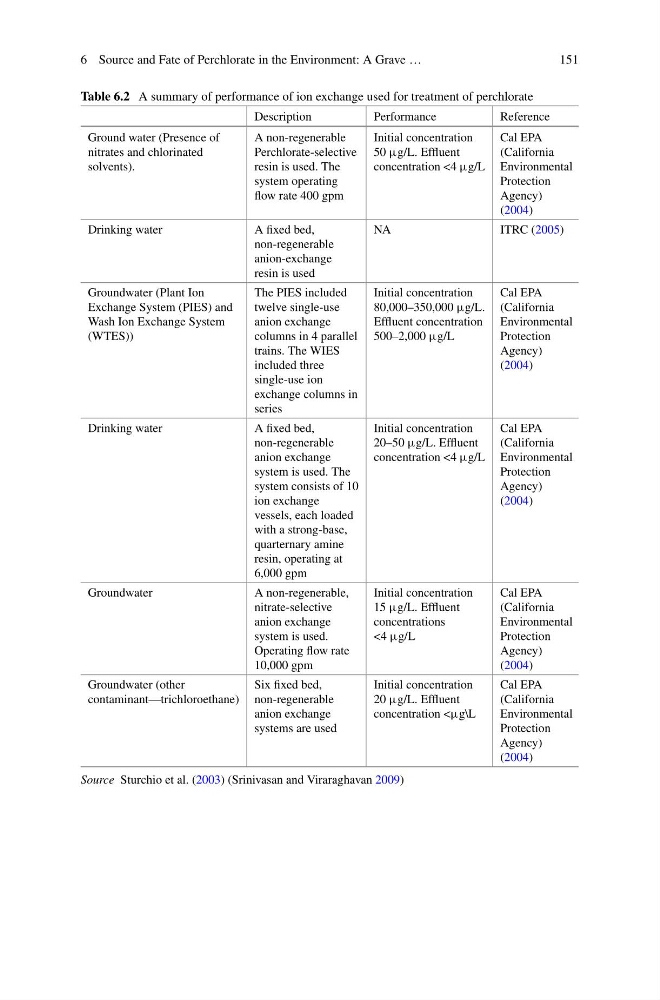
Table 6.2 A summary of performance of ion exchange used for treatment of perchlorate
Description
Performance
Reference
Ground water (Presence of
nitrates and chlorinated
solvents).
A non-regenerable
Perchlorate-selective
resin is used. The
system operating
flow rate 400 gpm
Initial concentration
50 µg/L. Effluent
concentration <4 µg/L
Cal EPA
(California
Environmental
Protection
Agency)
(2004)
Drinking water
A fixed bed,
non-regenerable
anion-exchange
resin is used
NA
ITRC (2005)
Groundwater (Plant Ion
Exchange System (PIES) and
Wash Ion Exchange System
(WTES))
The PIES included
twelve single-use
anion exchange
columns in 4 parallel
trains. The WIES
included three
single-use ion
exchange columns in
series
Initial concentration
80,000–350,000 µg/L.
Effluent concentration
500–2,000 µg/L
Cal EPA
(California
Environmental
Protection
Agency)
(2004)
Drinking water
A fixed bed,
non-regenerable
anion exchange
system is used. The
system consists of 10
ion exchange
vessels, each loaded
with a strong-base,
quarternary amine
resin, operating at
6,000 gpm
Initial concentration
20–50 µg/L. Effluent
concentration <4 µg/L
Cal EPA
(California
Environmental
Protection
Agency)
(2004)
Groundwater
A non-regenerable,
nitrate-selective
anion exchange
system is used.
Operating flow rate
10,000 gpm
Initial concentration
15 µg/L. Effluent
concentrations
<4 µg/L
Cal EPA
(California
Environmental
Protection
Agency)
(2004)
Groundwater (other
contaminant—trichloroethane)
Six fixed bed,
non-regenerable
anion exchange
systems are used
Initial concentration
20 µg/L. Effluent
concentration <µg\L
Cal EPA
(California
Environmental
Protection
Agency)
(2004)
Source Sturchio et al. (2003) (Srinivasan and Viraraghavan 2009)
151
Table 6.2 A summary of performance of ion exchange used for treatment of perchlorate
Description
Performance
Reference
Ground water (Presence of
nitrates and chlorinated
solvents).
A non-regenerable
Perchlorate-selective
resin is used. The
system operating
flow rate 400 gpm
Initial concentration
50 µg/L. Effluent
concentration <4 µg/L
Cal EPA
(California
Environmental
Protection
Agency)
(2004)
Drinking water
A fixed bed,
non-regenerable
anion-exchange
resin is used
NA
ITRC (2005)
Groundwater (Plant Ion
Exchange System (PIES) and
Wash Ion Exchange System
(WTES))
The PIES included
twelve single-use
anion exchange
columns in 4 parallel
trains. The WIES
included three
single-use ion
exchange columns in
series
Initial concentration
80,000–350,000 µg/L.
Effluent concentration
500–2,000 µg/L
Cal EPA
(California
Environmental
Protection
Agency)
(2004)
Drinking water
A fixed bed,
non-regenerable
anion exchange
system is used. The
system consists of 10
ion exchange
vessels, each loaded
with a strong-base,
quarternary amine
resin, operating at
6,000 gpm
Initial concentration
20–50 µg/L. Effluent
concentration <4 µg/L
Cal EPA
(California
Environmental
Protection
Agency)
(2004)
Groundwater
A non-regenerable,
nitrate-selective
anion exchange
system is used.
Operating flow rate
10,000 gpm
Initial concentration
15 µg/L. Effluent
concentrations
<4 µg/L
Cal EPA
(California
Environmental
Protection
Agency)
(2004)
Groundwater (other
contaminant—trichloroethane)
Six fixed bed,
non-regenerable
anion exchange
systems are used
Initial concentration
20 µg/L. Effluent
concentration <µg\L
Cal EPA
(California
Environmental
Protection
Agency)
(2004)
Source Sturchio et al. (2003) (Srinivasan and Viraraghavan 2009)