

4 Impact and Fate of Microplastics in the Riverine …
105
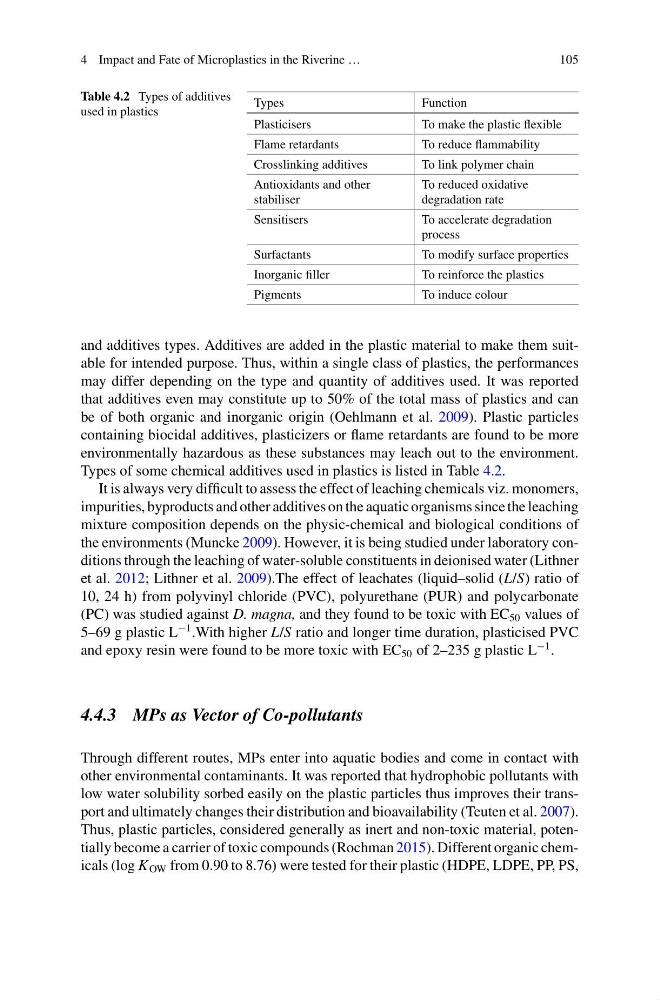
Table 4.2 Types of additives
used in plastics
Types
Function
Plasticisers
To make the plastic flexible
Flame retardants
To reduce flammability
Crosslinking additives
To link polymer chain
Antioxidants and other
stabiliser
To reduced oxidative
degradation rate
Sensitisers
To accelerate degradation
process
Surfactants
To modify surface properties
Inorganic filler
To reinforce the plastics
Pigments
To induce colour
and additives types. Additives are added in the plastic material to make them suitable for intended purpose. Thus, within a single class of plastics, the performances
may differ depending on the type and quantity of additives used. It was reported
that additives even may constitute up to 50% of the total mass of plastics and can
be of both organic and inorganic origin (Oehlmann et al. 2009). Plastic particles
containing biocidal additives, plasticizers or flame retardants are found to be more
environmentally hazardous as these substances may leach out to the environment.
Types of some chemical additives used in plastics is listed in Table 4.2.
It is always very difficult to assess the effect of leaching chemicals viz. monomers,
impurities, byproducts and other additives on the aquatic organisms since the leaching
mixture composition depends on the physic-chemical and biological conditions of
the environments (Muncke 2009). However, it is being studied under laboratory conditions through the leaching of water-soluble constituents in deionised water (Lithner
et al. 2012; Lithner et al. 2009).The effect of leachates (liquid–solid (L/S) ratio of
10, 24 h) from polyvinyl chloride (PVC), polyurethane (PUR) and polycarbonate
(PC) was studied against D. magna, and they found to be toxic with EC 50 values of
5–69 g plastic L
−1 .With higher L/S ratio and longer time duration, plasticised PVC
and epoxy resin were found to be more toxic with EC 50 of 2–235 g plastic L
−1 .
4.4.3 MPs as Vector of Co-pollutants
Through different routes, MPs enter into aquatic bodies and come in contact with
other environmental contaminants. It was reported that hydrophobic pollutants with
low water solubility sorbed easily on the plastic particles thus improves their transport and ultimately changes their distribution and bioavailability (Teuten et al. 2007).
Thus, plastic particles, considered generally as inert and non-toxic material, potentially become a carrier of toxic compounds (Rochman 2015). Different organic chemicals (log K OW from 0.90 to 8.76) were tested for their plastic (HDPE, LDPE, PP, PS,
105
Table 4.2 Types of additives
used in plastics
Types
Function
Plasticisers
To make the plastic flexible
Flame retardants
To reduce flammability
Crosslinking additives
To link polymer chain
Antioxidants and other
stabiliser
To reduced oxidative
degradation rate
Sensitisers
To accelerate degradation
process
Surfactants
To modify surface properties
Inorganic filler
To reinforce the plastics
Pigments
To induce colour
and additives types. Additives are added in the plastic material to make them suitable for intended purpose. Thus, within a single class of plastics, the performances
may differ depending on the type and quantity of additives used. It was reported
that additives even may constitute up to 50% of the total mass of plastics and can
be of both organic and inorganic origin (Oehlmann et al. 2009). Plastic particles
containing biocidal additives, plasticizers or flame retardants are found to be more
environmentally hazardous as these substances may leach out to the environment.
Types of some chemical additives used in plastics is listed in Table 4.2.
It is always very difficult to assess the effect of leaching chemicals viz. monomers,
impurities, byproducts and other additives on the aquatic organisms since the leaching
mixture composition depends on the physic-chemical and biological conditions of
the environments (Muncke 2009). However, it is being studied under laboratory conditions through the leaching of water-soluble constituents in deionised water (Lithner
et al. 2012; Lithner et al. 2009).The effect of leachates (liquid–solid (L/S) ratio of
10, 24 h) from polyvinyl chloride (PVC), polyurethane (PUR) and polycarbonate
(PC) was studied against D. magna, and they found to be toxic with EC 50 values of
5–69 g plastic L
−1 .With higher L/S ratio and longer time duration, plasticised PVC
and epoxy resin were found to be more toxic with EC 50 of 2–235 g plastic L
−1 .
4.4.3 MPs as Vector of Co-pollutants
Through different routes, MPs enter into aquatic bodies and come in contact with
other environmental contaminants. It was reported that hydrophobic pollutants with
low water solubility sorbed easily on the plastic particles thus improves their transport and ultimately changes their distribution and bioavailability (Teuten et al. 2007).
Thus, plastic particles, considered generally as inert and non-toxic material, potentially become a carrier of toxic compounds (Rochman 2015). Different organic chemicals (log K OW from 0.90 to 8.76) were tested for their plastic (HDPE, LDPE, PP, PS,