

15 Multifunctional Urban Landscapes: The Potential Role of Urban Agriculture …
295
Level of interaccon and collaboraaon
Market engagement
No
engagement
Occasional
engagement
Strong
engagement
Home gardens
Allotment gardens
School gardens
Individual/private
Consumer-producer interaccons
Therapeuuc gardens
School farms
Community-oriented interaccons
Community gardens
Intercultural gardens
Social farming Self-harvest gardens
Community-supported agriculture
Local direct markeeng
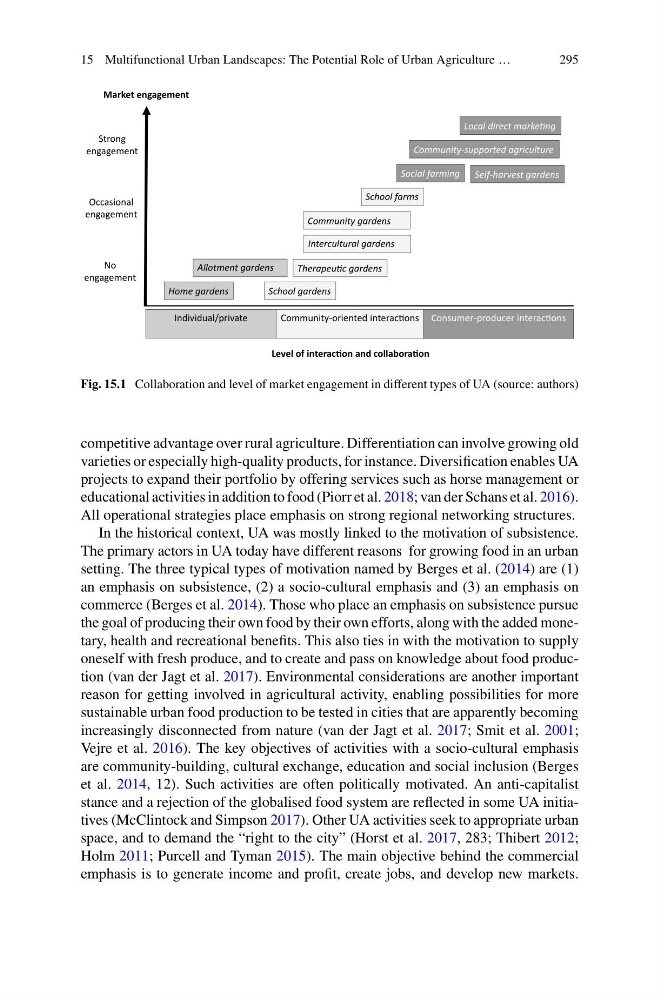
Fig. 15.1 Collaboration and level of market engagement in different types of UA (source: authors)
competitive advantage over rural agriculture. Differentiation can involve growing old
varieties or especially high-quality products, for instance. Diversification enables UA
projects to expand their portfolio by offering services such as horse management or
educational activities in addition to food (Piorr et al. 2018; van der Schans et al. 2016).
All operational strategies place emphasis on strong regional networking structures.
In the historical context, UA was mostly linked to the motivation of subsistence.
The primary actors in UA today have different reasons for growing food in an urban
setting. The three typical types of motivation named by Berges et al. (2014) are (1)
an emphasis on subsistence, (2) a socio-cultural emphasis and (3) an emphasis on
commerce (Berges et al. 2014). Those who place an emphasis on subsistence pursue
the goal of producing their own food by their own efforts, along with the added monetary, health and recreational benefits. This also ties in with the motivation to supply
oneself with fresh produce, and to create and pass on knowledge about food production (van der Jagt et al. 2017). Environmental considerations are another important
reason for getting involved in agricultural activity, enabling possibilities for more
sustainable urban food production to be tested in cities that are apparently becoming
increasingly disconnected from nature (van der Jagt et al. 2017; Smit et al. 2001;
Vejre et al. 2016). The key objectives of activities with a socio-cultural emphasis
are community-building, cultural exchange, education and social inclusion (Berges
et al. 2014, 12). Such activities are often politically motivated. An anti-capitalist
stance and a rejection of the globalised food system are reflected in some UA initiatives (McClintock and Simpson 2017). Other UA activities seek to appropriate urban
space, and to demand the “right to the city” (Horst et al. 2017, 283; Thibert 2012;
Holm 2011; Purcell and Tyman 2015). The main objective behind the commercial
emphasis is to generate income and profit, create jobs, and develop new markets.
295
Level of interaccon and collaboraaon
Market engagement
No
engagement
Occasional
engagement
Strong
engagement
Home gardens
Allotment gardens
School gardens
Individual/private
Consumer-producer interaccons
Therapeuuc gardens
School farms
Community-oriented interaccons
Community gardens
Intercultural gardens
Social farming Self-harvest gardens
Community-supported agriculture
Local direct markeeng
Fig. 15.1 Collaboration and level of market engagement in different types of UA (source: authors)
competitive advantage over rural agriculture. Differentiation can involve growing old
varieties or especially high-quality products, for instance. Diversification enables UA
projects to expand their portfolio by offering services such as horse management or
educational activities in addition to food (Piorr et al. 2018; van der Schans et al. 2016).
All operational strategies place emphasis on strong regional networking structures.
In the historical context, UA was mostly linked to the motivation of subsistence.
The primary actors in UA today have different reasons for growing food in an urban
setting. The three typical types of motivation named by Berges et al. (2014) are (1)
an emphasis on subsistence, (2) a socio-cultural emphasis and (3) an emphasis on
commerce (Berges et al. 2014). Those who place an emphasis on subsistence pursue
the goal of producing their own food by their own efforts, along with the added monetary, health and recreational benefits. This also ties in with the motivation to supply
oneself with fresh produce, and to create and pass on knowledge about food production (van der Jagt et al. 2017). Environmental considerations are another important
reason for getting involved in agricultural activity, enabling possibilities for more
sustainable urban food production to be tested in cities that are apparently becoming
increasingly disconnected from nature (van der Jagt et al. 2017; Smit et al. 2001;
Vejre et al. 2016). The key objectives of activities with a socio-cultural emphasis
are community-building, cultural exchange, education and social inclusion (Berges
et al. 2014, 12). Such activities are often politically motivated. An anti-capitalist
stance and a rejection of the globalised food system are reflected in some UA initiatives (McClintock and Simpson 2017). Other UA activities seek to appropriate urban
space, and to demand the “right to the city” (Horst et al. 2017, 283; Thibert 2012;
Holm 2011; Purcell and Tyman 2015). The main objective behind the commercial
emphasis is to generate income and profit, create jobs, and develop new markets.