

294
K. Specht et al.
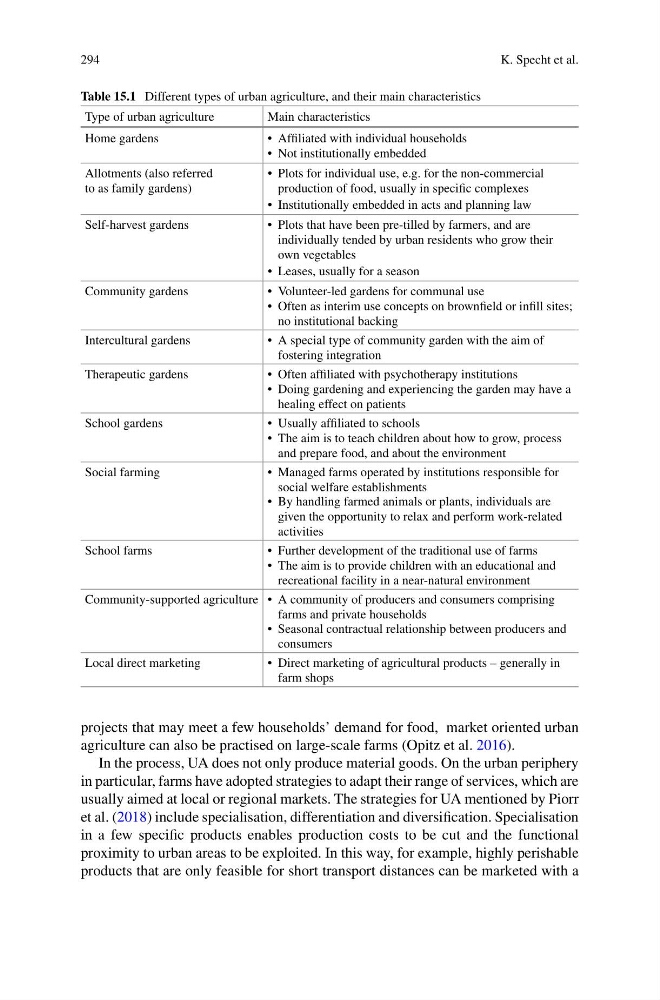
Table 15.1 Different types of urban agriculture, and their main characteristics
Type of urban agriculture
Main characteristics
Home gardens
• Affiliated with individual households
• Not institutionally embedded
Allotments (also referred
to as family gardens)
• Plots for individual use, e.g. for the non-commercial
production of food, usually in specific complexes
• Institutionally embedded in acts and planning law
Self-harvest gardens
• Plots that have been pre-tilled by farmers, and are
individually tended by urban residents who grow their
own vegetables
• Leases, usually for a season
Community gardens
• Volunteer-led gardens for communal use
• Often as interim use concepts on brownfield or infill sites;
no institutional backing
Intercultural gardens
• A special type of community garden with the aim of
fostering integration
Therapeutic gardens
• Often affiliated with psychotherapy institutions
• Doing gardening and experiencing the garden may have a
healing effect on patients
School gardens
• Usually affiliated to schools
• The aim is to teach children about how to grow, process
and prepare food, and about the environment
Social farming
• Managed farms operated by institutions responsible for
social welfare establishments
• By handling farmed animals or plants, individuals are
given the opportunity to relax and perform work-related
activities
School farms
• Further development of the traditional use of farms
• The aim is to provide children with an educational and
recreational facility in a near-natural environment
Community-supported agriculture • A community of producers and consumers comprising
farms and private households
• Seasonal contractual relationship between producers and
consumers
Local direct marketing
• Direct marketing of agricultural products – generally in
farm shops
projects that may meet a few households’ demand for food, market oriented urban
agriculture can also be practised on large-scale farms (Opitz et al. 2016).
In the process, UA does not only produce material goods. On the urban periphery
in particular, farms have adopted strategies to adapt their range of services, which are
usually aimed at local or regional markets. The strategies for UA mentioned by Piorr
et al. (2018) include specialisation, differentiation and diversification. Specialisation
in a few specific products enables production costs to be cut and the functional
proximity to urban areas to be exploited. In this way, for example, highly perishable
products that are only feasible for short transport distances can be marketed with a
K. Specht et al.
Table 15.1 Different types of urban agriculture, and their main characteristics
Type of urban agriculture
Main characteristics
Home gardens
• Affiliated with individual households
• Not institutionally embedded
Allotments (also referred
to as family gardens)
• Plots for individual use, e.g. for the non-commercial
production of food, usually in specific complexes
• Institutionally embedded in acts and planning law
Self-harvest gardens
• Plots that have been pre-tilled by farmers, and are
individually tended by urban residents who grow their
own vegetables
• Leases, usually for a season
Community gardens
• Volunteer-led gardens for communal use
• Often as interim use concepts on brownfield or infill sites;
no institutional backing
Intercultural gardens
• A special type of community garden with the aim of
fostering integration
Therapeutic gardens
• Often affiliated with psychotherapy institutions
• Doing gardening and experiencing the garden may have a
healing effect on patients
School gardens
• Usually affiliated to schools
• The aim is to teach children about how to grow, process
and prepare food, and about the environment
Social farming
• Managed farms operated by institutions responsible for
social welfare establishments
• By handling farmed animals or plants, individuals are
given the opportunity to relax and perform work-related
activities
School farms
• Further development of the traditional use of farms
• The aim is to provide children with an educational and
recreational facility in a near-natural environment
Community-supported agriculture • A community of producers and consumers comprising
farms and private households
• Seasonal contractual relationship between producers and
consumers
Local direct marketing
• Direct marketing of agricultural products – generally in
farm shops
projects that may meet a few households’ demand for food, market oriented urban
agriculture can also be practised on large-scale farms (Opitz et al. 2016).
In the process, UA does not only produce material goods. On the urban periphery
in particular, farms have adopted strategies to adapt their range of services, which are
usually aimed at local or regional markets. The strategies for UA mentioned by Piorr
et al. (2018) include specialisation, differentiation and diversification. Specialisation
in a few specific products enables production costs to be cut and the functional
proximity to urban areas to be exploited. In this way, for example, highly perishable
products that are only feasible for short transport distances can be marketed with a