

10 Serious Games in Sustainable Land Management
195
in eLAN represented their own local, state or federal level and were chosen from
different types of areas in the HMR, including parts of the city-state of Hamburg, the
western part of Mecklenburg-West Pomerania and the southern part of SchleswigHolstein. Thus the selected representatives of communal classes varied according to
population, economic structures and degree of vulnerability to fluctuations in (fossil)
energy costs. Unfortunately, no secondary city as a counterpart to Hamburg was able
to participate, which led to one classification to be omitted in the project.
Since Mecklenburg-West Pomerania and the southern part of Schleswig-Holstein
are very different in their settlement as well as administrative structure, the project
constructed two corridors for the serious game. The Eastern Corridor (Hamburg
to Mecklenburg-West Pomerania) and the Western Corridor (the southern part of
Schleswig-Holstein to Hamburg) addressed these differences and made it possible
to compare different structures for the serious game.
Continuity was a central factor for the project during the different parts of the
serious game. The sessions were held over a period of one-and-a-half years, between
April 2012 and October 2013. The long duration of the intervals between sessions was
in part necessary for the project to be able to additionally incorporate the federal level.
This was relevant for regional stakeholders’ decisions, as the federal government
sets the overall framework for possible responses at the regional level.
4 In order to
most realistically simulate regional decision-making, the regional level actors and
stakeholders therefore had to interact with the federal level to explore the relationship
between both levels, and to develop an exchange between them.
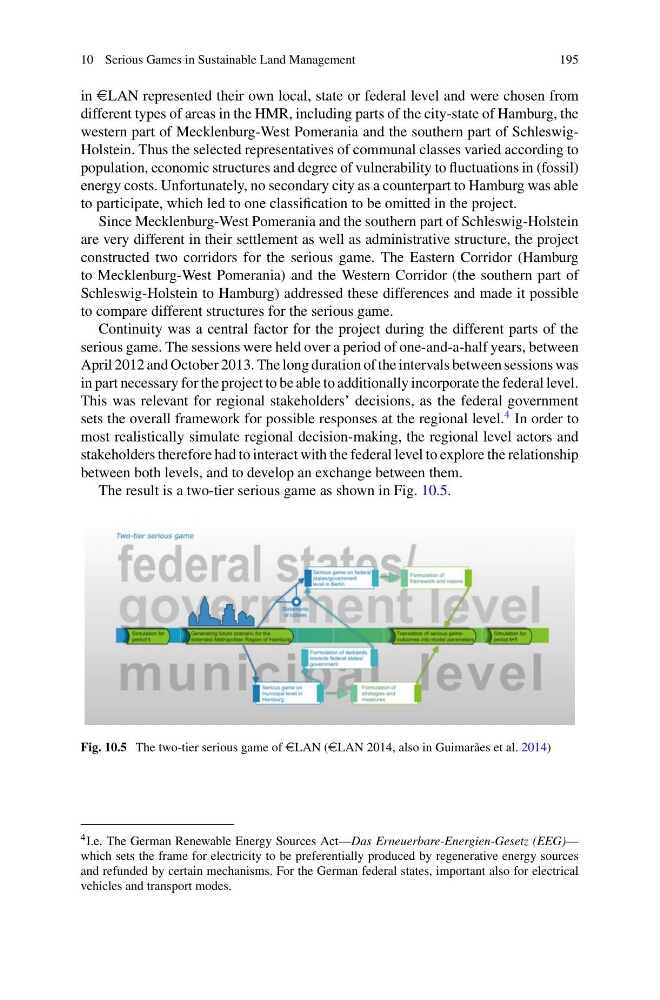
The result is a two-tier serious game as shown in Fig. 10.5.
Fig. 10.5 The two-tier serious game of eLAN (eLAN 2014, also in Guimarães et al. 2014)
4 I.e. The German Renewable Energy Sources Act—Das Erneuerbare-Energien-Gesetz (EEG)—
which sets the frame for electricity to be preferentially produced by regenerative energy sources
and refunded by certain mechanisms. For the German federal states, important also for electrical
vehicles and transport modes.
195
in eLAN represented their own local, state or federal level and were chosen from
different types of areas in the HMR, including parts of the city-state of Hamburg, the
western part of Mecklenburg-West Pomerania and the southern part of SchleswigHolstein. Thus the selected representatives of communal classes varied according to
population, economic structures and degree of vulnerability to fluctuations in (fossil)
energy costs. Unfortunately, no secondary city as a counterpart to Hamburg was able
to participate, which led to one classification to be omitted in the project.
Since Mecklenburg-West Pomerania and the southern part of Schleswig-Holstein
are very different in their settlement as well as administrative structure, the project
constructed two corridors for the serious game. The Eastern Corridor (Hamburg
to Mecklenburg-West Pomerania) and the Western Corridor (the southern part of
Schleswig-Holstein to Hamburg) addressed these differences and made it possible
to compare different structures for the serious game.
Continuity was a central factor for the project during the different parts of the
serious game. The sessions were held over a period of one-and-a-half years, between
April 2012 and October 2013. The long duration of the intervals between sessions was
in part necessary for the project to be able to additionally incorporate the federal level.
This was relevant for regional stakeholders’ decisions, as the federal government
sets the overall framework for possible responses at the regional level.
4 In order to
most realistically simulate regional decision-making, the regional level actors and
stakeholders therefore had to interact with the federal level to explore the relationship
between both levels, and to develop an exchange between them.
The result is a two-tier serious game as shown in Fig. 10.5.
Fig. 10.5 The two-tier serious game of eLAN (eLAN 2014, also in Guimarães et al. 2014)
4 I.e. The German Renewable Energy Sources Act—Das Erneuerbare-Energien-Gesetz (EEG)—
which sets the frame for electricity to be preferentially produced by regenerative energy sources
and refunded by certain mechanisms. For the German federal states, important also for electrical
vehicles and transport modes.