

194
J. Maaß
health services, and displays a relatively diverse economic structure with employment
opportunities in a variety of sectors.
Complex problems in planning require a comprehensive approach. This is why
the project undertook a policy analysis to identify which stakeholders played which
roles in the processes of decision-making and developing strategies pertaining to
land use and regional development. The logic for coming to decisions was based on
an analysis of the incentives or constraints, the relationships between stakeholders
and the administrative-institutional system.
This led to identifying two central dimensions in that context: the “role” and
the “region”. The former contained three scopes, which were important as both
descriptive and selective factors for potential participants and were called “selection
dimensions” (Projekt eLAN, 30 June 2011, p. 11):
• Political power (in the sense of the separation of powers)
• Policy
• Administration (Projekt eLAN 30 June 2011, p. 11); author’s translation).
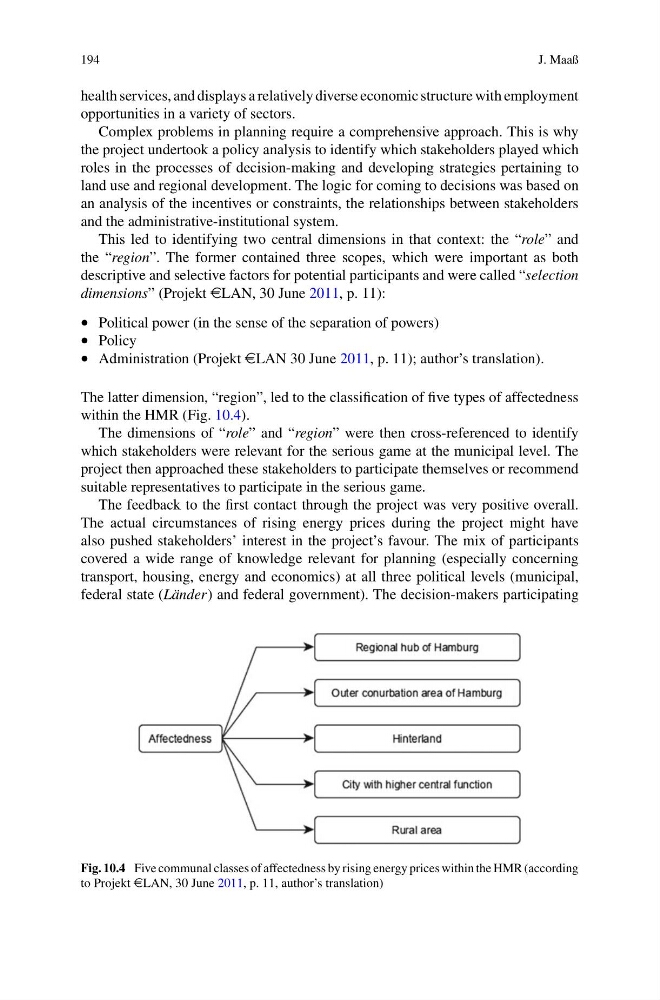
The latter dimension, “region”, led to the classification of five types of affectedness
within the HMR (Fig. 10.4).
The dimensions of “role” and “region” were then cross-referenced to identify
which stakeholders were relevant for the serious game at the municipal level. The
project then approached these stakeholders to participate themselves or recommend
suitable representatives to participate in the serious game.
The feedback to the first contact through the project was very positive overall.
The actual circumstances of rising energy prices during the project might have
also pushed stakeholders’ interest in the project’s favour. The mix of participants
covered a wide range of knowledge relevant for planning (especially concerning
transport, housing, energy and economics) at all three political levels (municipal,
federal state (Länder) and federal government). The decision-makers participating
Fig. 10.4 Five communal classes of affectedness by rising energy prices within the HMR (according
to Projekt eLAN, 30 June 2011, p. 11, author’s translation)
J. Maaß
health services, and displays a relatively diverse economic structure with employment
opportunities in a variety of sectors.
Complex problems in planning require a comprehensive approach. This is why
the project undertook a policy analysis to identify which stakeholders played which
roles in the processes of decision-making and developing strategies pertaining to
land use and regional development. The logic for coming to decisions was based on
an analysis of the incentives or constraints, the relationships between stakeholders
and the administrative-institutional system.
This led to identifying two central dimensions in that context: the “role” and
the “region”. The former contained three scopes, which were important as both
descriptive and selective factors for potential participants and were called “selection
dimensions” (Projekt eLAN, 30 June 2011, p. 11):
• Political power (in the sense of the separation of powers)
• Policy
• Administration (Projekt eLAN 30 June 2011, p. 11); author’s translation).
The latter dimension, “region”, led to the classification of five types of affectedness
within the HMR (Fig. 10.4).
The dimensions of “role” and “region” were then cross-referenced to identify
which stakeholders were relevant for the serious game at the municipal level. The
project then approached these stakeholders to participate themselves or recommend
suitable representatives to participate in the serious game.
The feedback to the first contact through the project was very positive overall.
The actual circumstances of rising energy prices during the project might have
also pushed stakeholders’ interest in the project’s favour. The mix of participants
covered a wide range of knowledge relevant for planning (especially concerning
transport, housing, energy and economics) at all three political levels (municipal,
federal state (Länder) and federal government). The decision-makers participating
Fig. 10.4 Five communal classes of affectedness by rising energy prices within the HMR (according
to Projekt eLAN, 30 June 2011, p. 11, author’s translation)