

176
M. Pütz and R. Brassel
Table 9.1. Barriers to
knowledge exchange
No Barrier
1
The divide between science and policymaking
2
The different time frames of scientists and policymakers
3
Different “languages” of science and policymaking
4
A lack of science/policy interfaces
5
Difficult access to scientific knowledge
6
A lack of applicability of scientific findings
7
Information overload
8
Pressure to publish in scientific journals
9
A lack of financial resources and time
10 Conflicts of interest and power issues
11 A lack of links between soil and spatial planning experts
Table 9.2. Opportunities for
knowledge exchange
No
Opportunity
1
Federalism and multilingualism
2
A small but well-connected expert community
3
The availability of informal and personal contacts
4
General openness to new developments
5
Motivation and a commitment to collaboration
9.5.1 Barriers to Knowledge Exchange
Some of the barriers to knowledge exchange that we identified can be classified
into groups. One group of barriers refers to the interaction between science and
policymaking (Barriers 1–4). A second group of barriers refers to issues around the
use of knowledge (Barriers 4–8). Three other issues complement the list of barriers
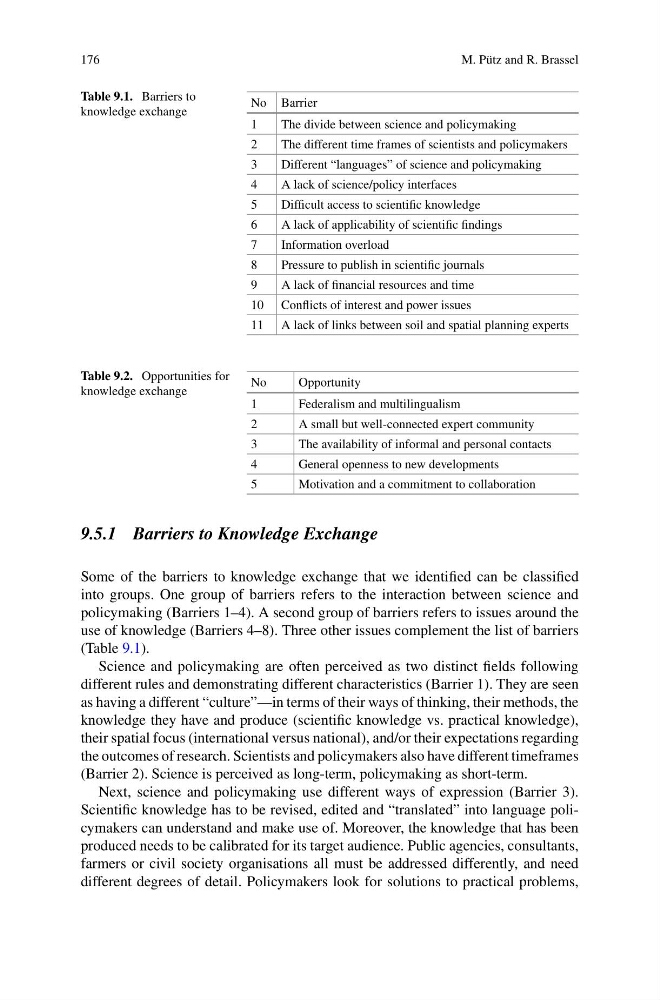
(Table 9.1).
Science and policymaking are often perceived as two distinct fields following
different rules and demonstrating different characteristics (Barrier 1). They are seen
as having a different “culture”—in terms of their ways of thinking, their methods, the
knowledge they have and produce (scientific knowledge vs. practical knowledge),
their spatial focus (international versus national), and/or their expectations regarding
the outcomes of research. Scientists and policymakers also have different timeframes
(Barrier 2). Science is perceived as long-term, policymaking as short-term.
Next, science and policymaking use different ways of expression (Barrier 3).
Scientific knowledge has to be revised, edited and “translated” into language policymakers can understand and make use of. Moreover, the knowledge that has been
produced needs to be calibrated for its target audience. Public agencies, consultants,
farmers or civil society organisations all must be addressed differently, and need
different degrees of detail. Policymakers look for solutions to practical problems,
M. Pütz and R. Brassel
Table 9.1. Barriers to
knowledge exchange
No Barrier
1
The divide between science and policymaking
2
The different time frames of scientists and policymakers
3
Different “languages” of science and policymaking
4
A lack of science/policy interfaces
5
Difficult access to scientific knowledge
6
A lack of applicability of scientific findings
7
Information overload
8
Pressure to publish in scientific journals
9
A lack of financial resources and time
10 Conflicts of interest and power issues
11 A lack of links between soil and spatial planning experts
Table 9.2. Opportunities for
knowledge exchange
No
Opportunity
1
Federalism and multilingualism
2
A small but well-connected expert community
3
The availability of informal and personal contacts
4
General openness to new developments
5
Motivation and a commitment to collaboration
9.5.1 Barriers to Knowledge Exchange
Some of the barriers to knowledge exchange that we identified can be classified
into groups. One group of barriers refers to the interaction between science and
policymaking (Barriers 1–4). A second group of barriers refers to issues around the
use of knowledge (Barriers 4–8). Three other issues complement the list of barriers
(Table 9.1).
Science and policymaking are often perceived as two distinct fields following
different rules and demonstrating different characteristics (Barrier 1). They are seen
as having a different “culture”—in terms of their ways of thinking, their methods, the
knowledge they have and produce (scientific knowledge vs. practical knowledge),
their spatial focus (international versus national), and/or their expectations regarding
the outcomes of research. Scientists and policymakers also have different timeframes
(Barrier 2). Science is perceived as long-term, policymaking as short-term.
Next, science and policymaking use different ways of expression (Barrier 3).
Scientific knowledge has to be revised, edited and “translated” into language policymakers can understand and make use of. Moreover, the knowledge that has been
produced needs to be calibrated for its target audience. Public agencies, consultants,
farmers or civil society organisations all must be addressed differently, and need
different degrees of detail. Policymakers look for solutions to practical problems,