

110
A. Doernberg and T. Weith
where the raw material is converted into energy represents the spillover system. The
agents involved are the producers of the energy carrier (e.g. farmers who produce
short rotation coppice), the power plant operator, the network operator, the energy
supplier, and the receiving households in the city. Besides flows of energy, raw
material and money as payments for the traded commodities, information is also
exchanged between the agents about energy prices, demand and trade details. The
causes of this urban-rural relationship include energy demand by the city population,
the limited possibility of fully producing one’s own urban energy, the rural capacity of
producing renewable energy carriers, and the political orientation towards renewable
energy within the overarching framework of the energy transition. In this telecoupled
system, the effects are the expansion of the production of renewable raw materials,
entailing the avoidance of nuclear risks, climate-friendly energy production, the
diversification of income for rural farmers, a land-use change in the production area,
and energy supplies for city dwellers.
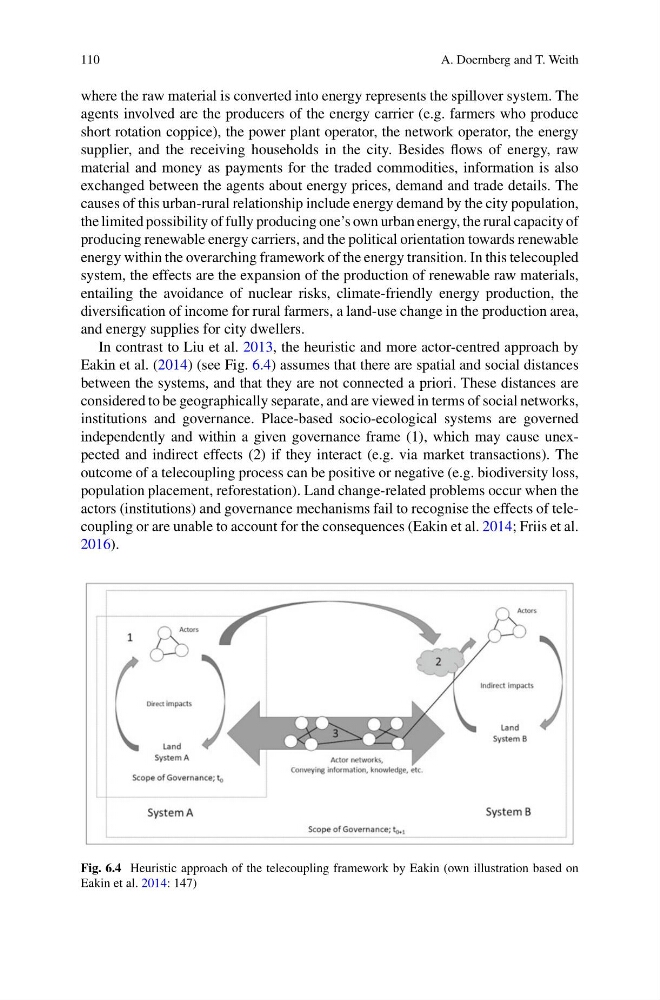
In contrast to Liu et al. 2013, the heuristic and more actor-centred approach by
Eakin et al. (2014) (see Fig. 6.4) assumes that there are spatial and social distances
between the systems, and that they are not connected a priori. These distances are
considered to be geographically separate, and are viewed in terms of social networks,
institutions and governance. Place-based socio-ecological systems are governed
independently and within a given governance frame (1), which may cause unexpected and indirect effects (2) if they interact (e.g. via market transactions). The
outcome of a telecoupling process can be positive or negative (e.g. biodiversity loss,
population placement, reforestation). Land change-related problems occur when the
actors (institutions) and governance mechanisms fail to recognise the effects of telecoupling or are unable to account for the consequences (Eakin et al. 2014; Friis et al.
2016).
Fig. 6.4 Heuristic approach of the telecoupling framework by Eakin (own illustration based on
Eakin et al. 2014: 147)
A. Doernberg and T. Weith
where the raw material is converted into energy represents the spillover system. The
agents involved are the producers of the energy carrier (e.g. farmers who produce
short rotation coppice), the power plant operator, the network operator, the energy
supplier, and the receiving households in the city. Besides flows of energy, raw
material and money as payments for the traded commodities, information is also
exchanged between the agents about energy prices, demand and trade details. The
causes of this urban-rural relationship include energy demand by the city population,
the limited possibility of fully producing one’s own urban energy, the rural capacity of
producing renewable energy carriers, and the political orientation towards renewable
energy within the overarching framework of the energy transition. In this telecoupled
system, the effects are the expansion of the production of renewable raw materials,
entailing the avoidance of nuclear risks, climate-friendly energy production, the
diversification of income for rural farmers, a land-use change in the production area,
and energy supplies for city dwellers.
In contrast to Liu et al. 2013, the heuristic and more actor-centred approach by
Eakin et al. (2014) (see Fig. 6.4) assumes that there are spatial and social distances
between the systems, and that they are not connected a priori. These distances are
considered to be geographically separate, and are viewed in terms of social networks,
institutions and governance. Place-based socio-ecological systems are governed
independently and within a given governance frame (1), which may cause unexpected and indirect effects (2) if they interact (e.g. via market transactions). The
outcome of a telecoupling process can be positive or negative (e.g. biodiversity loss,
population placement, reforestation). Land change-related problems occur when the
actors (institutions) and governance mechanisms fail to recognise the effects of telecoupling or are unable to account for the consequences (Eakin et al. 2014; Friis et al.
2016).
Fig. 6.4 Heuristic approach of the telecoupling framework by Eakin (own illustration based on
Eakin et al. 2014: 147)