

6 Urban-Rural Interrelations—A Challenge for Sustainable Land …
109
other by “feedback loops”, meaning that a cause induces an effect, and vice versa
(Liu et al. 2013, p. 3). The systems are linked by flows that can transport material
(e.g. goods, natural resources, organisms), energy and information (e.g. land titles,
agricultural techniques). These flows may be unidirectional or bidirectional (Liu et al.
2014). At the system level, a distinction can be made between sending, receiving and
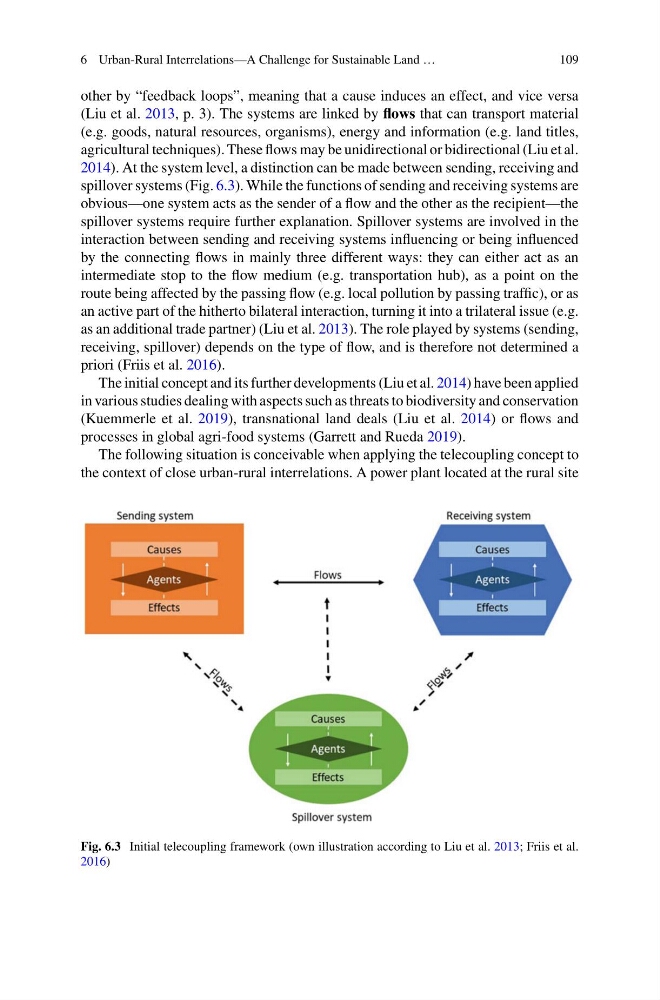
spillover systems (Fig. 6.3). While the functions of sending and receiving systems are
obvious—one system acts as the sender of a flow and the other as the recipient—the
spillover systems require further explanation. Spillover systems are involved in the
interaction between sending and receiving systems influencing or being influenced
by the connecting flows in mainly three different ways: they can either act as an
intermediate stop to the flow medium (e.g. transportation hub), as a point on the
route being affected by the passing flow (e.g. local pollution by passing traffic), or as
an active part of the hitherto bilateral interaction, turning it into a trilateral issue (e.g.
as an additional trade partner) (Liu et al. 2013). The role played by systems (sending,
receiving, spillover) depends on the type of flow, and is therefore not determined a
priori (Friis et al. 2016).
The initial concept and its further developments (Liu et al. 2014) have been applied
in various studies dealing with aspects such as threats to biodiversity and conservation
(Kuemmerle et al. 2019), transnational land deals (Liu et al. 2014) or flows and
processes in global agri-food systems (Garrett and Rueda 2019).
The following situation is conceivable when applying the telecoupling concept to
the context of close urban-rural interrelations. A power plant located at the rural site
Fig. 6.3 Initial telecoupling framework (own illustration according to Liu et al. 2013; Friis et al.
2016)
109
other by “feedback loops”, meaning that a cause induces an effect, and vice versa
(Liu et al. 2013, p. 3). The systems are linked by flows that can transport material
(e.g. goods, natural resources, organisms), energy and information (e.g. land titles,
agricultural techniques). These flows may be unidirectional or bidirectional (Liu et al.
2014). At the system level, a distinction can be made between sending, receiving and
spillover systems (Fig. 6.3). While the functions of sending and receiving systems are
obvious—one system acts as the sender of a flow and the other as the recipient—the
spillover systems require further explanation. Spillover systems are involved in the
interaction between sending and receiving systems influencing or being influenced
by the connecting flows in mainly three different ways: they can either act as an
intermediate stop to the flow medium (e.g. transportation hub), as a point on the
route being affected by the passing flow (e.g. local pollution by passing traffic), or as
an active part of the hitherto bilateral interaction, turning it into a trilateral issue (e.g.
as an additional trade partner) (Liu et al. 2013). The role played by systems (sending,
receiving, spillover) depends on the type of flow, and is therefore not determined a
priori (Friis et al. 2016).
The initial concept and its further developments (Liu et al. 2014) have been applied
in various studies dealing with aspects such as threats to biodiversity and conservation
(Kuemmerle et al. 2019), transnational land deals (Liu et al. 2014) or flows and
processes in global agri-food systems (Garrett and Rueda 2019).
The following situation is conceivable when applying the telecoupling concept to
the context of close urban-rural interrelations. A power plant located at the rural site
Fig. 6.3 Initial telecoupling framework (own illustration according to Liu et al. 2013; Friis et al.
2016)