

106
A. Doernberg and T. Weith
6.3.1 Stead’s Model of Urban-Rural Flows
According to Stead (2002), urban and rural areas are regarded as being distinct
(however they are defined), but interconnected and interdependent. In the model,
functional relations (flows) are used to describe urban-rural relationships. Based
on the theoretical framework of Preston (1975), Stead (2002) places the functional
relations between urban and rural spaces in the centre of his model, and differentiates
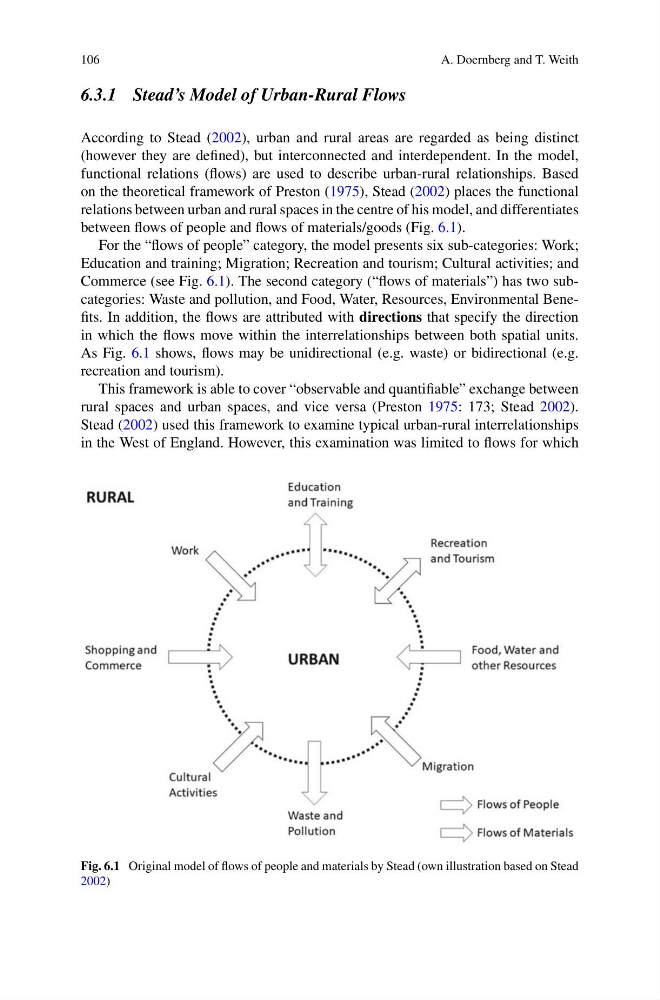
between flows of people and flows of materials/goods (Fig. 6.1).
For the “flows of people” category, the model presents six sub-categories: Work;
Education and training; Migration; Recreation and tourism; Cultural activities; and
Commerce (see Fig. 6.1). The second category (“flows of materials”) has two subcategories: Waste and pollution, and Food, Water, Resources, Environmental Benefits. In addition, the flows are attributed with directions that specify the direction
in which the flows move within the interrelationships between both spatial units.
As Fig. 6.1 shows, flows may be unidirectional (e.g. waste) or bidirectional (e.g.
recreation and tourism).
This framework is able to cover “observable and quantifiable” exchange between
rural spaces and urban spaces, and vice versa (Preston 1975: 173; Stead 2002).
Stead (2002) used this framework to examine typical urban-rural interrelationships
in the West of England. However, this examination was limited to flows for which
Fig. 6.1 Original model of flows of people and materials by Stead (own illustration based on Stead
2002)
A. Doernberg and T. Weith
6.3.1 Stead’s Model of Urban-Rural Flows
According to Stead (2002), urban and rural areas are regarded as being distinct
(however they are defined), but interconnected and interdependent. In the model,
functional relations (flows) are used to describe urban-rural relationships. Based
on the theoretical framework of Preston (1975), Stead (2002) places the functional
relations between urban and rural spaces in the centre of his model, and differentiates
between flows of people and flows of materials/goods (Fig. 6.1).
For the “flows of people” category, the model presents six sub-categories: Work;
Education and training; Migration; Recreation and tourism; Cultural activities; and
Commerce (see Fig. 6.1). The second category (“flows of materials”) has two subcategories: Waste and pollution, and Food, Water, Resources, Environmental Benefits. In addition, the flows are attributed with directions that specify the direction
in which the flows move within the interrelationships between both spatial units.
As Fig. 6.1 shows, flows may be unidirectional (e.g. waste) or bidirectional (e.g.
recreation and tourism).
This framework is able to cover “observable and quantifiable” exchange between
rural spaces and urban spaces, and vice versa (Preston 1975: 173; Stead 2002).
Stead (2002) used this framework to examine typical urban-rural interrelationships
in the West of England. However, this examination was limited to flows for which
Fig. 6.1 Original model of flows of people and materials by Stead (own illustration based on Stead
2002)