

52
they pass the significance test. It is noteworthy that this data from the outside
explains that we can approximately estimate the distribution of annual rainfall erosivity by the distribution of annual rainfall and qualitatively estimate the annual
value of rainfall erosivity by the amount of precipitation, which provides a simple
method for estimating rainfall erosivity. Soil loss is proportional to rainfall erosivity
(R) when other factors are kept constant (Gu et al. 2018).
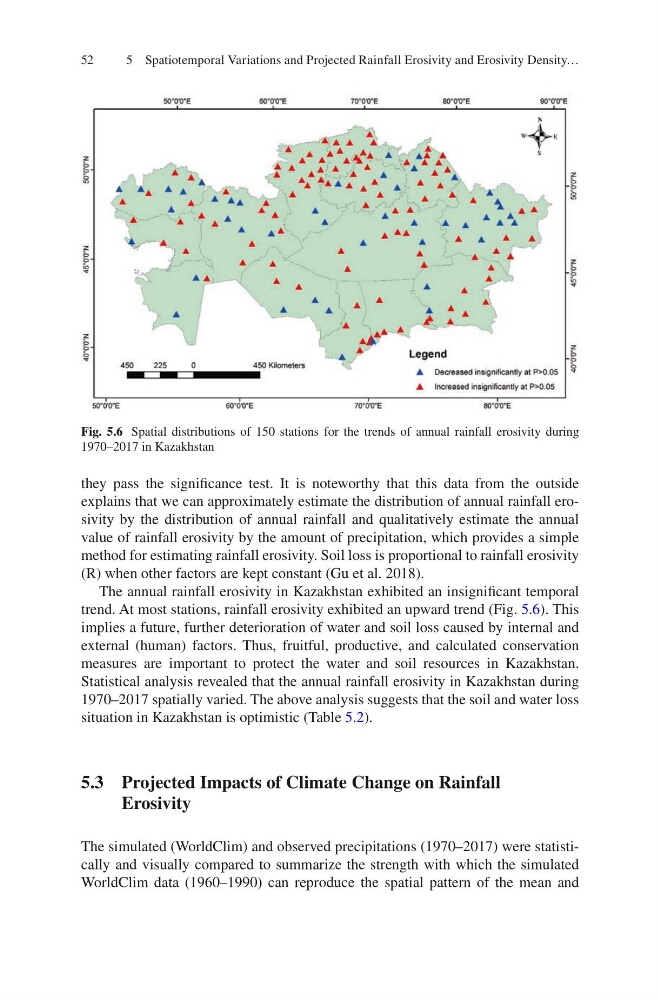
The annual rainfall erosivity in Kazakhstan exhibited an insignificant temporal
trend. At most stations, rainfall erosivity exhibited an upward trend (Fig. 5.6). This
implies a future, further deterioration of water and soil loss caused by internal and
external (human) factors. Thus, fruitful, productive, and calculated conservation
measures are important to protect the water and soil resources in Kazakhstan.
Statistical analysis revealed that the annual rainfall erosivity in Kazakhstan during
1970–2017 spatially varied. The above analysis suggests that the soil and water loss
situation in Kazakhstan is optimistic (Table 5.2).
5.3 Projected Impacts of Climate Change on Rainfall
Erosivity
The simulated (WorldClim) and observed precipitations (1970–2017) were statistically and visually compared to summarize the strength with which the simulated
WorldClim data (1960–1990) can reproduce the spatial pattern of the mean and
Fig. 5.6 Spatial distributions of 150 stations for the trends of annual rainfall erosivity during
1970–2017 in Kazakhstan
5 Spatiotemporal Variations and Projected Rainfall Erosivity and Erosivity Density…
they pass the significance test. It is noteworthy that this data from the outside
explains that we can approximately estimate the distribution of annual rainfall erosivity by the distribution of annual rainfall and qualitatively estimate the annual
value of rainfall erosivity by the amount of precipitation, which provides a simple
method for estimating rainfall erosivity. Soil loss is proportional to rainfall erosivity
(R) when other factors are kept constant (Gu et al. 2018).
The annual rainfall erosivity in Kazakhstan exhibited an insignificant temporal
trend. At most stations, rainfall erosivity exhibited an upward trend (Fig. 5.6). This
implies a future, further deterioration of water and soil loss caused by internal and
external (human) factors. Thus, fruitful, productive, and calculated conservation
measures are important to protect the water and soil resources in Kazakhstan.
Statistical analysis revealed that the annual rainfall erosivity in Kazakhstan during
1970–2017 spatially varied. The above analysis suggests that the soil and water loss
situation in Kazakhstan is optimistic (Table 5.2).
5.3 Projected Impacts of Climate Change on Rainfall
Erosivity
The simulated (WorldClim) and observed precipitations (1970–2017) were statistically and visually compared to summarize the strength with which the simulated
WorldClim data (1960–1990) can reproduce the spatial pattern of the mean and
Fig. 5.6 Spatial distributions of 150 stations for the trends of annual rainfall erosivity during
1970–2017 in Kazakhstan
5 Spatiotemporal Variations and Projected Rainfall Erosivity and Erosivity Density…