

18
Tibetan Plateau (Teng et al. 2018). Global precipitation with ~1-km
2
horizontal
resolution was obtained from the WorldClim database (Hijmans et al. 2005). In
assessing the future changes in the erosion of rainfall and possible consequences,
the predicted rainfall data for the “near” (2020–2049) and “far” future (2060–2089)
have been downloaded from the Climate Change Agriculture and Food Security
portal (CCAFS, http://www.ccafs- climate.org).
The data were statistically downscaled to ~1-km
2
horizontal resolution using the
delta method (Ramirez-Villegas and Jarvis 2010), based on the sum of interpolated
anomalies to high-resolution monthly climate surfaces from WorldClim (Hijmans
et al. 2005). These anomalies were then interpolated using thin-plate spline interpolation (Ramirez-Villegas and Jarvis 2010). Moreover, these datasets were used as
input data for this study.
To evaluate the precipitation of the baseline output, we used the precipitation
data from 150 rain gauge stations obtained from the Kazakhstan Hydro and
Meteorological Agency (Kazhydromet). Also, the “Central Asia Temperature and
Precipitation (CATP) data (1879–2003), Version 1” data, obtained from the National
Snow and Ice Data Center (NSIDC) (Williams and Konovalov 2008). The data of
270 rain gauges provided by the Hydrometeorological Agencies of Central Asian
countries. This dataset contains monthly climatic data.
3.2 RUSLE Model and Its Factors
The RUSLE parameters were calculated using separate equations with input data
from rainfall, satellite images, and DEM. The source data, their sources, and the
equations used are presented in Table 3.2. The equations available in the literature
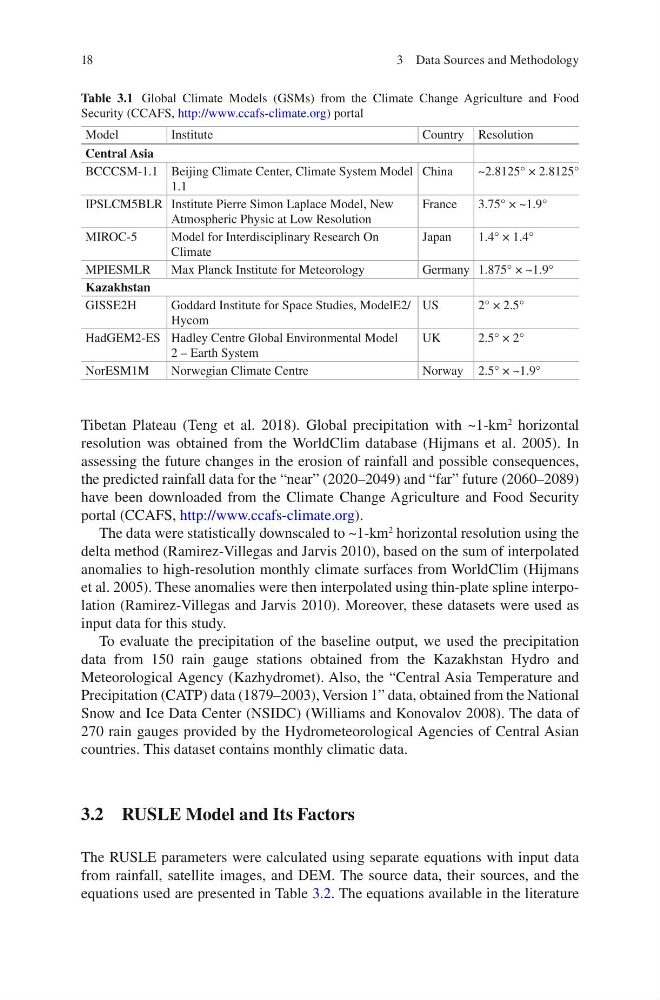
Table 3.1 Global Climate Models (GSMs) from the Climate Change Agriculture and Food
Security (CCAFS, http://www.ccafs- climate.org) portal
Model
Institute
Country Resolution
Central Asia
BCCCSM-1.1 Beijing Climate Center, Climate System Model
1.1
China
~2.8125° × 2.8125°
IPSLCM5BLR Institute Pierre Simon Laplace Model, New
Atmospheric Physic at Low Resolution
France
3.75° × ~1.9°
MIROC-5
Model for Interdisciplinary Research On
Climate
Japan
1.4° × 1.4°
MPIESMLR
Max Planck Institute for Meteorology
Germany 1.875° × ~1.9°
Kazakhstan
GISSE2H
Goddard Institute for Space Studies, ModelE2/
Hycom
US
2° × 2.5°
HadGEM2-ES Hadley Centre Global Environmental Model
2 – Earth System
UK
2.5° × 2°
NorESM1M
Norwegian Climate Centre
Norway 2.5° × ~1.9°
3 Data Sources and Methodology
Tibetan Plateau (Teng et al. 2018). Global precipitation with ~1-km
2
horizontal
resolution was obtained from the WorldClim database (Hijmans et al. 2005). In
assessing the future changes in the erosion of rainfall and possible consequences,
the predicted rainfall data for the “near” (2020–2049) and “far” future (2060–2089)
have been downloaded from the Climate Change Agriculture and Food Security
portal (CCAFS, http://www.ccafs- climate.org).
The data were statistically downscaled to ~1-km
2
horizontal resolution using the
delta method (Ramirez-Villegas and Jarvis 2010), based on the sum of interpolated
anomalies to high-resolution monthly climate surfaces from WorldClim (Hijmans
et al. 2005). These anomalies were then interpolated using thin-plate spline interpolation (Ramirez-Villegas and Jarvis 2010). Moreover, these datasets were used as
input data for this study.
To evaluate the precipitation of the baseline output, we used the precipitation
data from 150 rain gauge stations obtained from the Kazakhstan Hydro and
Meteorological Agency (Kazhydromet). Also, the “Central Asia Temperature and
Precipitation (CATP) data (1879–2003), Version 1” data, obtained from the National
Snow and Ice Data Center (NSIDC) (Williams and Konovalov 2008). The data of
270 rain gauges provided by the Hydrometeorological Agencies of Central Asian
countries. This dataset contains monthly climatic data.
3.2 RUSLE Model and Its Factors
The RUSLE parameters were calculated using separate equations with input data
from rainfall, satellite images, and DEM. The source data, their sources, and the
equations used are presented in Table 3.2. The equations available in the literature
Table 3.1 Global Climate Models (GSMs) from the Climate Change Agriculture and Food
Security (CCAFS, http://www.ccafs- climate.org) portal
Model
Institute
Country Resolution
Central Asia
BCCCSM-1.1 Beijing Climate Center, Climate System Model
1.1
China
~2.8125° × 2.8125°
IPSLCM5BLR Institute Pierre Simon Laplace Model, New
Atmospheric Physic at Low Resolution
France
3.75° × ~1.9°
MIROC-5
Model for Interdisciplinary Research On
Climate
Japan
1.4° × 1.4°
MPIESMLR
Max Planck Institute for Meteorology
Germany 1.875° × ~1.9°
Kazakhstan
GISSE2H
Goddard Institute for Space Studies, ModelE2/
Hycom
US
2° × 2.5°
HadGEM2-ES Hadley Centre Global Environmental Model
2 – Earth System
UK
2.5° × 2°
NorESM1M
Norwegian Climate Centre
Norway 2.5° × ~1.9°
3 Data Sources and Methodology