

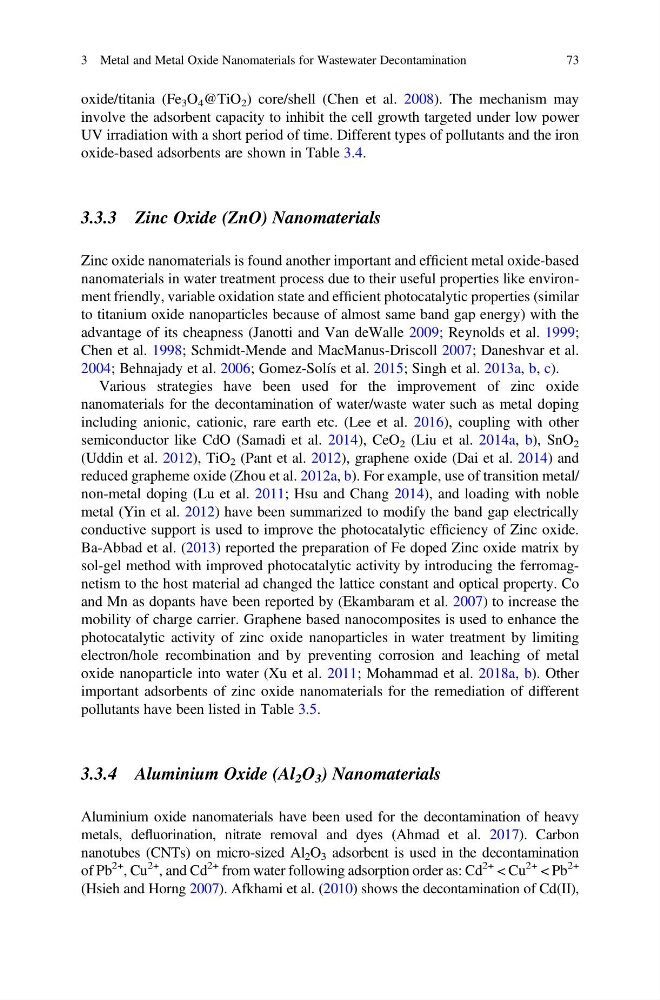
oxide/titania (Fe 3 O 4 @TiO 2 ) core/shell (Chen et al. 2008). The mechanism may
involve the adsorbent capacity to inhibit the cell growth targeted under low power
UV irradiation with a short period of time. Different types of pollutants and the iron
oxide-based adsorbents are shown in Table 3.4.
3.3.3 Zinc Oxide (ZnO) Nanomaterials
Zinc oxide nanomaterials is found another important and efficient metal oxide-based
nanomaterials in water treatment process due to their useful properties like environment friendly, variable oxidation state and efficient photocatalytic properties (similar
to titanium oxide nanoparticles because of almost same band gap energy) with the
advantage of its cheapness (Janotti and Van deWalle 2009; Reynolds et al. 1999;
Chen et al. 1998; Schmidt-Mende and MacManus-Driscoll 2007; Daneshvar et al.
2004; Behnajady et al. 2006; Gomez-Solís et al. 2015; Singh et al. 2013a, b, c).
Various strategies have been used for the improvement of zinc oxide
nanomaterials for the decontamination of water/waste water such as metal doping
including anionic, cationic, rare earth etc. (Lee et al. 2016), coupling with other
semiconductor like CdO (Samadi et al. 2014), CeO 2 (Liu et al. 2014a, b), SnO 2
(Uddin et al. 2012), TiO 2 (Pant et al. 2012), graphene oxide (Dai et al. 2014) and
reduced grapheme oxide (Zhou et al. 2012a, b). For example, use of transition metal/
non-metal doping (Lu et al. 2011; Hsu and Chang 2014), and loading with noble
metal (Yin et al. 2012) have been summarized to modify the band gap electrically
conductive support is used to improve the photocatalytic efficiency of Zinc oxide.
Ba-Abbad et al. (2013) reported the preparation of Fe doped Zinc oxide matrix by
sol-gel method with improved photocatalytic activity by introducing the ferromagnetism to the host material ad changed the lattice constant and optical property. Co
and Mn as dopants have been reported by (Ekambaram et al. 2007) to increase the
mobility of charge carrier. Graphene based nanocomposites is used to enhance the
photocatalytic activity of zinc oxide nanoparticles in water treatment by limiting
electron/hole recombination and by preventing corrosion and leaching of metal
oxide nanoparticle into water (Xu et al. 2011; Mohammad et al. 2018a, b). Other
important adsorbents of zinc oxide nanomaterials for the remediation of different
pollutants have been listed in Table 3.5.
3.3.4 Aluminium Oxide (Al 2 O 3 ) Nanomaterials
Aluminium oxide nanomaterials have been used for the decontamination of heavy
metals, defluorination, nitrate removal and dyes (Ahmad et al. 2017). Carbon
nanotubes (CNTs) on micro-sized Al 2 O 3 adsorbent is used in the decontamination
of Pb
2+
, Cu
2+
, and Cd
2+ from water following adsorption order as: Cd
2+ < Cu
2+ < Pb
2+
(Hsieh and Horng 2007). Afkhami et al. (2010) shows the decontamination of Cd(II),
3 Metal and Metal Oxide Nanomaterials for Wastewater Decontamination
73
involve the adsorbent capacity to inhibit the cell growth targeted under low power
UV irradiation with a short period of time. Different types of pollutants and the iron
oxide-based adsorbents are shown in Table 3.4.
3.3.3 Zinc Oxide (ZnO) Nanomaterials
Zinc oxide nanomaterials is found another important and efficient metal oxide-based
nanomaterials in water treatment process due to their useful properties like environment friendly, variable oxidation state and efficient photocatalytic properties (similar
to titanium oxide nanoparticles because of almost same band gap energy) with the
advantage of its cheapness (Janotti and Van deWalle 2009; Reynolds et al. 1999;
Chen et al. 1998; Schmidt-Mende and MacManus-Driscoll 2007; Daneshvar et al.
2004; Behnajady et al. 2006; Gomez-Solís et al. 2015; Singh et al. 2013a, b, c).
Various strategies have been used for the improvement of zinc oxide
nanomaterials for the decontamination of water/waste water such as metal doping
including anionic, cationic, rare earth etc. (Lee et al. 2016), coupling with other
semiconductor like CdO (Samadi et al. 2014), CeO 2 (Liu et al. 2014a, b), SnO 2
(Uddin et al. 2012), TiO 2 (Pant et al. 2012), graphene oxide (Dai et al. 2014) and
reduced grapheme oxide (Zhou et al. 2012a, b). For example, use of transition metal/
non-metal doping (Lu et al. 2011; Hsu and Chang 2014), and loading with noble
metal (Yin et al. 2012) have been summarized to modify the band gap electrically
conductive support is used to improve the photocatalytic efficiency of Zinc oxide.
Ba-Abbad et al. (2013) reported the preparation of Fe doped Zinc oxide matrix by
sol-gel method with improved photocatalytic activity by introducing the ferromagnetism to the host material ad changed the lattice constant and optical property. Co
and Mn as dopants have been reported by (Ekambaram et al. 2007) to increase the
mobility of charge carrier. Graphene based nanocomposites is used to enhance the
photocatalytic activity of zinc oxide nanoparticles in water treatment by limiting
electron/hole recombination and by preventing corrosion and leaching of metal
oxide nanoparticle into water (Xu et al. 2011; Mohammad et al. 2018a, b). Other
important adsorbents of zinc oxide nanomaterials for the remediation of different
pollutants have been listed in Table 3.5.
3.3.4 Aluminium Oxide (Al 2 O 3 ) Nanomaterials
Aluminium oxide nanomaterials have been used for the decontamination of heavy
metals, defluorination, nitrate removal and dyes (Ahmad et al. 2017). Carbon
nanotubes (CNTs) on micro-sized Al 2 O 3 adsorbent is used in the decontamination
of Pb
2+
, Cu
2+
, and Cd
2+ from water following adsorption order as: Cd
2+ < Cu
2+ < Pb
2+
(Hsieh and Horng 2007). Afkhami et al. (2010) shows the decontamination of Cd(II),
3 Metal and Metal Oxide Nanomaterials for Wastewater Decontamination
73