

(Pd NPs) have shown great result as catalysts for water treatment for removal of
4-nitrophenol (Cui et al. 2019).
3.2.5 Platinum (Pt) Based Nanomaterials
Platinum nanoparticles measure the concentration of ammonia in artificial and real
waste water samples showing its excellent selectivity, sensitivity, and capacity (Ning
et al. 2017) Granger research group shows the physico-chemical properties of
platinum nanoparticles, by dispersing homogenously on alumina framework and
acting as catalytic active in purification of water (Sekhar et al. 2018).
3.2.6 Zinc (Zn) Based Nanomaterials
Zinc based nanomaterial has also been considered as an alternative for iron
nanomaterials. Dehalogenation reactions are considered to be the main application
of nano-zero-valent zinc. The nano-zero-valent zinc has been utilized for CCl 4 and
octachlorodibenzo-p-dioxin removal from waste water treatment via dehalogenation
process (Tratnyek et al. 2010). Owija and co-worker have reported zinc
nanoparticles were used for the decontamination of acid red dye in real wastewater
sample, and results showed the high removal efficiency (Bokare et al. 2013). The bio
carrier containing zinc nanoparticles in bio film reactor have performed better for
textile waste water treatment (Wang et al. 2018; Salam et al. 2019).
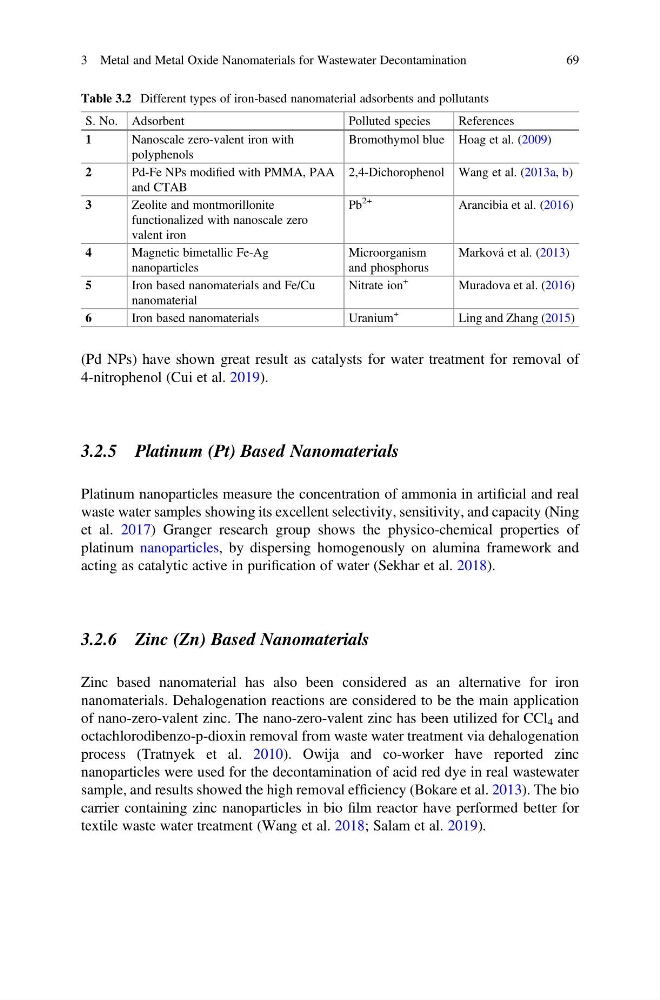
Table 3.2 Different types of iron-based nanomaterial adsorbents and pollutants
S. No. Adsorbent
Polluted species
References
1
Nanoscale zero-valent iron with
polyphenols
Bromothymol blue Hoag et al. (2009)
2
Pd-Fe NPs modified with PMMA, PAA
and CTAB
2,4-Dichorophenol Wang et al. (2013a, b)
3
Zeolite and montmorillonite
functionalized with nanoscale zero
valent iron
Pb
2+
Arancibia et al. (2016)
4
Magnetic bimetallic Fe-Ag
nanoparticles
Microorganism
and phosphorus
Marková et al. (2013)
5
Iron based nanomaterials and Fe/Cu
nanomaterial
Nitrate ion
+
Muradova et al. (2016)
6
Iron based nanomaterials
Uranium
+
Ling and Zhang (2015)
3 Metal and Metal Oxide Nanomaterials for Wastewater Decontamination
69
4-nitrophenol (Cui et al. 2019).
3.2.5 Platinum (Pt) Based Nanomaterials
Platinum nanoparticles measure the concentration of ammonia in artificial and real
waste water samples showing its excellent selectivity, sensitivity, and capacity (Ning
et al. 2017) Granger research group shows the physico-chemical properties of
platinum nanoparticles, by dispersing homogenously on alumina framework and
acting as catalytic active in purification of water (Sekhar et al. 2018).
3.2.6 Zinc (Zn) Based Nanomaterials
Zinc based nanomaterial has also been considered as an alternative for iron
nanomaterials. Dehalogenation reactions are considered to be the main application
of nano-zero-valent zinc. The nano-zero-valent zinc has been utilized for CCl 4 and
octachlorodibenzo-p-dioxin removal from waste water treatment via dehalogenation
process (Tratnyek et al. 2010). Owija and co-worker have reported zinc
nanoparticles were used for the decontamination of acid red dye in real wastewater
sample, and results showed the high removal efficiency (Bokare et al. 2013). The bio
carrier containing zinc nanoparticles in bio film reactor have performed better for
textile waste water treatment (Wang et al. 2018; Salam et al. 2019).
Table 3.2 Different types of iron-based nanomaterial adsorbents and pollutants
S. No. Adsorbent
Polluted species
References
1
Nanoscale zero-valent iron with
polyphenols
Bromothymol blue Hoag et al. (2009)
2
Pd-Fe NPs modified with PMMA, PAA
and CTAB
2,4-Dichorophenol Wang et al. (2013a, b)
3
Zeolite and montmorillonite
functionalized with nanoscale zero
valent iron
Pb
2+
Arancibia et al. (2016)
4
Magnetic bimetallic Fe-Ag
nanoparticles
Microorganism
and phosphorus
Marková et al. (2013)
5
Iron based nanomaterials and Fe/Cu
nanomaterial
Nitrate ion
+
Muradova et al. (2016)
6
Iron based nanomaterials
Uranium
+
Ling and Zhang (2015)
3 Metal and Metal Oxide Nanomaterials for Wastewater Decontamination
69