

treatment with presence of ammonium salts as a surfactant (Wan and Yeow 2012).
Polydopamine-functionalized poly (vinyl alcohol) microporous supported gold
nanoparticles are extreme efficient for waste water treatment to remove organic
pollutant (Li et al. 2019). Chitosan functionalized activated coke for gold
nanoparticles anchoring has been shown tremendous results towards pollutant treatment of nitrophenol and azo dyes (Fu et al. 2019). Intercalating gold nanoparticles
and graphitic carbon nitride into graphene oxide (GNPs/g-C 3 N 4 /GO) membrane is
useful for removal of environmental pollutants (Qu et al. 2017). Rao and co-worker
reported Silver (Ag) and Gold (Au) nanoparticles (NPs), which is using an aqueous
extract of A. elaeagnoidea flower for the decontamination of Methylene Blue,
Congo Red and p-Nitrophenol (Manjari et al. 2017). Some of the gold-based
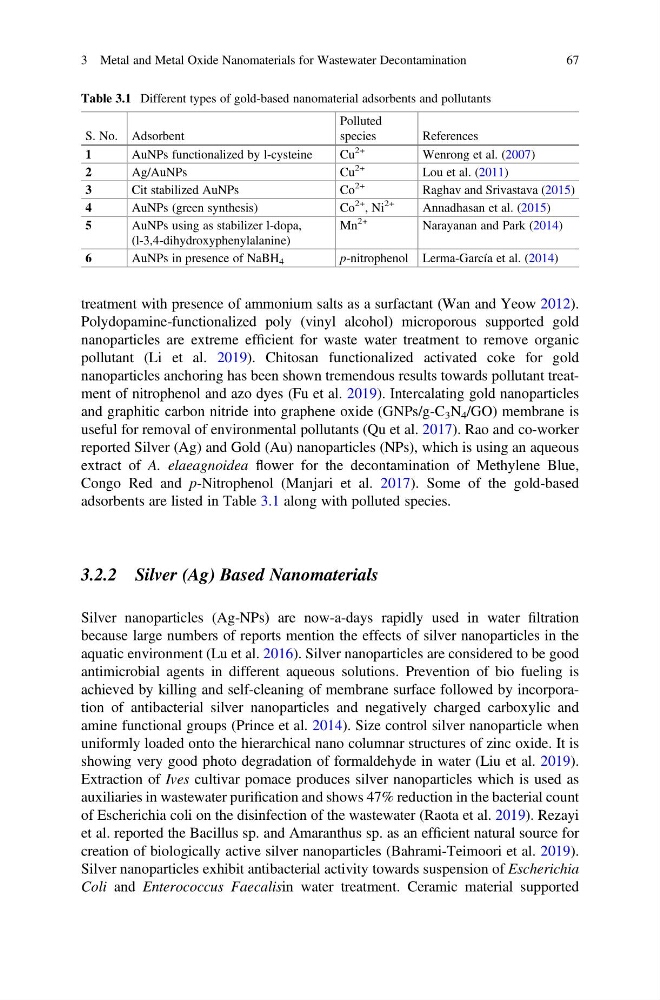
adsorbents are listed in Table 3.1 along with polluted species.
3.2.2 Silver (Ag) Based Nanomaterials
Silver nanoparticles (Ag-NPs) are now-a-days rapidly used in water filtration
because large numbers of reports mention the effects of silver nanoparticles in the
aquatic environment (Lu et al. 2016). Silver nanoparticles are considered to be good
antimicrobial agents in different aqueous solutions. Prevention of bio fueling is
achieved by killing and self-cleaning of membrane surface followed by incorporation of antibacterial silver nanoparticles and negatively charged carboxylic and
amine functional groups (Prince et al. 2014). Size control silver nanoparticle when
uniformly loaded onto the hierarchical nano columnar structures of zinc oxide. It is
showing very good photo degradation of formaldehyde in water (Liu et al. 2019).
Extraction of Ives cultivar pomace produces silver nanoparticles which is used as
auxiliaries in wastewater purification and shows 47% reduction in the bacterial count
of Escherichia coli on the disinfection of the wastewater (Raota et al. 2019). Rezayi
et al. reported the Bacillus sp. and Amaranthus sp. as an efficient natural source for
creation of biologically active silver nanoparticles (Bahrami-Teimoori et al. 2019).
Silver nanoparticles exhibit antibacterial activity towards suspension of Escherichia
Coli and Enterococcus Faecalisin water treatment. Ceramic material supported
Table 3.1 Different types of gold-based nanomaterial adsorbents and pollutants
S. No. Adsorbent
Polluted
species
References
1
AuNPs functionalized by l-cysteine
Cu
2+
Wenrong et al. (2007)
2
Ag/AuNPs
Cu
2+
Lou et al. (2011)
3
Cit stabilized AuNPs
Co
2+
Raghav and Srivastava (2015)
4
AuNPs (green synthesis)
Co
2+ , Ni
2+
Annadhasan et al. (2015)
5
AuNPs using as stabilizer l-dopa,
(l-3,4-dihydroxyphenylalanine)
Mn
2+
Narayanan and Park (2014)
6
AuNPs in presence of NaBH 4
p-nitrophenol Lerma-García et al. (2014)
3 Metal and Metal Oxide Nanomaterials for Wastewater Decontamination
67
Polydopamine-functionalized poly (vinyl alcohol) microporous supported gold
nanoparticles are extreme efficient for waste water treatment to remove organic
pollutant (Li et al. 2019). Chitosan functionalized activated coke for gold
nanoparticles anchoring has been shown tremendous results towards pollutant treatment of nitrophenol and azo dyes (Fu et al. 2019). Intercalating gold nanoparticles
and graphitic carbon nitride into graphene oxide (GNPs/g-C 3 N 4 /GO) membrane is
useful for removal of environmental pollutants (Qu et al. 2017). Rao and co-worker
reported Silver (Ag) and Gold (Au) nanoparticles (NPs), which is using an aqueous
extract of A. elaeagnoidea flower for the decontamination of Methylene Blue,
Congo Red and p-Nitrophenol (Manjari et al. 2017). Some of the gold-based
adsorbents are listed in Table 3.1 along with polluted species.
3.2.2 Silver (Ag) Based Nanomaterials
Silver nanoparticles (Ag-NPs) are now-a-days rapidly used in water filtration
because large numbers of reports mention the effects of silver nanoparticles in the
aquatic environment (Lu et al. 2016). Silver nanoparticles are considered to be good
antimicrobial agents in different aqueous solutions. Prevention of bio fueling is
achieved by killing and self-cleaning of membrane surface followed by incorporation of antibacterial silver nanoparticles and negatively charged carboxylic and
amine functional groups (Prince et al. 2014). Size control silver nanoparticle when
uniformly loaded onto the hierarchical nano columnar structures of zinc oxide. It is
showing very good photo degradation of formaldehyde in water (Liu et al. 2019).
Extraction of Ives cultivar pomace produces silver nanoparticles which is used as
auxiliaries in wastewater purification and shows 47% reduction in the bacterial count
of Escherichia coli on the disinfection of the wastewater (Raota et al. 2019). Rezayi
et al. reported the Bacillus sp. and Amaranthus sp. as an efficient natural source for
creation of biologically active silver nanoparticles (Bahrami-Teimoori et al. 2019).
Silver nanoparticles exhibit antibacterial activity towards suspension of Escherichia
Coli and Enterococcus Faecalisin water treatment. Ceramic material supported
Table 3.1 Different types of gold-based nanomaterial adsorbents and pollutants
S. No. Adsorbent
Polluted
species
References
1
AuNPs functionalized by l-cysteine
Cu
2+
Wenrong et al. (2007)
2
Ag/AuNPs
Cu
2+
Lou et al. (2011)
3
Cit stabilized AuNPs
Co
2+
Raghav and Srivastava (2015)
4
AuNPs (green synthesis)
Co
2+ , Ni
2+
Annadhasan et al. (2015)
5
AuNPs using as stabilizer l-dopa,
(l-3,4-dihydroxyphenylalanine)
Mn
2+
Narayanan and Park (2014)
6
AuNPs in presence of NaBH 4
p-nitrophenol Lerma-García et al. (2014)
3 Metal and Metal Oxide Nanomaterials for Wastewater Decontamination
67