

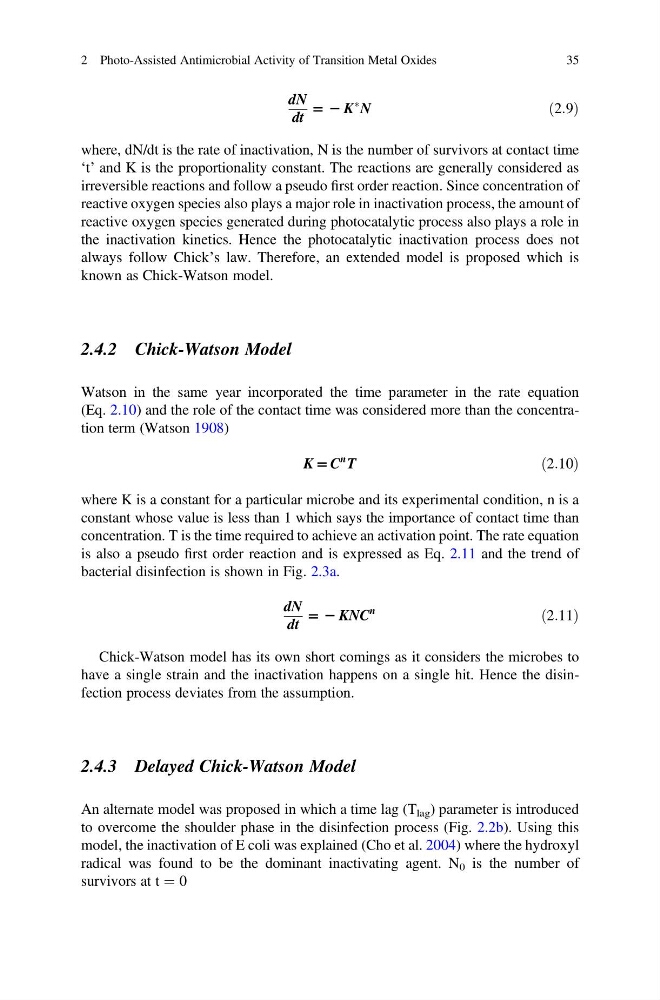
dN
dt
= 2 K
à N
ð2:9Þ
where, dN/dt is the rate of inactivation, N is the number of survivors at contact time
‘t’ and K is the proportionality constant. The reactions are generally considered as
irreversible reactions and follow a pseudo first order reaction. Since concentration of
reactive oxygen species also plays a major role in inactivation process, the amount of
reactive oxygen species generated during photocatalytic process also plays a role in
the inactivation kinetics. Hence the photocatalytic inactivation process does not
always follow Chick’s law. Therefore, an extended model is proposed which is
known as Chick-Watson model.
2.4.2 Chick-Watson Model
Watson in the same year incorporated the time parameter in the rate equation
(Eq. 2.10) and the role of the contact time was considered more than the concentration term (Watson 1908)
K = C
n T
ð2:10Þ
where K is a constant for a particular microbe and its experimental condition, n is a
constant whose value is less than 1 which says the importance of contact time than
concentration. T is the time required to achieve an activation point. The rate equation
is also a pseudo first order reaction and is expressed as Eq. 2.11 and the trend of
bacterial disinfection is shown in Fig. 2.3a.
dN
dt
= 2 KNC
n
ð2:11Þ
Chick-Watson model has its own short comings as it considers the microbes to
have a single strain and the inactivation happens on a single hit. Hence the disinfection process deviates from the assumption.
2.4.3 Delayed Chick-Watson Model
An alternate model was proposed in which a time lag (T lag ) parameter is introduced
to overcome the shoulder phase in the disinfection process (Fig. 2.2b). Using this
model, the inactivation of E coli was explained (Cho et al. 2004) where the hydroxyl
radical was found to be the dominant inactivating agent. N 0 is the number of
survivors at t ¼ 0
2 Photo-Assisted Antimicrobial Activity of Transition Metal Oxides
35
dt
= 2 K
à N
ð2:9Þ
where, dN/dt is the rate of inactivation, N is the number of survivors at contact time
‘t’ and K is the proportionality constant. The reactions are generally considered as
irreversible reactions and follow a pseudo first order reaction. Since concentration of
reactive oxygen species also plays a major role in inactivation process, the amount of
reactive oxygen species generated during photocatalytic process also plays a role in
the inactivation kinetics. Hence the photocatalytic inactivation process does not
always follow Chick’s law. Therefore, an extended model is proposed which is
known as Chick-Watson model.
2.4.2 Chick-Watson Model
Watson in the same year incorporated the time parameter in the rate equation
(Eq. 2.10) and the role of the contact time was considered more than the concentration term (Watson 1908)
K = C
n T
ð2:10Þ
where K is a constant for a particular microbe and its experimental condition, n is a
constant whose value is less than 1 which says the importance of contact time than
concentration. T is the time required to achieve an activation point. The rate equation
is also a pseudo first order reaction and is expressed as Eq. 2.11 and the trend of
bacterial disinfection is shown in Fig. 2.3a.
dN
dt
= 2 KNC
n
ð2:11Þ
Chick-Watson model has its own short comings as it considers the microbes to
have a single strain and the inactivation happens on a single hit. Hence the disinfection process deviates from the assumption.
2.4.3 Delayed Chick-Watson Model
An alternate model was proposed in which a time lag (T lag ) parameter is introduced
to overcome the shoulder phase in the disinfection process (Fig. 2.2b). Using this
model, the inactivation of E coli was explained (Cho et al. 2004) where the hydroxyl
radical was found to be the dominant inactivating agent. N 0 is the number of
survivors at t ¼ 0
2 Photo-Assisted Antimicrobial Activity of Transition Metal Oxides
35