

a major role in cell lysis by photocatalysis (Matai et al. 2014; Wang et al. 2011).
These processes can inhibit DNA replication and gene alteration by metal ions and
reactive oxygen species respectively. The kinetics of photocatalytic process is
generally explained by models such as Langmuir-Hinselwood model and direct
indirect model whose details are available elsewhere (Ganguly et al. 2018).
Based on all these report, it is evident that a kinetic model can help to predict the
kinetics of the photocatalytic disinfection process and based on these, several models
namely (1) Chick’s Model (2) Chick-Watson model (3) Delayed Chick-Watson
model and (4) Hom model are proposed by various groups, where the trends in the
survival/inactivation rates are portrayed with time. These models are defined based
on the following assumptions.
(a) Uniform distribution of the nanoparticles and microorganism
(b) Constant temperature, pH and concentration of the nanoparticles
(c) Uniform mixing of solution to rule out the diffusion limited condition.
2.4.1 Chick’s Model
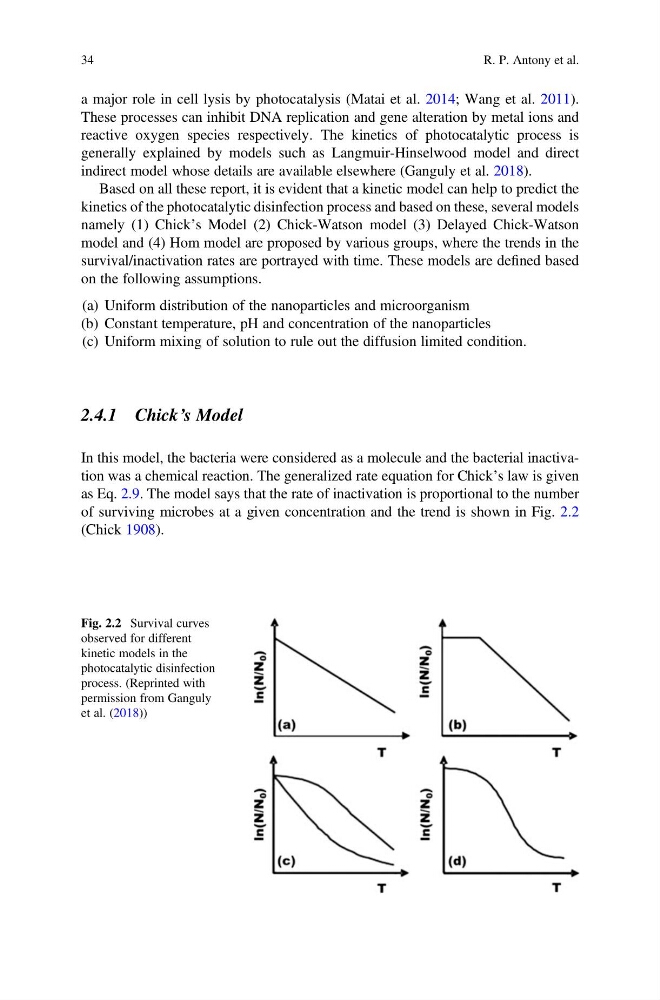
In this model, the bacteria were considered as a molecule and the bacterial inactivation was a chemical reaction. The generalized rate equation for Chick’s law is given
as Eq. 2.9. The model says that the rate of inactivation is proportional to the number
of surviving microbes at a given concentration and the trend is shown in Fig. 2.2
(Chick 1908).
Fig. 2.2 Survival curves
observed for different
kinetic models in the
photocatalytic disinfection
process. (Reprinted with
permission from Ganguly
et al. (2018))
34
R. P. Antony et al.
These processes can inhibit DNA replication and gene alteration by metal ions and
reactive oxygen species respectively. The kinetics of photocatalytic process is
generally explained by models such as Langmuir-Hinselwood model and direct
indirect model whose details are available elsewhere (Ganguly et al. 2018).
Based on all these report, it is evident that a kinetic model can help to predict the
kinetics of the photocatalytic disinfection process and based on these, several models
namely (1) Chick’s Model (2) Chick-Watson model (3) Delayed Chick-Watson
model and (4) Hom model are proposed by various groups, where the trends in the
survival/inactivation rates are portrayed with time. These models are defined based
on the following assumptions.
(a) Uniform distribution of the nanoparticles and microorganism
(b) Constant temperature, pH and concentration of the nanoparticles
(c) Uniform mixing of solution to rule out the diffusion limited condition.
2.4.1 Chick’s Model
In this model, the bacteria were considered as a molecule and the bacterial inactivation was a chemical reaction. The generalized rate equation for Chick’s law is given
as Eq. 2.9. The model says that the rate of inactivation is proportional to the number
of surviving microbes at a given concentration and the trend is shown in Fig. 2.2
(Chick 1908).
Fig. 2.2 Survival curves
observed for different
kinetic models in the
photocatalytic disinfection
process. (Reprinted with
permission from Ganguly
et al. (2018))
34
R. P. Antony et al.