

application in adsorption process (Vlasova et al. 2016). The focus of this chapter is
on the photocatalytic degradation of wastewater pollutants by MOFs.
10.4.5 Photocatalytic Degradation of Dyes Using MOFs
The photochemical reactivity and stability of MOFs have gained them popularity for
application in the degradation of dye pollutants from wastewater. Table 10.2 shows
some of the MOF materials that have been studied for the degradation of organic dye
pollutants such as methylene blue (MB), methyl orange (MO), and rhodamine blue
(RhB). These studies revealed that MOFs have various photoactive properties based
on their different structures as shown in Fig. 10.7a (Glatzmaier et al. 1990; Zeng
et al. 2016; Sharma and Feng 2017). In Type I strategy, metal cores (semiconductor
dots) in MOFs act as sequestered nano-semiconductors that are separated by organic
linkers (Bedia et al. 2019). These types of MOFs are more effective due to their
high porosity, when comparing them to conventional semiconductors and the
adsorption of pollutants that are near t the semiconductor and photo-generated
charges is favoured. Furthermore, the photo-response of MOFs is enhanced by the
high density of photoactive dots and the organic linkers which serves as light
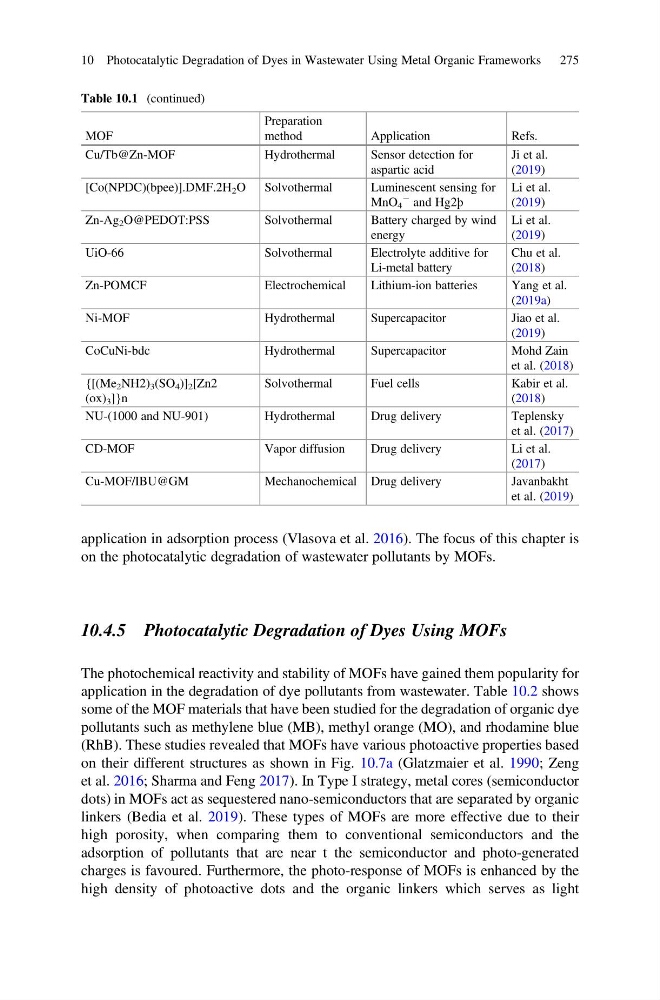
Table 10.1 (continued)
MOF
Preparation
method
Application
Refs.
Cu/Tb@Zn-MOF
Hydrothermal
Sensor detection for
aspartic acid
Ji et al.
(2019)
[Co(NPDC)(bpee)].DMF.2H 2 O Solvothermal
Luminescent sensing for
MnO 4
À and Hg2þ
Li et al.
(2019)
Zn-Ag 2 O@PEDOT:PSS
Solvothermal
Battery charged by wind
energy
Li et al.
(2019)
UiO-66
Solvothermal
Electrolyte additive for
Li-metal battery
Chu et al.
(2018)
Zn-POMCF
Electrochemical
Lithium-ion batteries
Yang et al.
(2019a)
Ni-MOF
Hydrothermal
Supercapacitor
Jiao et al.
(2019)
CoCuNi-bdc
Hydrothermal
Supercapacitor
Mohd Zain
et al. (2018)
{[(Me 2 NH2) 3 (SO 4 )] 2 [Zn2
(ox) 3 ]}n
Solvothermal
Fuel cells
Kabir et al.
(2018)
NU-(1000 and NU-901)
Hydrothermal
Drug delivery
Teplensky
et al. (2017)
CD-MOF
Vapor diffusion
Drug delivery
Li et al.
(2017)
Cu-MOF/IBU@GM
Mechanochemical Drug delivery
Javanbakht
et al. (2019)
10 Photocatalytic Degradation of Dyes in Wastewater Using Metal Organic Frameworks 275
on the photocatalytic degradation of wastewater pollutants by MOFs.
10.4.5 Photocatalytic Degradation of Dyes Using MOFs
The photochemical reactivity and stability of MOFs have gained them popularity for
application in the degradation of dye pollutants from wastewater. Table 10.2 shows
some of the MOF materials that have been studied for the degradation of organic dye
pollutants such as methylene blue (MB), methyl orange (MO), and rhodamine blue
(RhB). These studies revealed that MOFs have various photoactive properties based
on their different structures as shown in Fig. 10.7a (Glatzmaier et al. 1990; Zeng
et al. 2016; Sharma and Feng 2017). In Type I strategy, metal cores (semiconductor
dots) in MOFs act as sequestered nano-semiconductors that are separated by organic
linkers (Bedia et al. 2019). These types of MOFs are more effective due to their
high porosity, when comparing them to conventional semiconductors and the
adsorption of pollutants that are near t the semiconductor and photo-generated
charges is favoured. Furthermore, the photo-response of MOFs is enhanced by the
high density of photoactive dots and the organic linkers which serves as light
Table 10.1 (continued)
MOF
Preparation
method
Application
Refs.
Cu/Tb@Zn-MOF
Hydrothermal
Sensor detection for
aspartic acid
Ji et al.
(2019)
[Co(NPDC)(bpee)].DMF.2H 2 O Solvothermal
Luminescent sensing for
MnO 4
À and Hg2þ
Li et al.
(2019)
Zn-Ag 2 O@PEDOT:PSS
Solvothermal
Battery charged by wind
energy
Li et al.
(2019)
UiO-66
Solvothermal
Electrolyte additive for
Li-metal battery
Chu et al.
(2018)
Zn-POMCF
Electrochemical
Lithium-ion batteries
Yang et al.
(2019a)
Ni-MOF
Hydrothermal
Supercapacitor
Jiao et al.
(2019)
CoCuNi-bdc
Hydrothermal
Supercapacitor
Mohd Zain
et al. (2018)
{[(Me 2 NH2) 3 (SO 4 )] 2 [Zn2
(ox) 3 ]}n
Solvothermal
Fuel cells
Kabir et al.
(2018)
NU-(1000 and NU-901)
Hydrothermal
Drug delivery
Teplensky
et al. (2017)
CD-MOF
Vapor diffusion
Drug delivery
Li et al.
(2017)
Cu-MOF/IBU@GM
Mechanochemical Drug delivery
Javanbakht
et al. (2019)
10 Photocatalytic Degradation of Dyes in Wastewater Using Metal Organic Frameworks 275