

temperature, concentration of metal salt, and the solubility of the reactants (Lin et al.
2012). In this case, the metal cores are attached to organic linker through functional
groups to give a 3D structure of porous materials which is a paddle-wheel-like unit
of cubic structure. Furthermore, the use of conventional synthesis schemes, powdered MOFs with low densities have often been synthesized (Candu et al. 2013).
Nevertheless, it was observed that the low density property of MOF is not suitable
for hydrogen storage application (Ramohlola et al. 2017a, b, c; Qamar et al. 2016).
The hydrothermal approach is normally performed in a stainless steel autoclave as
given in Fig. 10.5a. This approach allows a defined regulation on the shape and size
of the material to be prepared, not like conventional approach (Ramohlola et al.
2017a, b, c). As presented in Fig. 10.5d, the epitaxial growth ZIF-67 attached to
ZIF-8 benefits from harmonized unit cell parameters, and core-shell structured
ZIF-8@ZIF-67 crystals were prepared (Wang and Hu 2018).
10.4.3.2 Microwave-Assisted Synthesis
Microwave-assisted preparation route has revealed to be an interesting method for
fast fabrication of nanostructured porous materials (Qamar et al. 2016). Moreover,
this route gives potential advantages like facile morphology control on MOF
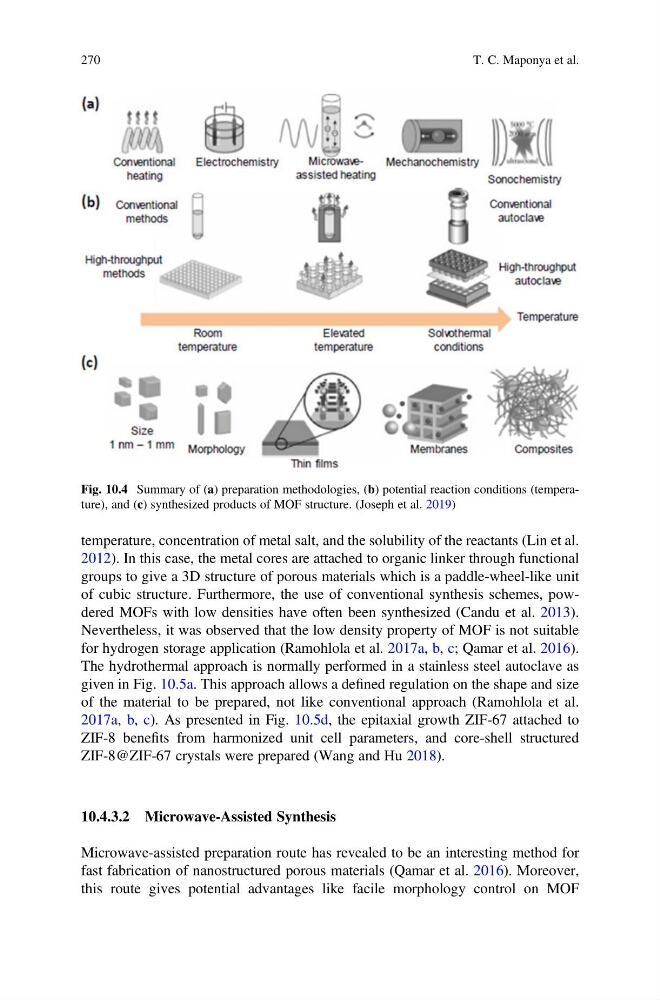
Fig. 10.4 Summary of (a) preparation methodologies, (b) potential reaction conditions (temperature), and (c) synthesized products of MOF structure. (Joseph et al. 2019)
270
T. C. Maponya et al.
2012). In this case, the metal cores are attached to organic linker through functional
groups to give a 3D structure of porous materials which is a paddle-wheel-like unit
of cubic structure. Furthermore, the use of conventional synthesis schemes, powdered MOFs with low densities have often been synthesized (Candu et al. 2013).
Nevertheless, it was observed that the low density property of MOF is not suitable
for hydrogen storage application (Ramohlola et al. 2017a, b, c; Qamar et al. 2016).
The hydrothermal approach is normally performed in a stainless steel autoclave as
given in Fig. 10.5a. This approach allows a defined regulation on the shape and size
of the material to be prepared, not like conventional approach (Ramohlola et al.
2017a, b, c). As presented in Fig. 10.5d, the epitaxial growth ZIF-67 attached to
ZIF-8 benefits from harmonized unit cell parameters, and core-shell structured
ZIF-8@ZIF-67 crystals were prepared (Wang and Hu 2018).
10.4.3.2 Microwave-Assisted Synthesis
Microwave-assisted preparation route has revealed to be an interesting method for
fast fabrication of nanostructured porous materials (Qamar et al. 2016). Moreover,
this route gives potential advantages like facile morphology control on MOF
Fig. 10.4 Summary of (a) preparation methodologies, (b) potential reaction conditions (temperature), and (c) synthesized products of MOF structure. (Joseph et al. 2019)
270
T. C. Maponya et al.