

bio-composting process, soil respiration, and reduction in the enzyme activity and
affects the fungal spore formation (Tyler 1974; Hepper and Smith 1976).
In the soil ecosystem, metal ions are immobilized and mobilized by bacteria/fungi
and final uptake by the plants (Birch and Bachofen 1990). Soil is an essential source
for soil-dwelling microorganisms, as it includes various essential nutrients for
growth. Approximately one billion colony forming units (CFUs) of diverse microorganisms were present in the soil, including fungi comprising of 10
5 to 10
8
numbers/gram (Lenart-Boron and Boron 2014).
Fungal cell wall chemical composition and structure may trigger metal ions. Their
active binding sites were uptake during binding the heavy metals from the water and
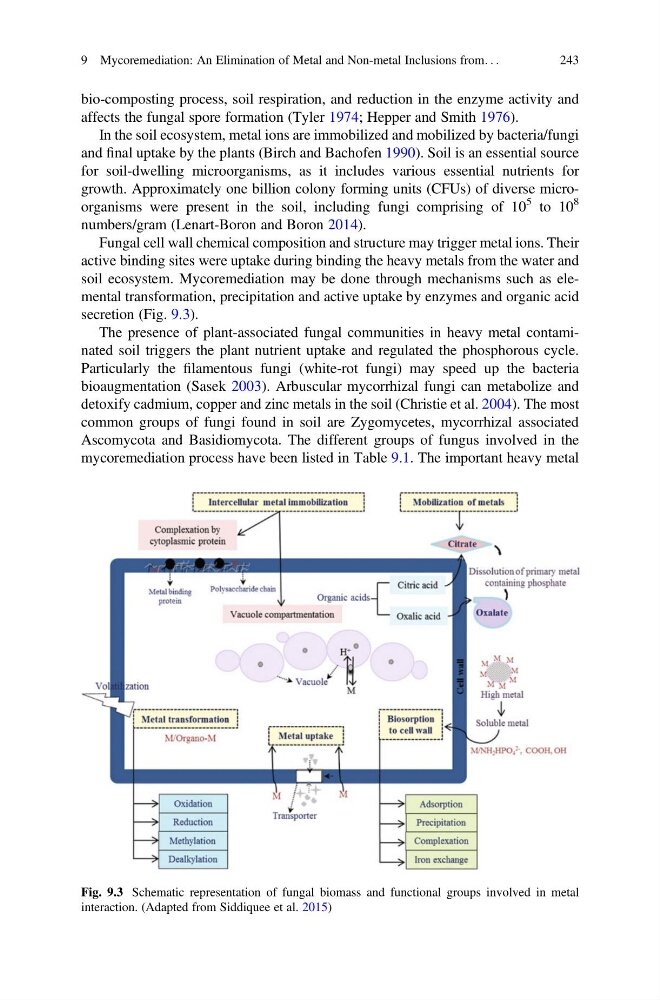
soil ecosystem. Mycoremediation may be done through mechanisms such as elemental transformation, precipitation and active uptake by enzymes and organic acid
secretion (Fig. 9.3).
The presence of plant-associated fungal communities in heavy metal contaminated soil triggers the plant nutrient uptake and regulated the phosphorous cycle.
Particularly the filamentous fungi (white-rot fungi) may speed up the bacteria
bioaugmentation (Sasek 2003). Arbuscular mycorrhizal fungi can metabolize and
detoxify cadmium, copper and zinc metals in the soil (Christie et al. 2004). The most
common groups of fungi found in soil are Zygomycetes, mycorrhizal associated
Ascomycota and Basidiomycota. The different groups of fungus involved in the
mycoremediation process have been listed in Table 9.1. The important heavy metal
Fig. 9.3 Schematic representation of fungal biomass and functional groups involved in metal
interaction. (Adapted from Siddiquee et al. 2015)
9 Mycoremediation: An Elimination of Metal and Non-metal Inclusions from. . .
243
affects the fungal spore formation (Tyler 1974; Hepper and Smith 1976).
In the soil ecosystem, metal ions are immobilized and mobilized by bacteria/fungi
and final uptake by the plants (Birch and Bachofen 1990). Soil is an essential source
for soil-dwelling microorganisms, as it includes various essential nutrients for
growth. Approximately one billion colony forming units (CFUs) of diverse microorganisms were present in the soil, including fungi comprising of 10
5 to 10
8
numbers/gram (Lenart-Boron and Boron 2014).
Fungal cell wall chemical composition and structure may trigger metal ions. Their
active binding sites were uptake during binding the heavy metals from the water and
soil ecosystem. Mycoremediation may be done through mechanisms such as elemental transformation, precipitation and active uptake by enzymes and organic acid
secretion (Fig. 9.3).
The presence of plant-associated fungal communities in heavy metal contaminated soil triggers the plant nutrient uptake and regulated the phosphorous cycle.
Particularly the filamentous fungi (white-rot fungi) may speed up the bacteria
bioaugmentation (Sasek 2003). Arbuscular mycorrhizal fungi can metabolize and
detoxify cadmium, copper and zinc metals in the soil (Christie et al. 2004). The most
common groups of fungi found in soil are Zygomycetes, mycorrhizal associated
Ascomycota and Basidiomycota. The different groups of fungus involved in the
mycoremediation process have been listed in Table 9.1. The important heavy metal
Fig. 9.3 Schematic representation of fungal biomass and functional groups involved in metal
interaction. (Adapted from Siddiquee et al. 2015)
9 Mycoremediation: An Elimination of Metal and Non-metal Inclusions from. . .
243