

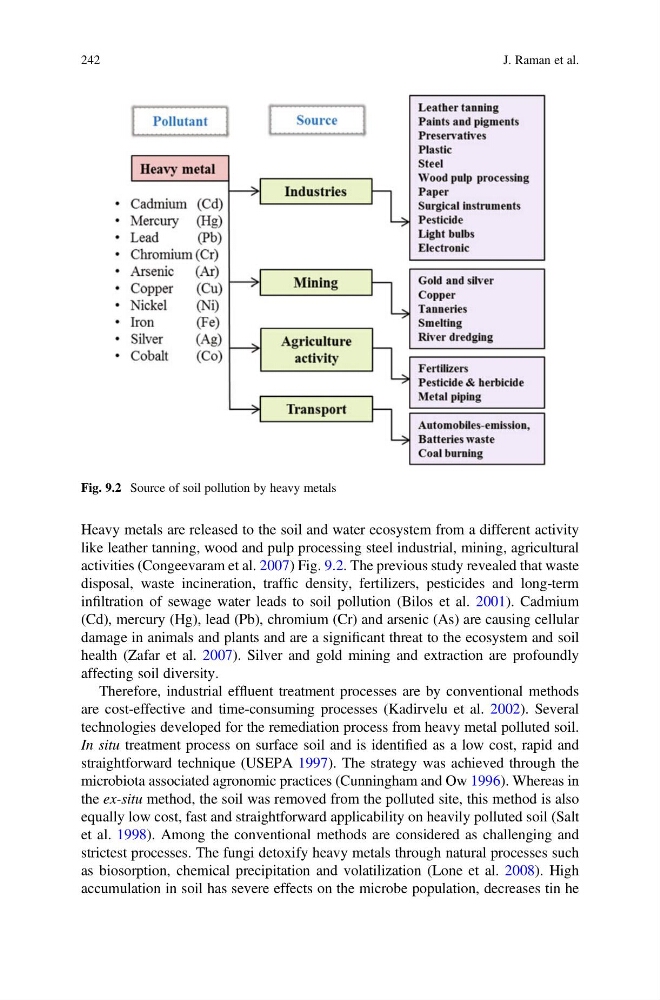
Heavy metals are released to the soil and water ecosystem from a different activity
like leather tanning, wood and pulp processing steel industrial, mining, agricultural
activities (Congeevaram et al. 2007) Fig. 9.2. The previous study revealed that waste
disposal, waste incineration, traffic density, fertilizers, pesticides and long-term
infiltration of sewage water leads to soil pollution (Bilos et al. 2001). Cadmium
(Cd), mercury (Hg), lead (Pb), chromium (Cr) and arsenic (As) are causing cellular
damage in animals and plants and are a significant threat to the ecosystem and soil
health (Zafar et al. 2007). Silver and gold mining and extraction are profoundly
affecting soil diversity.
Therefore, industrial effluent treatment processes are by conventional methods
are cost-effective and time-consuming processes (Kadirvelu et al. 2002). Several
technologies developed for the remediation process from heavy metal polluted soil.
In situ treatment process on surface soil and is identified as a low cost, rapid and
straightforward technique (USEPA 1997). The strategy was achieved through the
microbiota associated agronomic practices (Cunningham and Ow 1996). Whereas in
the ex-situ method, the soil was removed from the polluted site, this method is also
equally low cost, fast and straightforward applicability on heavily polluted soil (Salt
et al. 1998). Among the conventional methods are considered as challenging and
strictest processes. The fungi detoxify heavy metals through natural processes such
as biosorption, chemical precipitation and volatilization (Lone et al. 2008). High
accumulation in soil has severe effects on the microbe population, decreases tin he
Fig. 9.2 Source of soil pollution by heavy metals
242
J. Raman et al.
like leather tanning, wood and pulp processing steel industrial, mining, agricultural
activities (Congeevaram et al. 2007) Fig. 9.2. The previous study revealed that waste
disposal, waste incineration, traffic density, fertilizers, pesticides and long-term
infiltration of sewage water leads to soil pollution (Bilos et al. 2001). Cadmium
(Cd), mercury (Hg), lead (Pb), chromium (Cr) and arsenic (As) are causing cellular
damage in animals and plants and are a significant threat to the ecosystem and soil
health (Zafar et al. 2007). Silver and gold mining and extraction are profoundly
affecting soil diversity.
Therefore, industrial effluent treatment processes are by conventional methods
are cost-effective and time-consuming processes (Kadirvelu et al. 2002). Several
technologies developed for the remediation process from heavy metal polluted soil.
In situ treatment process on surface soil and is identified as a low cost, rapid and
straightforward technique (USEPA 1997). The strategy was achieved through the
microbiota associated agronomic practices (Cunningham and Ow 1996). Whereas in
the ex-situ method, the soil was removed from the polluted site, this method is also
equally low cost, fast and straightforward applicability on heavily polluted soil (Salt
et al. 1998). Among the conventional methods are considered as challenging and
strictest processes. The fungi detoxify heavy metals through natural processes such
as biosorption, chemical precipitation and volatilization (Lone et al. 2008). High
accumulation in soil has severe effects on the microbe population, decreases tin he
Fig. 9.2 Source of soil pollution by heavy metals
242
J. Raman et al.