

biotransformation and biooxidation (Srivastava et al. 2011; Liu et al. 2009; Casarett
et al. 2008). With several limitations of non-biological approaches, biological
approach is gaining popularity, particularly due to its cost effectiveness. Biological
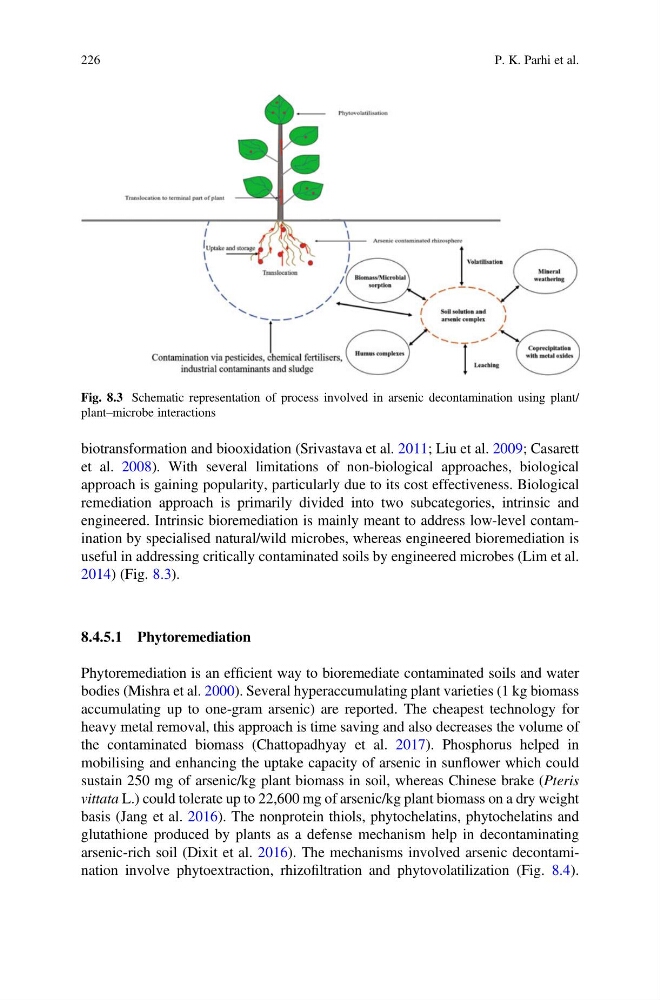
remediation approach is primarily divided into two subcategories, intrinsic and
engineered. Intrinsic bioremediation is mainly meant to address low-level contamination by specialised natural/wild microbes, whereas engineered bioremediation is
useful in addressing critically contaminated soils by engineered microbes (Lim et al.
2014) (Fig. 8.3).
8.4.5.1 Phytoremediation
Phytoremediation is an efficient way to bioremediate contaminated soils and water
bodies (Mishra et al. 2000). Several hyperaccumulating plant varieties (1 kg biomass
accumulating up to one-gram arsenic) are reported. The cheapest technology for
heavy metal removal, this approach is time saving and also decreases the volume of
the contaminated biomass (Chattopadhyay et al. 2017). Phosphorus helped in
mobilising and enhancing the uptake capacity of arsenic in sunflower which could
sustain 250 mg of arsenic/kg plant biomass in soil, whereas Chinese brake (Pteris
vittata L.) could tolerate up to 22,600 mg of arsenic/kg plant biomass on a dry weight
basis (Jang et al. 2016). The nonprotein thiols, phytochelatins, phytochelatins and
glutathione produced by plants as a defense mechanism help in decontaminating
arsenic-rich soil (Dixit et al. 2016). The mechanisms involved arsenic decontamination involve phytoextraction, rhizofiltration and phytovolatilization (Fig. 8.4).
Fig. 8.3 Schematic representation of process involved in arsenic decontamination using plant/
plant–microbe interactions
226
P. K. Parhi et al.
et al. 2008). With several limitations of non-biological approaches, biological
approach is gaining popularity, particularly due to its cost effectiveness. Biological
remediation approach is primarily divided into two subcategories, intrinsic and
engineered. Intrinsic bioremediation is mainly meant to address low-level contamination by specialised natural/wild microbes, whereas engineered bioremediation is
useful in addressing critically contaminated soils by engineered microbes (Lim et al.
2014) (Fig. 8.3).
8.4.5.1 Phytoremediation
Phytoremediation is an efficient way to bioremediate contaminated soils and water
bodies (Mishra et al. 2000). Several hyperaccumulating plant varieties (1 kg biomass
accumulating up to one-gram arsenic) are reported. The cheapest technology for
heavy metal removal, this approach is time saving and also decreases the volume of
the contaminated biomass (Chattopadhyay et al. 2017). Phosphorus helped in
mobilising and enhancing the uptake capacity of arsenic in sunflower which could
sustain 250 mg of arsenic/kg plant biomass in soil, whereas Chinese brake (Pteris
vittata L.) could tolerate up to 22,600 mg of arsenic/kg plant biomass on a dry weight
basis (Jang et al. 2016). The nonprotein thiols, phytochelatins, phytochelatins and
glutathione produced by plants as a defense mechanism help in decontaminating
arsenic-rich soil (Dixit et al. 2016). The mechanisms involved arsenic decontamination involve phytoextraction, rhizofiltration and phytovolatilization (Fig. 8.4).
Fig. 8.3 Schematic representation of process involved in arsenic decontamination using plant/
plant–microbe interactions
226
P. K. Parhi et al.