

lowering the energy which is possible by the lowering the active energy of the
reaction. Hence, when compared to the uncatalyzed reaction, rate of the reaction is
much higher.
Photocatalyst
hν
e
O 2
Dyes
H 2 O 2
O 2
Dyes
H 2 O ð7:1Þ
Photocatalyst
hν
h
H 2 O
OH
Dye s
CO 2
H 2 O
+
ð7:2Þ
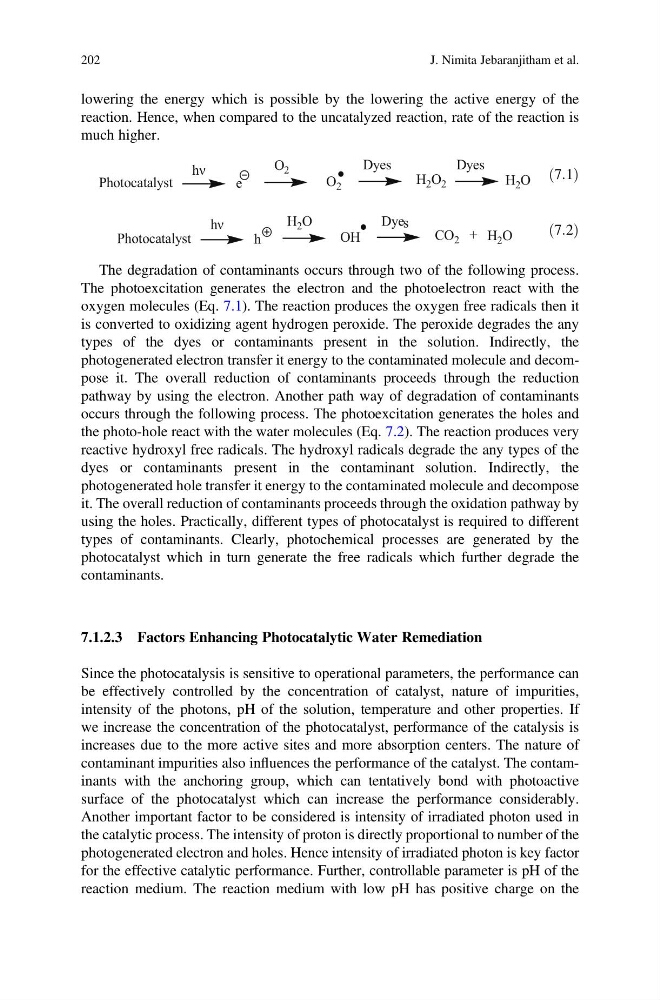
The degradation of contaminants occurs through two of the following process.
The photoexcitation generates the electron and the photoelectron react with the
oxygen molecules (Eq. 7.1). The reaction produces the oxygen free radicals then it
is converted to oxidizing agent hydrogen peroxide. The peroxide degrades the any
types of the dyes or contaminants present in the solution. Indirectly, the
photogenerated electron transfer it energy to the contaminated molecule and decompose it. The overall reduction of contaminants proceeds through the reduction
pathway by using the electron. Another path way of degradation of contaminants
occurs through the following process. The photoexcitation generates the holes and
the photo-hole react with the water molecules (Eq. 7.2). The reaction produces very
reactive hydroxyl free radicals. The hydroxyl radicals degrade the any types of the
dyes or contaminants present in the contaminant solution. Indirectly, the
photogenerated hole transfer it energy to the contaminated molecule and decompose
it. The overall reduction of contaminants proceeds through the oxidation pathway by
using the holes. Practically, different types of photocatalyst is required to different
types of contaminants. Clearly, photochemical processes are generated by the
photocatalyst which in turn generate the free radicals which further degrade the
contaminants.
7.1.2.3 Factors Enhancing Photocatalytic Water Remediation
Since the photocatalysis is sensitive to operational parameters, the performance can
be effectively controlled by the concentration of catalyst, nature of impurities,
intensity of the photons, pH of the solution, temperature and other properties. If
we increase the concentration of the photocatalyst, performance of the catalysis is
increases due to the more active sites and more absorption centers. The nature of
contaminant impurities also influences the performance of the catalyst. The contaminants with the anchoring group, which can tentatively bond with photoactive
surface of the photocatalyst which can increase the performance considerably.
Another important factor to be considered is intensity of irradiated photon used in
the catalytic process. The intensity of proton is directly proportional to number of the
photogenerated electron and holes. Hence intensity of irradiated photon is key factor
for the effective catalytic performance. Further, controllable parameter is pH of the
reaction medium. The reaction medium with low pH has positive charge on the
202
J. Nimita Jebaranjitham et al.
reaction. Hence, when compared to the uncatalyzed reaction, rate of the reaction is
much higher.
Photocatalyst
hν
e
O 2
Dyes
H 2 O 2
O 2
Dyes
H 2 O ð7:1Þ
Photocatalyst
hν
h
H 2 O
OH
Dye s
CO 2
H 2 O
+
ð7:2Þ
The degradation of contaminants occurs through two of the following process.
The photoexcitation generates the electron and the photoelectron react with the
oxygen molecules (Eq. 7.1). The reaction produces the oxygen free radicals then it
is converted to oxidizing agent hydrogen peroxide. The peroxide degrades the any
types of the dyes or contaminants present in the solution. Indirectly, the
photogenerated electron transfer it energy to the contaminated molecule and decompose it. The overall reduction of contaminants proceeds through the reduction
pathway by using the electron. Another path way of degradation of contaminants
occurs through the following process. The photoexcitation generates the holes and
the photo-hole react with the water molecules (Eq. 7.2). The reaction produces very
reactive hydroxyl free radicals. The hydroxyl radicals degrade the any types of the
dyes or contaminants present in the contaminant solution. Indirectly, the
photogenerated hole transfer it energy to the contaminated molecule and decompose
it. The overall reduction of contaminants proceeds through the oxidation pathway by
using the holes. Practically, different types of photocatalyst is required to different
types of contaminants. Clearly, photochemical processes are generated by the
photocatalyst which in turn generate the free radicals which further degrade the
contaminants.
7.1.2.3 Factors Enhancing Photocatalytic Water Remediation
Since the photocatalysis is sensitive to operational parameters, the performance can
be effectively controlled by the concentration of catalyst, nature of impurities,
intensity of the photons, pH of the solution, temperature and other properties. If
we increase the concentration of the photocatalyst, performance of the catalysis is
increases due to the more active sites and more absorption centers. The nature of
contaminant impurities also influences the performance of the catalyst. The contaminants with the anchoring group, which can tentatively bond with photoactive
surface of the photocatalyst which can increase the performance considerably.
Another important factor to be considered is intensity of irradiated photon used in
the catalytic process. The intensity of proton is directly proportional to number of the
photogenerated electron and holes. Hence intensity of irradiated photon is key factor
for the effective catalytic performance. Further, controllable parameter is pH of the
reaction medium. The reaction medium with low pH has positive charge on the
202
J. Nimita Jebaranjitham et al.