

7.1.2.2 The Mechanism of Photocatalytic Water Remediation
In the photocatalysis reaction, both the catalysis and photolysis occur simultaneously. In the catalysis reaction, the catalyst is absorbent and contaminants are
adsorbate. During the degradation process, contaminants adsorb at the active sites of
the catalytic surface and degrades gradually. The entire catalytic process happens at
the surface of the photocatalyst. During the irradiation, catalyst absorb the irradiated
light based on its absorption region such UV or visible. The UV region is
200–400 nm where pi-pi transition occurs and visible region is 400–750 nm where
n-pi transition occurs. The band gap of the catalyst is determined by separation of
valance-conduction band and different materials have different types of bandgap.
When the energy of the absorbed light is equal or higher than bandgap of the
photocatalyst, the electron excitation occurs in the catalyst. The excitation process
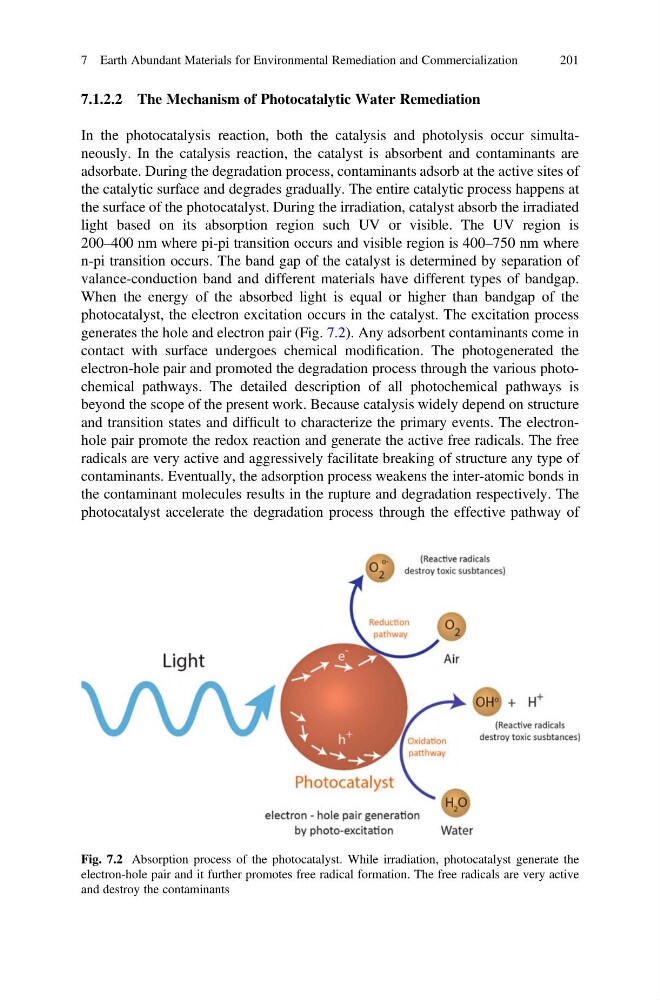
generates the hole and electron pair (Fig. 7.2). Any adsorbent contaminants come in
contact with surface undergoes chemical modification. The photogenerated the
electron-hole pair and promoted the degradation process through the various photochemical pathways. The detailed description of all photochemical pathways is
beyond the scope of the present work. Because catalysis widely depend on structure
and transition states and difficult to characterize the primary events. The electronhole pair promote the redox reaction and generate the active free radicals. The free
radicals are very active and aggressively facilitate breaking of structure any type of
contaminants. Eventually, the adsorption process weakens the inter-atomic bonds in
the contaminant molecules results in the rupture and degradation respectively. The
photocatalyst accelerate the degradation process through the effective pathway of
Fig. 7.2 Absorption process of the photocatalyst. While irradiation, photocatalyst generate the
electron-hole pair and it further promotes free radical formation. The free radicals are very active
and destroy the contaminants
7 Earth Abundant Materials for Environmental Remediation and Commercialization
201
In the photocatalysis reaction, both the catalysis and photolysis occur simultaneously. In the catalysis reaction, the catalyst is absorbent and contaminants are
adsorbate. During the degradation process, contaminants adsorb at the active sites of
the catalytic surface and degrades gradually. The entire catalytic process happens at
the surface of the photocatalyst. During the irradiation, catalyst absorb the irradiated
light based on its absorption region such UV or visible. The UV region is
200–400 nm where pi-pi transition occurs and visible region is 400–750 nm where
n-pi transition occurs. The band gap of the catalyst is determined by separation of
valance-conduction band and different materials have different types of bandgap.
When the energy of the absorbed light is equal or higher than bandgap of the
photocatalyst, the electron excitation occurs in the catalyst. The excitation process
generates the hole and electron pair (Fig. 7.2). Any adsorbent contaminants come in
contact with surface undergoes chemical modification. The photogenerated the
electron-hole pair and promoted the degradation process through the various photochemical pathways. The detailed description of all photochemical pathways is
beyond the scope of the present work. Because catalysis widely depend on structure
and transition states and difficult to characterize the primary events. The electronhole pair promote the redox reaction and generate the active free radicals. The free
radicals are very active and aggressively facilitate breaking of structure any type of
contaminants. Eventually, the adsorption process weakens the inter-atomic bonds in
the contaminant molecules results in the rupture and degradation respectively. The
photocatalyst accelerate the degradation process through the effective pathway of
Fig. 7.2 Absorption process of the photocatalyst. While irradiation, photocatalyst generate the
electron-hole pair and it further promotes free radical formation. The free radicals are very active
and destroy the contaminants
7 Earth Abundant Materials for Environmental Remediation and Commercialization
201