

about 40 ppb of toxic chemicals. The contaminants seriously pollute the eco-systems
including land, air and water which in turn harm to human, animals and plants. Since
human body contains most of water, the water is considered as source of life. Hence
much consideration given to the purification of water. Providing high pure water is
pressing problem is many developing, undeveloped and developed countries such as
India and Africa. The contaminants are many types and it can be removed by
physical, chemical and biological methods. Among the various purification/remediation technologies of water, heterogenous technology is proven to be cost-effective,
efficient and often rated as most practical. Since the method does not require any
energy to purify the chemicals it attracted wide interest in industry and academia.
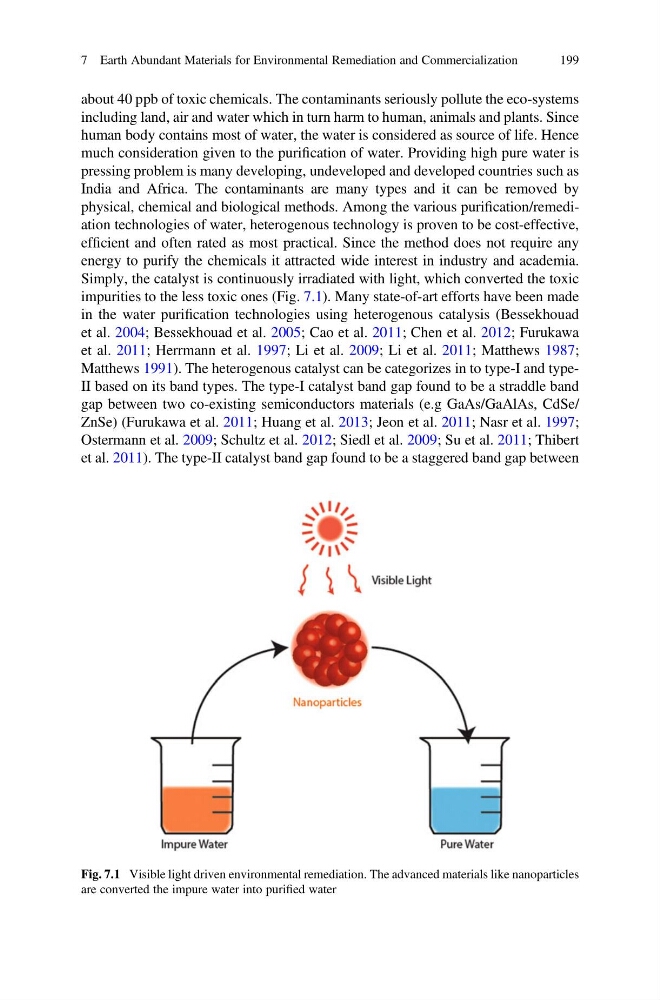
Simply, the catalyst is continuously irradiated with light, which converted the toxic
impurities to the less toxic ones (Fig. 7.1). Many state-of-art efforts have been made
in the water purification technologies using heterogenous catalysis (Bessekhouad
et al. 2004; Bessekhouad et al. 2005; Cao et al. 2011; Chen et al. 2012; Furukawa
et al. 2011; Herrmann et al. 1997; Li et al. 2009; Li et al. 2011; Matthews 1987;
Matthews 1991). The heterogenous catalyst can be categorizes in to type-I and typeII based on its band types. The type-I catalyst band gap found to be a straddle band
gap between two co-existing semiconductors materials (e.g GaAs/GaAlAs, CdSe/
ZnSe) (Furukawa et al. 2011; Huang et al. 2013; Jeon et al. 2011; Nasr et al. 1997;
Ostermann et al. 2009; Schultz et al. 2012; Siedl et al. 2009; Su et al. 2011; Thibert
et al. 2011). The type-II catalyst band gap found to be a staggered band gap between
Fig. 7.1 Visible light driven environmental remediation. The advanced materials like nanoparticles
are converted the impure water into purified water
7 Earth Abundant Materials for Environmental Remediation and Commercialization
199
including land, air and water which in turn harm to human, animals and plants. Since
human body contains most of water, the water is considered as source of life. Hence
much consideration given to the purification of water. Providing high pure water is
pressing problem is many developing, undeveloped and developed countries such as
India and Africa. The contaminants are many types and it can be removed by
physical, chemical and biological methods. Among the various purification/remediation technologies of water, heterogenous technology is proven to be cost-effective,
efficient and often rated as most practical. Since the method does not require any
energy to purify the chemicals it attracted wide interest in industry and academia.
Simply, the catalyst is continuously irradiated with light, which converted the toxic
impurities to the less toxic ones (Fig. 7.1). Many state-of-art efforts have been made
in the water purification technologies using heterogenous catalysis (Bessekhouad
et al. 2004; Bessekhouad et al. 2005; Cao et al. 2011; Chen et al. 2012; Furukawa
et al. 2011; Herrmann et al. 1997; Li et al. 2009; Li et al. 2011; Matthews 1987;
Matthews 1991). The heterogenous catalyst can be categorizes in to type-I and typeII based on its band types. The type-I catalyst band gap found to be a straddle band
gap between two co-existing semiconductors materials (e.g GaAs/GaAlAs, CdSe/
ZnSe) (Furukawa et al. 2011; Huang et al. 2013; Jeon et al. 2011; Nasr et al. 1997;
Ostermann et al. 2009; Schultz et al. 2012; Siedl et al. 2009; Su et al. 2011; Thibert
et al. 2011). The type-II catalyst band gap found to be a staggered band gap between
Fig. 7.1 Visible light driven environmental remediation. The advanced materials like nanoparticles
are converted the impure water into purified water
7 Earth Abundant Materials for Environmental Remediation and Commercialization
199