

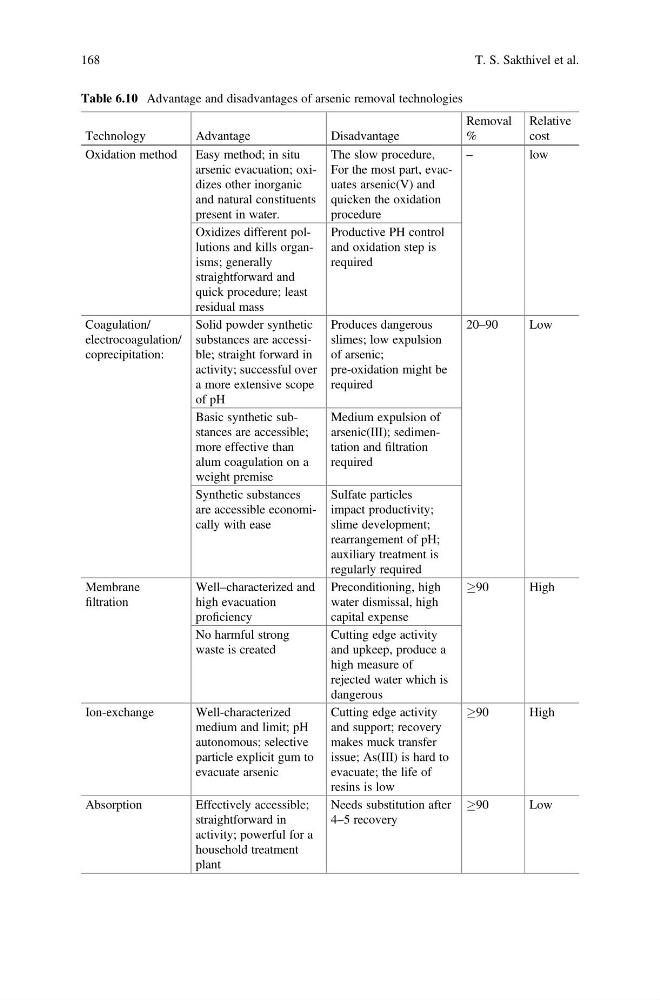
Table 6.10 Advantage and disadvantages of arsenic removal technologies
Technology
Advantage
Disadvantage
Removal
%
Relative
cost
Oxidation method Easy method; in situ
arsenic evacuation; oxidizes other inorganic
and natural constituents
present in water.
The slow procedure,
For the most part, evacuates arsenic(V) and
quicken the oxidation
procedure
–
low
Oxidizes different pollutions and kills organisms; generally
straightforward and
quick procedure; least
residual mass
Productive PH control
and oxidation step is
required
Coagulation/
electrocoagulation/
coprecipitation:
Solid powder synthetic
substances are accessible; straight forward in
activity; successful over
a more extensive scope
of pH
Produces dangerous
slimes; low expulsion
of arsenic;
pre-oxidation might be
required
20–90
Low
Basic synthetic substances are accessible;
more effective than
alum coagulation on a
weight premise
Medium expulsion of
arsenic(III); sedimentation and filtration
required
Synthetic substances
are accessible economically with ease
Sulfate particles
impact productivity;
slime development;
rearrangement of pH;
auxiliary treatment is
regularly required
Membrane
filtration
Well–characterized and
high evacuation
proficiency
Preconditioning, high
water dismissal, high
capital expense
!90
High
No harmful strong
waste is created
Cutting edge activity
and upkeep, produce a
high measure of
rejected water which is
dangerous
Ion-exchange
Well-characterized
medium and limit; pH
autonomous; selective
particle explicit gum to
evacuate arsenic
Cutting edge activity
and support; recovery
makes muck transfer
issue; As(III) is hard to
evacuate; the life of
resins is low
!90
High
Absorption
Effectively accessible;
straightforward in
activity; powerful for a
household treatment
plant
Needs substitution after
4–5 recovery
!90
Low
168
T. S. Sakthivel et al.
Technology
Advantage
Disadvantage
Removal
%
Relative
cost
Oxidation method Easy method; in situ
arsenic evacuation; oxidizes other inorganic
and natural constituents
present in water.
The slow procedure,
For the most part, evacuates arsenic(V) and
quicken the oxidation
procedure
–
low
Oxidizes different pollutions and kills organisms; generally
straightforward and
quick procedure; least
residual mass
Productive PH control
and oxidation step is
required
Coagulation/
electrocoagulation/
coprecipitation:
Solid powder synthetic
substances are accessible; straight forward in
activity; successful over
a more extensive scope
of pH
Produces dangerous
slimes; low expulsion
of arsenic;
pre-oxidation might be
required
20–90
Low
Basic synthetic substances are accessible;
more effective than
alum coagulation on a
weight premise
Medium expulsion of
arsenic(III); sedimentation and filtration
required
Synthetic substances
are accessible economically with ease
Sulfate particles
impact productivity;
slime development;
rearrangement of pH;
auxiliary treatment is
regularly required
Membrane
filtration
Well–characterized and
high evacuation
proficiency
Preconditioning, high
water dismissal, high
capital expense
!90
High
No harmful strong
waste is created
Cutting edge activity
and upkeep, produce a
high measure of
rejected water which is
dangerous
Ion-exchange
Well-characterized
medium and limit; pH
autonomous; selective
particle explicit gum to
evacuate arsenic
Cutting edge activity
and support; recovery
makes muck transfer
issue; As(III) is hard to
evacuate; the life of
resins is low
!90
High
Absorption
Effectively accessible;
straightforward in
activity; powerful for a
household treatment
plant
Needs substitution after
4–5 recovery
!90
Low
168
T. S. Sakthivel et al.