

arsenite separations in various pKa qualities are exhibited in Table 6.4 (Chiban et al.
2012; Mohan and Pittman 2007; Tuutijärvi 2013).
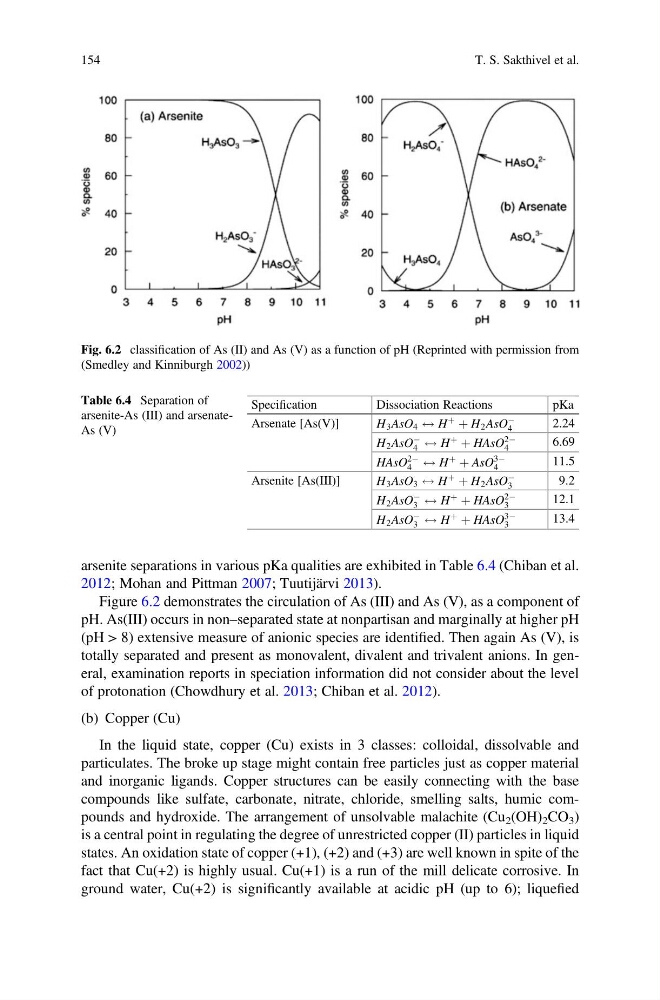
Figure 6.2 demonstrates the circulation of As (III) and As (V), as a component of
pH. As(III) occurs in non–separated state at nonpartisan and marginally at higher pH
(pH > 8) extensive measure of anionic species are identified. Then again As (V), is
totally separated and present as monovalent, divalent and trivalent anions. In general, examination reports in speciation information did not consider about the level
of protonation (Chowdhury et al. 2013; Chiban et al. 2012).
(b) Copper (Cu)
In the liquid state, copper (Cu) exists in 3 classes: colloidal, dissolvable and
particulates. The broke up stage might contain free particles just as copper material
and inorganic ligands. Copper structures can be easily connecting with the base
compounds like sulfate, carbonate, nitrate, chloride, smelling salts, humic compounds and hydroxide. The arrangement of unsolvable malachite (Cu 2 (OH) 2 CO 3 )
is a central point in regulating the degree of unrestricted copper (II) particles in liquid
states. An oxidation state of copper (+1), (+2) and (+3) are well known in spite of the
fact that Cu(+2) is highly usual. Cu(+1) is a run of the mill delicate corrosive. In
ground water, Cu(+2) is significantly available at acidic pH (up to 6); liquefied
Fig. 6.2 classification of As (II) and As (V) as a function of pH (Reprinted with permission from
(Smedley and Kinniburgh 2002))
Table 6.4 Separation of
arsenite-As (III) and arsenateAs (V)
Specification
Dissociation Reactions
pKa
Arsenate [As(V)]
H 3 AsO 4 $ H
þ þ H 2 AsO
À
4
2.24
H 2 AsO
À
4 $ H
þ þ HAsO
2À
4
6.69
HAsO
2À
4 $ H
þ þ AsO
3À
4
11.5
Arsenite [As(III)]
H 3 AsO 3 $ H
þ þ H 2 AsO
À
3
9.2
H 2 AsO
À
3 $ H
þ þ HAsO
2À
3
12.1
H 2 AsO
À
3 $ H
þ þ HAsO
3À
3
13.4
154
T. S. Sakthivel et al.
2012; Mohan and Pittman 2007; Tuutijärvi 2013).
Figure 6.2 demonstrates the circulation of As (III) and As (V), as a component of
pH. As(III) occurs in non–separated state at nonpartisan and marginally at higher pH
(pH > 8) extensive measure of anionic species are identified. Then again As (V), is
totally separated and present as monovalent, divalent and trivalent anions. In general, examination reports in speciation information did not consider about the level
of protonation (Chowdhury et al. 2013; Chiban et al. 2012).
(b) Copper (Cu)
In the liquid state, copper (Cu) exists in 3 classes: colloidal, dissolvable and
particulates. The broke up stage might contain free particles just as copper material
and inorganic ligands. Copper structures can be easily connecting with the base
compounds like sulfate, carbonate, nitrate, chloride, smelling salts, humic compounds and hydroxide. The arrangement of unsolvable malachite (Cu 2 (OH) 2 CO 3 )
is a central point in regulating the degree of unrestricted copper (II) particles in liquid
states. An oxidation state of copper (+1), (+2) and (+3) are well known in spite of the
fact that Cu(+2) is highly usual. Cu(+1) is a run of the mill delicate corrosive. In
ground water, Cu(+2) is significantly available at acidic pH (up to 6); liquefied
Fig. 6.2 classification of As (II) and As (V) as a function of pH (Reprinted with permission from
(Smedley and Kinniburgh 2002))
Table 6.4 Separation of
arsenite-As (III) and arsenateAs (V)
Specification
Dissociation Reactions
pKa
Arsenate [As(V)]
H 3 AsO 4 $ H
þ þ H 2 AsO
À
4
2.24
H 2 AsO
À
4 $ H
þ þ HAsO
2À
4
6.69
HAsO
2À
4 $ H
þ þ AsO
3À
4
11.5
Arsenite [As(III)]
H 3 AsO 3 $ H
þ þ H 2 AsO
À
3
9.2
H 2 AsO
À
3 $ H
þ þ HAsO
2À
3
12.1
H 2 AsO
À
3 $ H
þ þ HAsO
3À
3
13.4
154
T. S. Sakthivel et al.