

on the planet’s history (Nigam et al. 2013a, b). As of 2011, in West Bengal, the
polluted arsenic concentration in groundwater, and in drinking water was accounted
for in the range from 50 to 3600 ppb in 111 squares of 12 regions of the state
(Mondal et al. 2011); influencing around 1 million individuals (Basu et al. 2014).
Therefore, the expulsion of arsenic contamination from water has gotten huge
consideration and significant worry to many water utilities and administrative
organizations
Arsenic exists in As
–3 , As
0 , As
+3 , and As
+5 oxidation states, however in groundwater it is typically identified in inorganic structure as oxyanions: trivalent arseniteAs(III) species and pentavalent arsenate -As(V) species (Kumari et al. 2005; Chiban
et al. 2012; Basu et al. 2014). In eastern part of India, the arsenic species in drinking
water or groundwater are seen as As (V) and As(III) in 1:1 proportion (Roy et al.
2013b; De Anil 2003). Both As (V) and As (III) are sensitive to the assembly at the
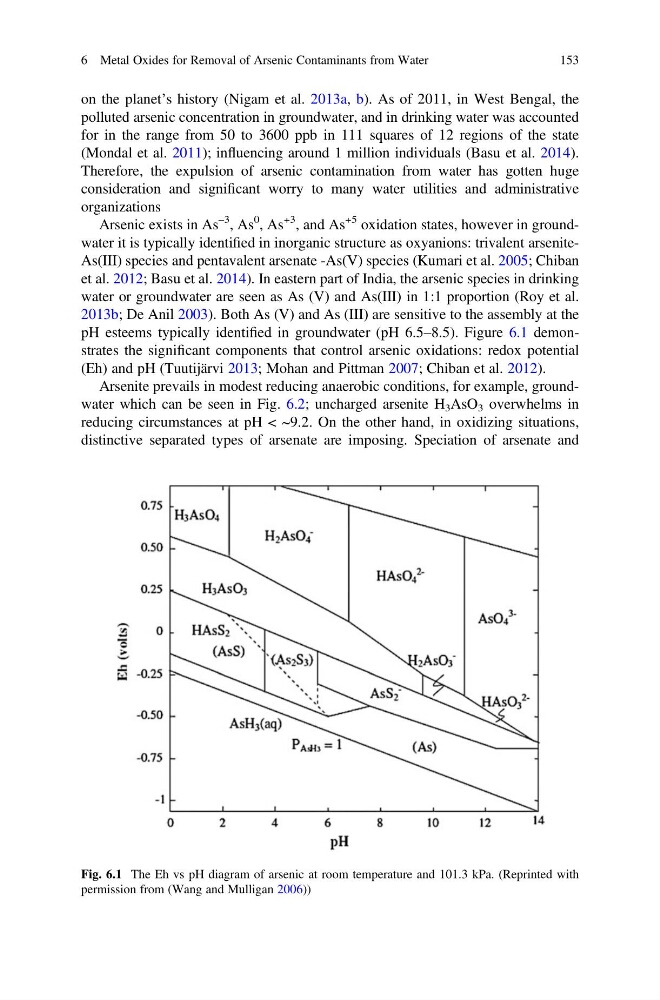
pH esteems typically identified in groundwater (pH 6.5–8.5). Figure 6.1 demonstrates the significant components that control arsenic oxidations: redox potential
(Eh) and pH (Tuutijärvi 2013; Mohan and Pittman 2007; Chiban et al. 2012).
Arsenite prevails in modest reducing anaerobic conditions, for example, groundwater which can be seen in Fig. 6.2; uncharged arsenite H 3 AsO 3 overwhelms in
reducing circumstances at pH < ~9.2. On the other hand, in oxidizing situations,
distinctive separated types of arsenate are imposing. Speciation of arsenate and
Fig. 6.1 The Eh vs pH diagram of arsenic at room temperature and 101.3 kPa. (Reprinted with
permission from (Wang and Mulligan 2006))
6 Metal Oxides for Removal of Arsenic Contaminants from Water
153
polluted arsenic concentration in groundwater, and in drinking water was accounted
for in the range from 50 to 3600 ppb in 111 squares of 12 regions of the state
(Mondal et al. 2011); influencing around 1 million individuals (Basu et al. 2014).
Therefore, the expulsion of arsenic contamination from water has gotten huge
consideration and significant worry to many water utilities and administrative
organizations
Arsenic exists in As
–3 , As
0 , As
+3 , and As
+5 oxidation states, however in groundwater it is typically identified in inorganic structure as oxyanions: trivalent arseniteAs(III) species and pentavalent arsenate -As(V) species (Kumari et al. 2005; Chiban
et al. 2012; Basu et al. 2014). In eastern part of India, the arsenic species in drinking
water or groundwater are seen as As (V) and As(III) in 1:1 proportion (Roy et al.
2013b; De Anil 2003). Both As (V) and As (III) are sensitive to the assembly at the
pH esteems typically identified in groundwater (pH 6.5–8.5). Figure 6.1 demonstrates the significant components that control arsenic oxidations: redox potential
(Eh) and pH (Tuutijärvi 2013; Mohan and Pittman 2007; Chiban et al. 2012).
Arsenite prevails in modest reducing anaerobic conditions, for example, groundwater which can be seen in Fig. 6.2; uncharged arsenite H 3 AsO 3 overwhelms in
reducing circumstances at pH < ~9.2. On the other hand, in oxidizing situations,
distinctive separated types of arsenate are imposing. Speciation of arsenate and
Fig. 6.1 The Eh vs pH diagram of arsenic at room temperature and 101.3 kPa. (Reprinted with
permission from (Wang and Mulligan 2006))
6 Metal Oxides for Removal of Arsenic Contaminants from Water
153