

Different human exercises can bring about huge deviations in the states of
groundwater assets arrangement which causes exhaustion and contamination.
Groundwater contamination, as a rule, is an immediate aftereffect of ecological
contamination. Groundwater is contaminated basically by nitrogen mixes (nitrate,
alkali, and ammonium), oil-based commodities, phenols, iron mixes, and substantial
metals (zinc, copper cadmium, mercury, lead, etc.) (Vrba and van der Gun 2004).
Groundwater is firmly interconnected with different parts of the earth. In the least
progressions in ecological rainfall can cause variations in the earth’s water body or
groundwater system, assets, and quality. Siphoning could concentrate the chemical
compounds in groundwater which may not suitable for drinking in profound springs
and could attract saline seawater in beach front zones. These conditions ought to be
viewed when pumping groundwater in use. If the groundwater is contaminated,
cleaning up the polluted water can be a generally long haul (several years), in fact
challenging and overpriced (Urba 1985).
Groundwater frameworks are recharged by rainfall and surface water. Generally,
groundwater flow is not exactly distinctive, thus far what is stored underneath the
ground’s surface is the biggest savings of waterbody. Its complete volume denotes to
96% of total world’s freshwater (Shiklomanov and Rodde 2011). Around 60% of the
under groundwater is collected and utilized for cultivation in numerous nations
wherever dry and semi-dry environments prevails; balance 40% of the groundwater
is similarly separated between the industrial and household segments (Shiklomanov
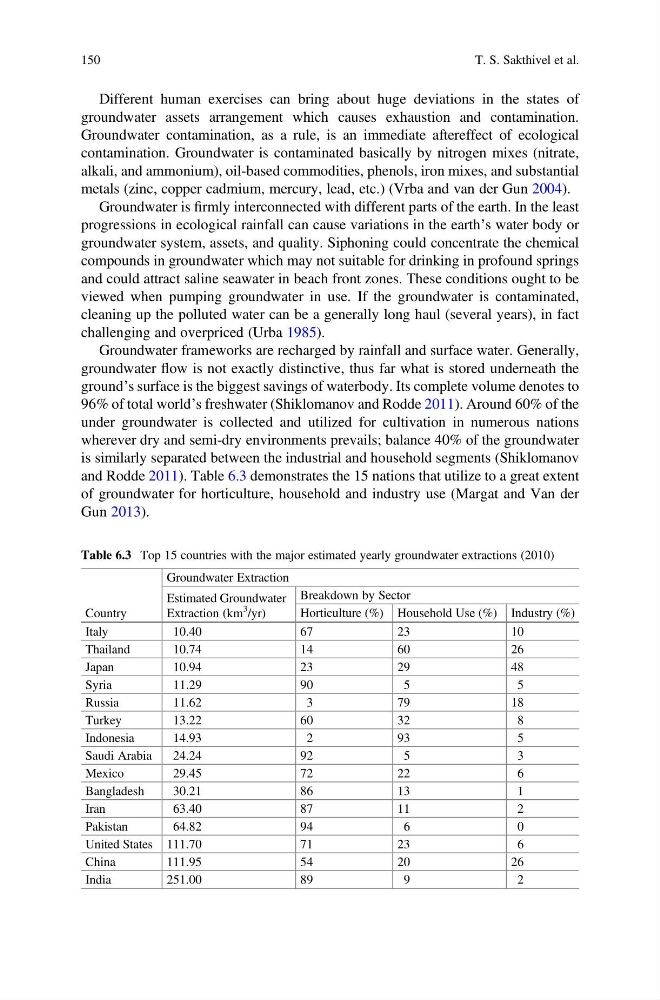
and Rodde 2011). Table 6.3 demonstrates the 15 nations that utilize to a great extent
of groundwater for horticulture, household and industry use (Margat and Van der
Gun 2013).
Table 6.3 Top 15 countries with the major estimated yearly groundwater extractions (2010)
Country
Groundwater Extraction
Estimated Groundwater
Extraction (km
3
/yr)
Breakdown by Sector
Horticulture (%) Household Use (%) Industry (%)
Italy
10.40
67
23
10
Thailand
10.74
14
60
26
Japan
10.94
23
29
48
Syria
11.29
90
5
5
Russia
11.62
3
79
18
Turkey
13.22
60
32
8
Indonesia
14.93
2
93
5
Saudi Arabia
24.24
92
5
3
Mexico
29.45
72
22
6
Bangladesh
30.21
86
13
1
Iran
63.40
87
11
2
Pakistan
64.82
94
6
0
United States 111.70
71
23
6
China
111.95
54
20
26
India
251.00
89
9
2
150
T. S. Sakthivel et al.
groundwater assets arrangement which causes exhaustion and contamination.
Groundwater contamination, as a rule, is an immediate aftereffect of ecological
contamination. Groundwater is contaminated basically by nitrogen mixes (nitrate,
alkali, and ammonium), oil-based commodities, phenols, iron mixes, and substantial
metals (zinc, copper cadmium, mercury, lead, etc.) (Vrba and van der Gun 2004).
Groundwater is firmly interconnected with different parts of the earth. In the least
progressions in ecological rainfall can cause variations in the earth’s water body or
groundwater system, assets, and quality. Siphoning could concentrate the chemical
compounds in groundwater which may not suitable for drinking in profound springs
and could attract saline seawater in beach front zones. These conditions ought to be
viewed when pumping groundwater in use. If the groundwater is contaminated,
cleaning up the polluted water can be a generally long haul (several years), in fact
challenging and overpriced (Urba 1985).
Groundwater frameworks are recharged by rainfall and surface water. Generally,
groundwater flow is not exactly distinctive, thus far what is stored underneath the
ground’s surface is the biggest savings of waterbody. Its complete volume denotes to
96% of total world’s freshwater (Shiklomanov and Rodde 2011). Around 60% of the
under groundwater is collected and utilized for cultivation in numerous nations
wherever dry and semi-dry environments prevails; balance 40% of the groundwater
is similarly separated between the industrial and household segments (Shiklomanov
and Rodde 2011). Table 6.3 demonstrates the 15 nations that utilize to a great extent
of groundwater for horticulture, household and industry use (Margat and Van der
Gun 2013).
Table 6.3 Top 15 countries with the major estimated yearly groundwater extractions (2010)
Country
Groundwater Extraction
Estimated Groundwater
Extraction (km
3
/yr)
Breakdown by Sector
Horticulture (%) Household Use (%) Industry (%)
Italy
10.40
67
23
10
Thailand
10.74
14
60
26
Japan
10.94
23
29
48
Syria
11.29
90
5
5
Russia
11.62
3
79
18
Turkey
13.22
60
32
8
Indonesia
14.93
2
93
5
Saudi Arabia
24.24
92
5
3
Mexico
29.45
72
22
6
Bangladesh
30.21
86
13
1
Iran
63.40
87
11
2
Pakistan
64.82
94
6
0
United States 111.70
71
23
6
China
111.95
54
20
26
India
251.00
89
9
2
150
T. S. Sakthivel et al.