

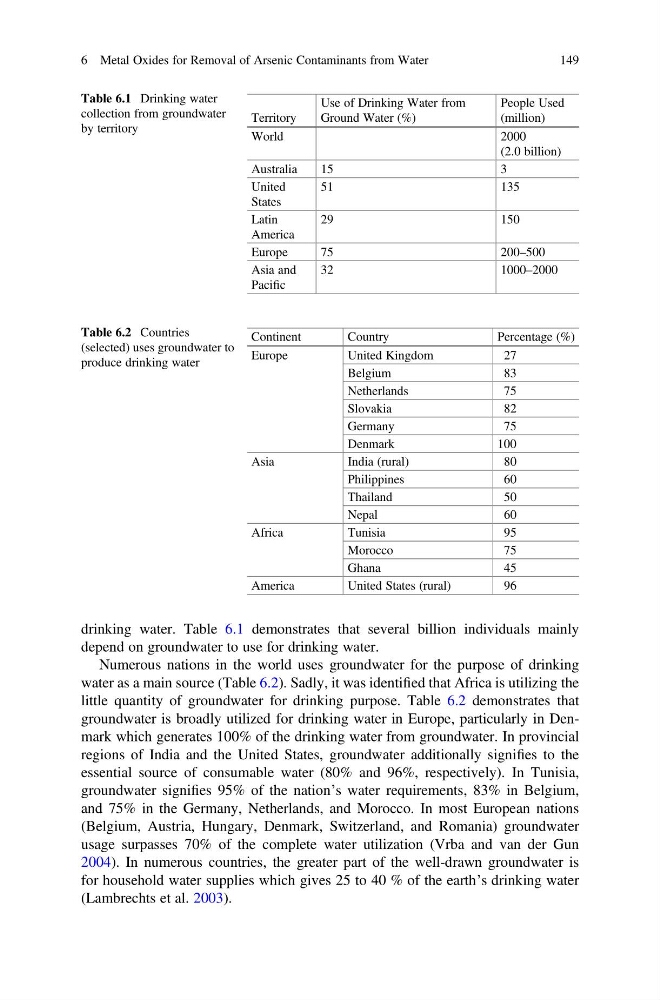
drinking water. Table 6.1 demonstrates that several billion individuals mainly
depend on groundwater to use for drinking water.
Numerous nations in the world uses groundwater for the purpose of drinking
water as a main source (Table 6.2). Sadly, it was identified that Africa is utilizing the
little quantity of groundwater for drinking purpose. Table 6.2 demonstrates that
groundwater is broadly utilized for drinking water in Europe, particularly in Denmark which generates 100% of the drinking water from groundwater. In provincial
regions of India and the United States, groundwater additionally signifies to the
essential source of consumable water (80% and 96%, respectively). In Tunisia,
groundwater signifies 95% of the nation’s water requirements, 83% in Belgium,
and 75% in the Germany, Netherlands, and Morocco. In most European nations
(Belgium, Austria, Hungary, Denmark, Switzerland, and Romania) groundwater
usage surpasses 70% of the complete water utilization (Vrba and van der Gun
2004). In numerous countries, the greater part of the well-drawn groundwater is
for household water supplies which gives 25 to 40 % of the earth’s drinking water
(Lambrechts et al. 2003).
Table 6.1 Drinking water
collection from groundwater
by territory
Territory
Use of Drinking Water from
Ground Water (%)
People Used
(million)
World
2000
(2.0 billion)
Australia
15
3
United
States
51
135
Latin
America
29
150
Europe
75
200–500
Asia and
Pacific
32
1000–2000
Table 6.2 Countries
(selected) uses groundwater to
produce drinking water
Continent
Country
Percentage (%)
Europe
United Kingdom
27
Belgium
83
Netherlands
75
Slovakia
82
Germany
75
Denmark
100
Asia
India (rural)
80
Philippines
60
Thailand
50
Nepal
60
Africa
Tunisia
95
Morocco
75
Ghana
45
America
United States (rural)
96
6 Metal Oxides for Removal of Arsenic Contaminants from Water
149
depend on groundwater to use for drinking water.
Numerous nations in the world uses groundwater for the purpose of drinking
water as a main source (Table 6.2). Sadly, it was identified that Africa is utilizing the
little quantity of groundwater for drinking purpose. Table 6.2 demonstrates that
groundwater is broadly utilized for drinking water in Europe, particularly in Denmark which generates 100% of the drinking water from groundwater. In provincial
regions of India and the United States, groundwater additionally signifies to the
essential source of consumable water (80% and 96%, respectively). In Tunisia,
groundwater signifies 95% of the nation’s water requirements, 83% in Belgium,
and 75% in the Germany, Netherlands, and Morocco. In most European nations
(Belgium, Austria, Hungary, Denmark, Switzerland, and Romania) groundwater
usage surpasses 70% of the complete water utilization (Vrba and van der Gun
2004). In numerous countries, the greater part of the well-drawn groundwater is
for household water supplies which gives 25 to 40 % of the earth’s drinking water
(Lambrechts et al. 2003).
Table 6.1 Drinking water
collection from groundwater
by territory
Territory
Use of Drinking Water from
Ground Water (%)
People Used
(million)
World
2000
(2.0 billion)
Australia
15
3
United
States
51
135
Latin
America
29
150
Europe
75
200–500
Asia and
Pacific
32
1000–2000
Table 6.2 Countries
(selected) uses groundwater to
produce drinking water
Continent
Country
Percentage (%)
Europe
United Kingdom
27
Belgium
83
Netherlands
75
Slovakia
82
Germany
75
Denmark
100
Asia
India (rural)
80
Philippines
60
Thailand
50
Nepal
60
Africa
Tunisia
95
Morocco
75
Ghana
45
America
United States (rural)
96
6 Metal Oxides for Removal of Arsenic Contaminants from Water
149