

5.4 Oxidative Processes for the Degradation of Priority
Organic Pollutants
Most techniques for the remediation of contaminated water only retain the contaminant by physical or physico-chemical systems. However, these methods do not
degrade pollutants and the problem does not end there, because they must have the
means of retention saturated with contaminants, in this sense, the trend in research is
aimed at changing the chemical nature of pollutants by degrading them even simpler
elements or compounds that do not represent a danger to the environment or health.
Processes such as oxidation are considered a highly competitive water treatment
technology for the elimination of those contaminants that can’t be treated with
conventional techniques due to their high chemical stability and/or low biodegradability. Oxidative processes can be classified generally into two types: chemical and
biological. Chemical oxidation has the characteristics that it can have a slow or
moderate rate of degradation, besides being able to be selective; it may even be quick
but not selective, which depends on the reactors and reactants used and translates
into high costs. On the other hand, aerobic biological oxidation is usually of low
cost, but operationally it has enough limitations since the fragility of the used strains
is usually high, and the degradation is limited when the food is resistant to biodegradation, inhibitory or toxic for the bioculture (Scott and Ollis 1995).
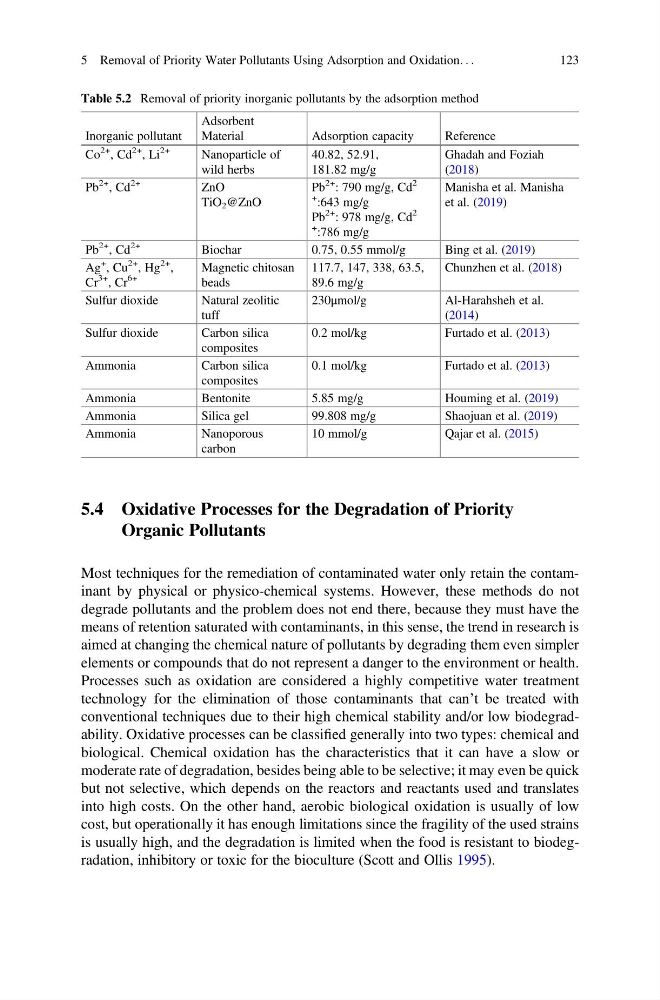
Table 5.2 Removal of priority inorganic pollutants by the adsorption method
Inorganic pollutant
Adsorbent
Material
Adsorption capacity
Reference
Co
2+ , Cd
2+ , Li
2+
Nanoparticle of
wild herbs
40.82, 52.91,
181.82 mg/g
Ghadah and Foziah
(2018)
Pb
2+ , Cd
2+
ZnO
TiO 2 @ZnO
Pb
2+ : 790 mg/g, Cd
2
+ :643 mg/g
Pb
2+ : 978 mg/g, Cd
2
+ :786 mg/g
Manisha et al. Manisha
et al. (2019)
Pb
2+ , Cd
2+
Biochar
0.75, 0.55 mmol/g
Bing et al. (2019)
Ag
+ , Cu
2+ , Hg
2+ ,
Cr
3+ , Cr
6+
Magnetic chitosan
beads
117.7, 147, 338, 63.5,
89.6 mg/g
Chunzhen et al. (2018)
Sulfur dioxide
Natural zeolitic
tuff
230μmol/g
Al-Harahsheh et al.
(2014)
Sulfur dioxide
Carbon silica
composites
0.2 mol/kg
Furtado et al. (2013)
Ammonia
Carbon silica
composites
0.1 mol/kg
Furtado et al. (2013)
Ammonia
Bentonite
5.85 mg/g
Houming et al. (2019)
Ammonia
Silica gel
99.808 mg/g
Shaojuan et al. (2019)
Ammonia
Nanoporous
carbon
10 mmol/g
Qajar et al. (2015)
5 Removal of Priority Water Pollutants Using Adsorption and Oxidation. . .
123
Organic Pollutants
Most techniques for the remediation of contaminated water only retain the contaminant by physical or physico-chemical systems. However, these methods do not
degrade pollutants and the problem does not end there, because they must have the
means of retention saturated with contaminants, in this sense, the trend in research is
aimed at changing the chemical nature of pollutants by degrading them even simpler
elements or compounds that do not represent a danger to the environment or health.
Processes such as oxidation are considered a highly competitive water treatment
technology for the elimination of those contaminants that can’t be treated with
conventional techniques due to their high chemical stability and/or low biodegradability. Oxidative processes can be classified generally into two types: chemical and
biological. Chemical oxidation has the characteristics that it can have a slow or
moderate rate of degradation, besides being able to be selective; it may even be quick
but not selective, which depends on the reactors and reactants used and translates
into high costs. On the other hand, aerobic biological oxidation is usually of low
cost, but operationally it has enough limitations since the fragility of the used strains
is usually high, and the degradation is limited when the food is resistant to biodegradation, inhibitory or toxic for the bioculture (Scott and Ollis 1995).
Table 5.2 Removal of priority inorganic pollutants by the adsorption method
Inorganic pollutant
Adsorbent
Material
Adsorption capacity
Reference
Co
2+ , Cd
2+ , Li
2+
Nanoparticle of
wild herbs
40.82, 52.91,
181.82 mg/g
Ghadah and Foziah
(2018)
Pb
2+ , Cd
2+
ZnO
TiO 2 @ZnO
Pb
2+ : 790 mg/g, Cd
2
+ :643 mg/g
Pb
2+ : 978 mg/g, Cd
2
+ :786 mg/g
Manisha et al. Manisha
et al. (2019)
Pb
2+ , Cd
2+
Biochar
0.75, 0.55 mmol/g
Bing et al. (2019)
Ag
+ , Cu
2+ , Hg
2+ ,
Cr
3+ , Cr
6+
Magnetic chitosan
beads
117.7, 147, 338, 63.5,
89.6 mg/g
Chunzhen et al. (2018)
Sulfur dioxide
Natural zeolitic
tuff
230μmol/g
Al-Harahsheh et al.
(2014)
Sulfur dioxide
Carbon silica
composites
0.2 mol/kg
Furtado et al. (2013)
Ammonia
Carbon silica
composites
0.1 mol/kg
Furtado et al. (2013)
Ammonia
Bentonite
5.85 mg/g
Houming et al. (2019)
Ammonia
Silica gel
99.808 mg/g
Shaojuan et al. (2019)
Ammonia
Nanoporous
carbon
10 mmol/g
Qajar et al. (2015)
5 Removal of Priority Water Pollutants Using Adsorption and Oxidation. . .
123