

2011). The most commonly used materials for the removal of organic pollutants are
granular activated carbon and carbon fibers (Da browski et al. 2005), synthetic resins
(Abburi 2003), natural zeolites (Canli et al. 2013; Damjanović et al. 2010), among
other.
In adsorption in a liquid phase, the adsorption capacity of materials for organic
compounds depends on several factors (Haghseresht et al. 2002): (1) physical nature
of the adsorbent: pore structure, ash content, functional groups, (2) chemical nature
of the adsorbate: its pKa, functional groups present, polarity, molecular weight and
size, and (3) conditions of the solution: the pH, the ionic strength and the concentration of adsorbate.
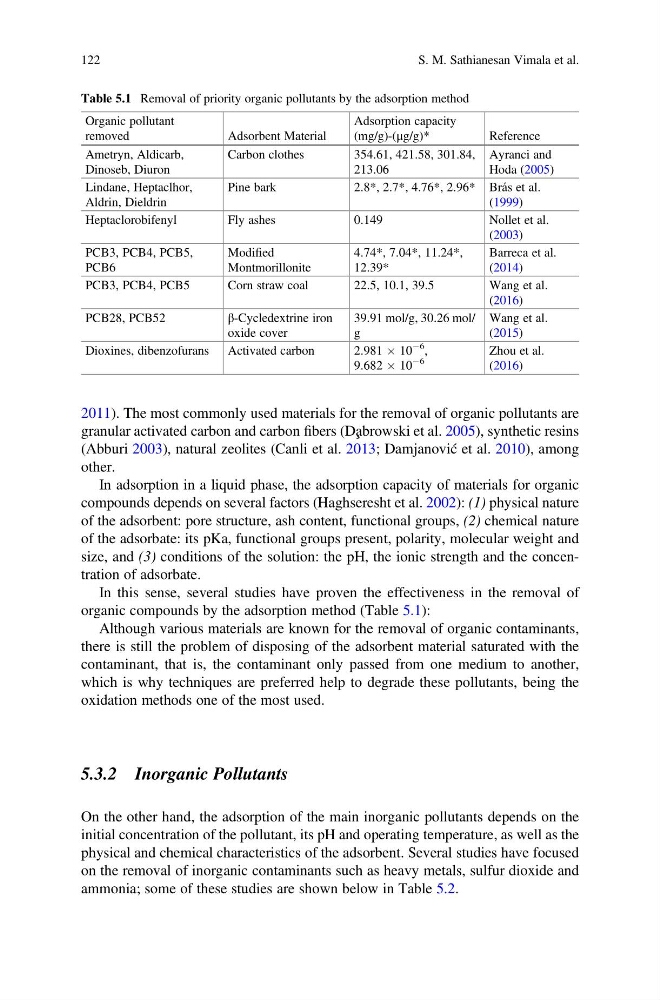
In this sense, several studies have proven the effectiveness in the removal of
organic compounds by the adsorption method (Table 5.1):
Although various materials are known for the removal of organic contaminants,
there is still the problem of disposing of the adsorbent material saturated with the
contaminant, that is, the contaminant only passed from one medium to another,
which is why techniques are preferred help to degrade these pollutants, being the
oxidation methods one of the most used.
5.3.2 Inorganic Pollutants
On the other hand, the adsorption of the main inorganic pollutants depends on the
initial concentration of the pollutant, its pH and operating temperature, as well as the
physical and chemical characteristics of the adsorbent. Several studies have focused
on the removal of inorganic contaminants such as heavy metals, sulfur dioxide and
ammonia; some of these studies are shown below in Table 5.2.
Table 5.1 Removal of priority organic pollutants by the adsorption method
Organic pollutant
removed
Adsorbent Material
Adsorption capacity
(mg/g)-(μg/g)*
Reference
Ametryn, Aldicarb,
Dinoseb, Diuron
Carbon clothes
354.61, 421.58, 301.84,
213.06
Ayranci and
Hoda (2005)
Lindane, Heptaclhor,
Aldrin, Dieldrin
Pine bark
2.8*, 2.7*, 4.76*, 2.96* Brás et al.
(1999)
Heptaclorobifenyl
Fly ashes
0.149
Nollet et al.
(2003)
PCB3, PCB4, PCB5,
PCB6
Modified
Montmorillonite
4.74*, 7.04*, 11.24*,
12.39*
Barreca et al.
(2014)
PCB3, PCB4, PCB5
Corn straw coal
22.5, 10.1, 39.5
Wang et al.
(2016)
PCB28, PCB52
β-Cycledextrine iron
oxide cover
39.91 mol/g, 30.26 mol/
g
Wang et al.
(2015)
Dioxines, dibenzofurans Activated carbon
2.981 Â 10
À6
,
9.682 Â 10
À6
Zhou et al.
(2016)
122
S. M. Sathianesan Vimala et al.
granular activated carbon and carbon fibers (Da browski et al. 2005), synthetic resins
(Abburi 2003), natural zeolites (Canli et al. 2013; Damjanović et al. 2010), among
other.
In adsorption in a liquid phase, the adsorption capacity of materials for organic
compounds depends on several factors (Haghseresht et al. 2002): (1) physical nature
of the adsorbent: pore structure, ash content, functional groups, (2) chemical nature
of the adsorbate: its pKa, functional groups present, polarity, molecular weight and
size, and (3) conditions of the solution: the pH, the ionic strength and the concentration of adsorbate.
In this sense, several studies have proven the effectiveness in the removal of
organic compounds by the adsorption method (Table 5.1):
Although various materials are known for the removal of organic contaminants,
there is still the problem of disposing of the adsorbent material saturated with the
contaminant, that is, the contaminant only passed from one medium to another,
which is why techniques are preferred help to degrade these pollutants, being the
oxidation methods one of the most used.
5.3.2 Inorganic Pollutants
On the other hand, the adsorption of the main inorganic pollutants depends on the
initial concentration of the pollutant, its pH and operating temperature, as well as the
physical and chemical characteristics of the adsorbent. Several studies have focused
on the removal of inorganic contaminants such as heavy metals, sulfur dioxide and
ammonia; some of these studies are shown below in Table 5.2.
Table 5.1 Removal of priority organic pollutants by the adsorption method
Organic pollutant
removed
Adsorbent Material
Adsorption capacity
(mg/g)-(μg/g)*
Reference
Ametryn, Aldicarb,
Dinoseb, Diuron
Carbon clothes
354.61, 421.58, 301.84,
213.06
Ayranci and
Hoda (2005)
Lindane, Heptaclhor,
Aldrin, Dieldrin
Pine bark
2.8*, 2.7*, 4.76*, 2.96* Brás et al.
(1999)
Heptaclorobifenyl
Fly ashes
0.149
Nollet et al.
(2003)
PCB3, PCB4, PCB5,
PCB6
Modified
Montmorillonite
4.74*, 7.04*, 11.24*,
12.39*
Barreca et al.
(2014)
PCB3, PCB4, PCB5
Corn straw coal
22.5, 10.1, 39.5
Wang et al.
(2016)
PCB28, PCB52
β-Cycledextrine iron
oxide cover
39.91 mol/g, 30.26 mol/
g
Wang et al.
(2015)
Dioxines, dibenzofurans Activated carbon
2.981 Â 10
À6
,
9.682 Â 10
À6
Zhou et al.
(2016)
122
S. M. Sathianesan Vimala et al.