

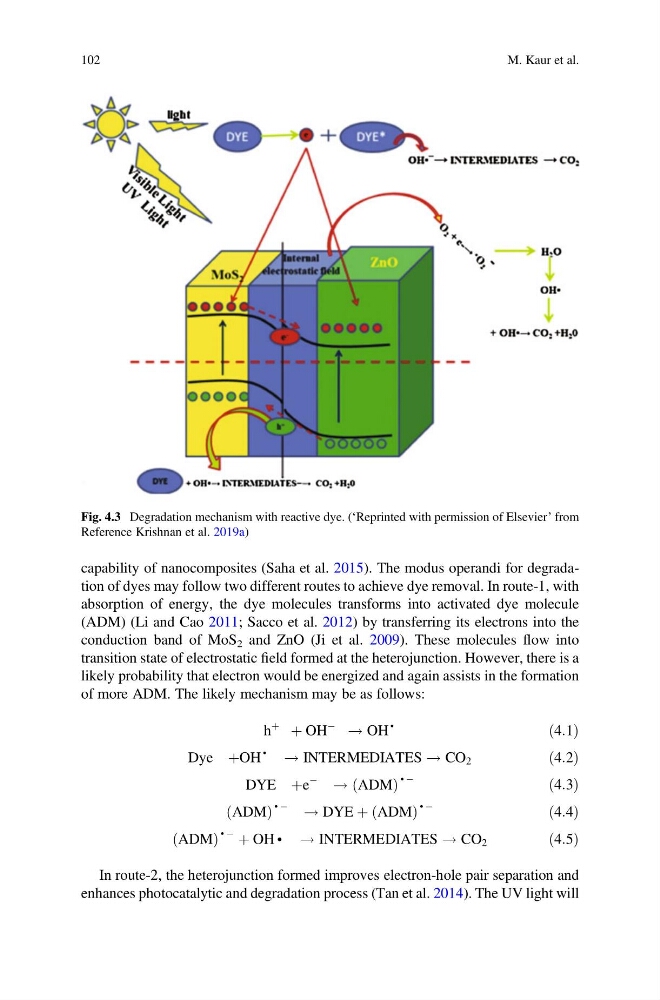
capability of nanocomposites (Saha et al. 2015). The modus operandi for degradation of dyes may follow two different routes to achieve dye removal. In route-1, with
absorption of energy, the dye molecules transforms into activated dye molecule
(ADM) (Li and Cao 2011; Sacco et al. 2012) by transferring its electrons into the
conduction band of MoS 2 and ZnO (Ji et al. 2009). These molecules flow into
transition state of electrostatic field formed at the heterojunction. However, there is a
likely probability that electron would be energized and again assists in the formation
of more ADM. The likely mechanism may be as follows:
h
þ
þ OH
À
! OH
•
ð4:1Þ
Dye þOH
•
! INTERMEDIATES ! CO 2
ð4:2Þ
DYE þe
À
! ADM
ð
Þ
• À
ð4:3Þ
ADM
ð
Þ
• À
! DYE þ ADM
ð
Þ
• À
ð4:4Þ
ADM
ð
Þ
• À þ OH • ! INTERMEDIATES ! CO 2
ð4:5Þ
In route-2, the heterojunction formed improves electron-hole pair separation and
enhances photocatalytic and degradation process (Tan et al. 2014). The UV light will
Fig. 4.3 Degradation mechanism with reactive dye. (‘Reprinted with permission of Elsevier’ from
Reference Krishnan et al. 2019a)
102
M. Kaur et al.
absorption of energy, the dye molecules transforms into activated dye molecule
(ADM) (Li and Cao 2011; Sacco et al. 2012) by transferring its electrons into the
conduction band of MoS 2 and ZnO (Ji et al. 2009). These molecules flow into
transition state of electrostatic field formed at the heterojunction. However, there is a
likely probability that electron would be energized and again assists in the formation
of more ADM. The likely mechanism may be as follows:
h
þ
þ OH
À
! OH
•
ð4:1Þ
Dye þOH
•
! INTERMEDIATES ! CO 2
ð4:2Þ
DYE þe
À
! ADM
ð
Þ
• À
ð4:3Þ
ADM
ð
Þ
• À
! DYE þ ADM
ð
Þ
• À
ð4:4Þ
ADM
ð
Þ
• À þ OH • ! INTERMEDIATES ! CO 2
ð4:5Þ
In route-2, the heterojunction formed improves electron-hole pair separation and
enhances photocatalytic and degradation process (Tan et al. 2014). The UV light will
Fig. 4.3 Degradation mechanism with reactive dye. (‘Reprinted with permission of Elsevier’ from
Reference Krishnan et al. 2019a)
102
M. Kaur et al.