

biofuels are believed to have the potential to reduce CO 2 emission up to 80% over
fossil fuels. In case of aviation industry, camelina feedstock has shown this reduction
up to 84% (Lee and Mo 2011). Moreover, these requirements are also met by “dropin” biofuels, which are synonyms of hydrocarbon biofuels. Presently, researchers
involve in the production of bio-jet fuel and focus on various strategies like
hydroprocessing of oil seeds, pyrolysis, gasification/Fischer–Tropsch, or progressed
biomass fermentation. Drop-in bio-jet fuels share a similarity with ethanol, as both
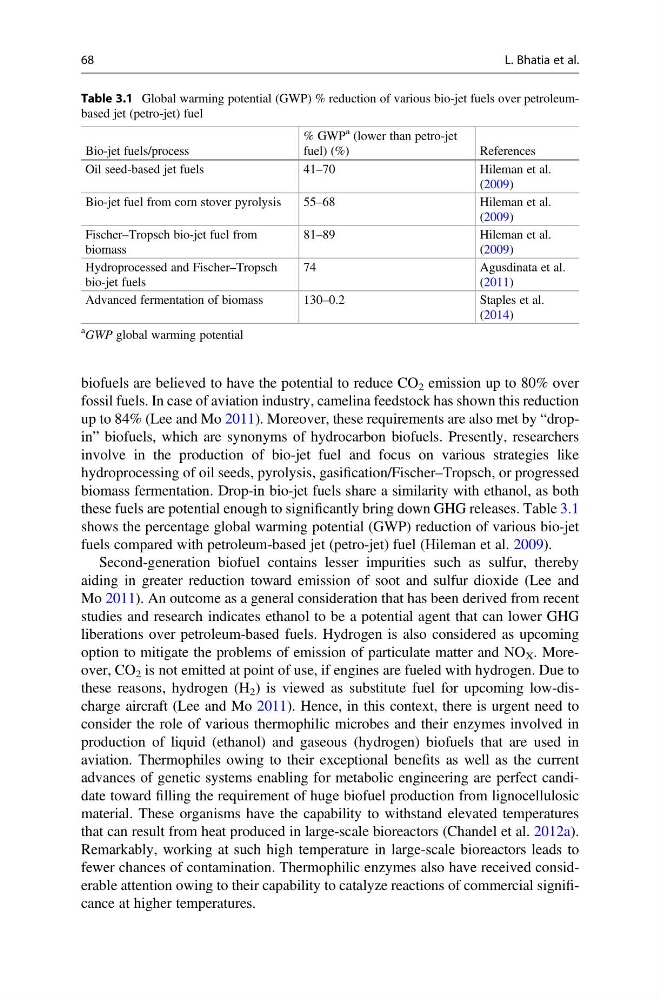
these fuels are potential enough to significantly bring down GHG releases. Table 3.1
shows the percentage global warming potential (GWP) reduction of various bio-jet
fuels compared with petroleum-based jet (petro-jet) fuel (Hileman et al. 2009).
Second-generation biofuel contains lesser impurities such as sulfur, thereby
aiding in greater reduction toward emission of soot and sulfur dioxide (Lee and
Mo 2011). An outcome as a general consideration that has been derived from recent
studies and research indicates ethanol to be a potential agent that can lower GHG
liberations over petroleum-based fuels. Hydrogen is also considered as upcoming
option to mitigate the problems of emission of particulate matter and NO X . Moreover, CO 2 is not emitted at point of use, if engines are fueled with hydrogen. Due to
these reasons, hydrogen (H 2 ) is viewed as substitute fuel for upcoming low-discharge aircraft (Lee and Mo 2011). Hence, in this context, there is urgent need to
consider the role of various thermophilic microbes and their enzymes involved in
production of liquid (ethanol) and gaseous (hydrogen) biofuels that are used in
aviation. Thermophiles owing to their exceptional benefits as well as the current
advances of genetic systems enabling for metabolic engineering are perfect candidate toward filling the requirement of huge biofuel production from lignocellulosic
material. These organisms have the capability to withstand elevated temperatures
that can result from heat produced in large-scale bioreactors (Chandel et al. 2012a).
Remarkably, working at such high temperature in large-scale bioreactors leads to
fewer chances of contamination. Thermophilic enzymes also have received considerable attention owing to their capability to catalyze reactions of commercial significance at higher temperatures.
Table 3.1 Global warming potential (GWP) % reduction of various bio-jet fuels over petroleumbased jet (petro-jet) fuel
Bio-jet fuels/process
% GWP
a (lower than petro-jet
fuel) (%)
References
Oil seed-based jet fuels
41–70
Hileman et al.
(2009)
Bio-jet fuel from corn stover pyrolysis
55–68
Hileman et al.
(2009)
Fischer–Tropsch bio-jet fuel from
biomass
81–89
Hileman et al.
(2009)
Hydroprocessed and Fischer–Tropsch
bio-jet fuels
74
Agusdinata et al.
(2011)
Advanced fermentation of biomass
130–0.2
Staples et al.
(2014)
a GWP global warming potential
68
L. Bhatia et al.
fossil fuels. In case of aviation industry, camelina feedstock has shown this reduction
up to 84% (Lee and Mo 2011). Moreover, these requirements are also met by “dropin” biofuels, which are synonyms of hydrocarbon biofuels. Presently, researchers
involve in the production of bio-jet fuel and focus on various strategies like
hydroprocessing of oil seeds, pyrolysis, gasification/Fischer–Tropsch, or progressed
biomass fermentation. Drop-in bio-jet fuels share a similarity with ethanol, as both
these fuels are potential enough to significantly bring down GHG releases. Table 3.1
shows the percentage global warming potential (GWP) reduction of various bio-jet
fuels compared with petroleum-based jet (petro-jet) fuel (Hileman et al. 2009).
Second-generation biofuel contains lesser impurities such as sulfur, thereby
aiding in greater reduction toward emission of soot and sulfur dioxide (Lee and
Mo 2011). An outcome as a general consideration that has been derived from recent
studies and research indicates ethanol to be a potential agent that can lower GHG
liberations over petroleum-based fuels. Hydrogen is also considered as upcoming
option to mitigate the problems of emission of particulate matter and NO X . Moreover, CO 2 is not emitted at point of use, if engines are fueled with hydrogen. Due to
these reasons, hydrogen (H 2 ) is viewed as substitute fuel for upcoming low-discharge aircraft (Lee and Mo 2011). Hence, in this context, there is urgent need to
consider the role of various thermophilic microbes and their enzymes involved in
production of liquid (ethanol) and gaseous (hydrogen) biofuels that are used in
aviation. Thermophiles owing to their exceptional benefits as well as the current
advances of genetic systems enabling for metabolic engineering are perfect candidate toward filling the requirement of huge biofuel production from lignocellulosic
material. These organisms have the capability to withstand elevated temperatures
that can result from heat produced in large-scale bioreactors (Chandel et al. 2012a).
Remarkably, working at such high temperature in large-scale bioreactors leads to
fewer chances of contamination. Thermophilic enzymes also have received considerable attention owing to their capability to catalyze reactions of commercial significance at higher temperatures.
Table 3.1 Global warming potential (GWP) % reduction of various bio-jet fuels over petroleumbased jet (petro-jet) fuel
Bio-jet fuels/process
% GWP
a (lower than petro-jet
fuel) (%)
References
Oil seed-based jet fuels
41–70
Hileman et al.
(2009)
Bio-jet fuel from corn stover pyrolysis
55–68
Hileman et al.
(2009)
Fischer–Tropsch bio-jet fuel from
biomass
81–89
Hileman et al.
(2009)
Hydroprocessed and Fischer–Tropsch
bio-jet fuels
74
Agusdinata et al.
(2011)
Advanced fermentation of biomass
130–0.2
Staples et al.
(2014)
a GWP global warming potential
68
L. Bhatia et al.