

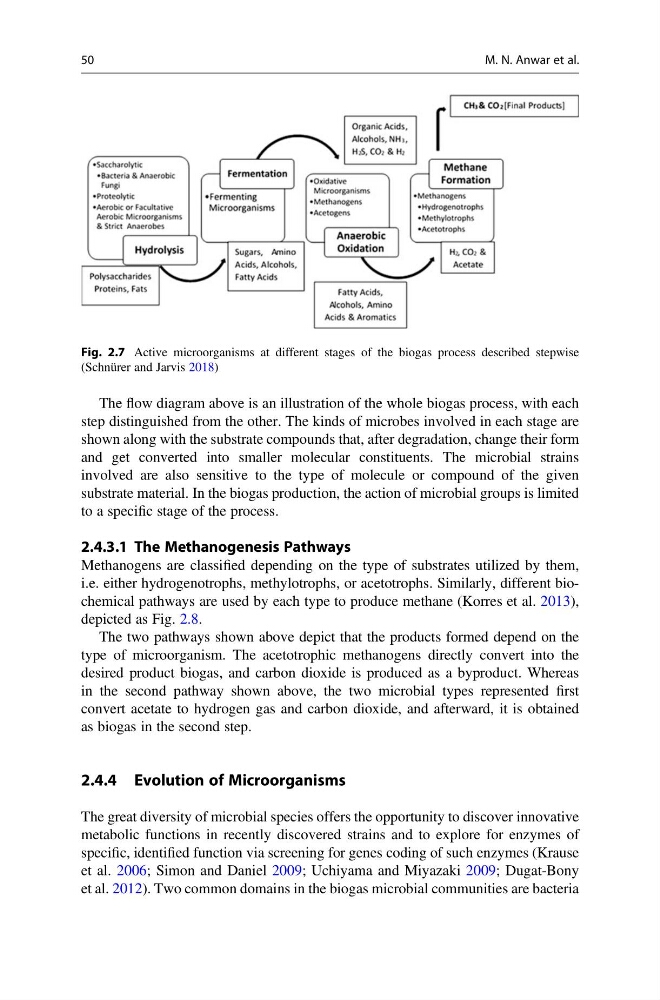
The flow diagram above is an illustration of the whole biogas process, with each
step distinguished from the other. The kinds of microbes involved in each stage are
shown along with the substrate compounds that, after degradation, change their form
and get converted into smaller molecular constituents. The microbial strains
involved are also sensitive to the type of molecule or compound of the given
substrate material. In the biogas production, the action of microbial groups is limited
to a specific stage of the process.
2.4.3.1 The Methanogenesis Pathways
Methanogens are classified depending on the type of substrates utilized by them,
i.e. either hydrogenotrophs, methylotrophs, or acetotrophs. Similarly, different biochemical pathways are used by each type to produce methane (Korres et al. 2013),
depicted as Fig. 2.8.
The two pathways shown above depict that the products formed depend on the
type of microorganism. The acetotrophic methanogens directly convert into the
desired product biogas, and carbon dioxide is produced as a byproduct. Whereas
in the second pathway shown above, the two microbial types represented first
convert acetate to hydrogen gas and carbon dioxide, and afterward, it is obtained
as biogas in the second step.
2.4.4 Evolution of Microorganisms
The great diversity of microbial species offers the opportunity to discover innovative
metabolic functions in recently discovered strains and to explore for enzymes of
specific, identified function via screening for genes coding of such enzymes (Krause
et al. 2006; Simon and Daniel 2009; Uchiyama and Miyazaki 2009; Dugat-Bony
et al. 2012). Two common domains in the biogas microbial communities are bacteria
Fig. 2.7 Active microorganisms at different stages of the biogas process described stepwise
(Schnürer and Jarvis 2018)
50
M. N. Anwar et al.
step distinguished from the other. The kinds of microbes involved in each stage are
shown along with the substrate compounds that, after degradation, change their form
and get converted into smaller molecular constituents. The microbial strains
involved are also sensitive to the type of molecule or compound of the given
substrate material. In the biogas production, the action of microbial groups is limited
to a specific stage of the process.
2.4.3.1 The Methanogenesis Pathways
Methanogens are classified depending on the type of substrates utilized by them,
i.e. either hydrogenotrophs, methylotrophs, or acetotrophs. Similarly, different biochemical pathways are used by each type to produce methane (Korres et al. 2013),
depicted as Fig. 2.8.
The two pathways shown above depict that the products formed depend on the
type of microorganism. The acetotrophic methanogens directly convert into the
desired product biogas, and carbon dioxide is produced as a byproduct. Whereas
in the second pathway shown above, the two microbial types represented first
convert acetate to hydrogen gas and carbon dioxide, and afterward, it is obtained
as biogas in the second step.
2.4.4 Evolution of Microorganisms
The great diversity of microbial species offers the opportunity to discover innovative
metabolic functions in recently discovered strains and to explore for enzymes of
specific, identified function via screening for genes coding of such enzymes (Krause
et al. 2006; Simon and Daniel 2009; Uchiyama and Miyazaki 2009; Dugat-Bony
et al. 2012). Two common domains in the biogas microbial communities are bacteria
Fig. 2.7 Active microorganisms at different stages of the biogas process described stepwise
(Schnürer and Jarvis 2018)
50
M. N. Anwar et al.