

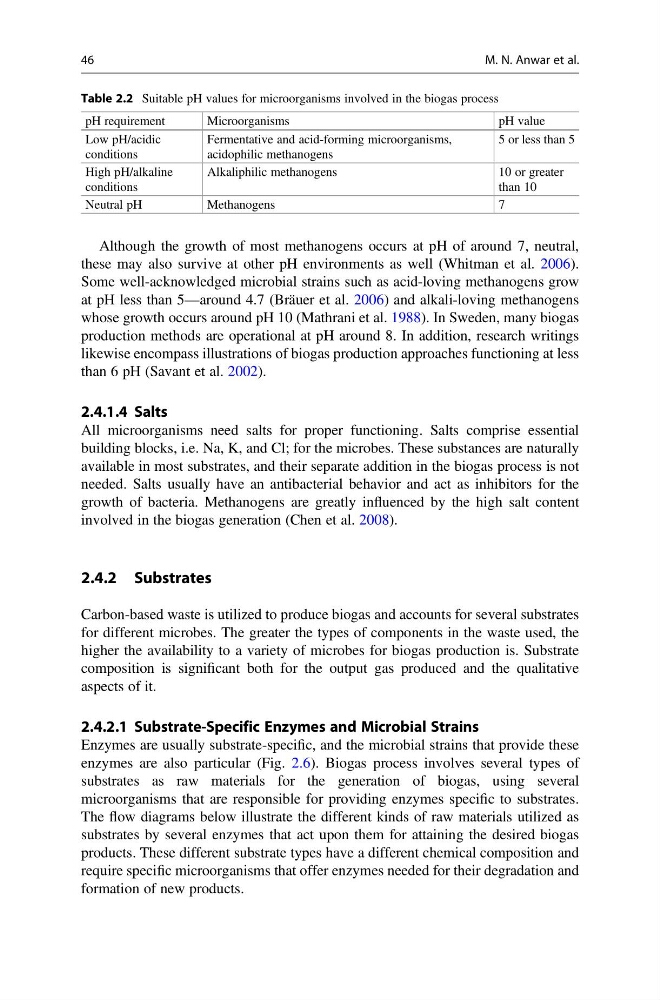
Although the growth of most methanogens occurs at pH of around 7, neutral,
these may also survive at other pH environments as well (Whitman et al. 2006).
Some well-acknowledged microbial strains such as acid-loving methanogens grow
at pH less than 5—around 4.7 (Bräuer et al. 2006) and alkali-loving methanogens
whose growth occurs around pH 10 (Mathrani et al. 1988). In Sweden, many biogas
production methods are operational at pH around 8. In addition, research writings
likewise encompass illustrations of biogas production approaches functioning at less
than 6 pH (Savant et al. 2002).
2.4.1.4 Salts
All microorganisms need salts for proper functioning. Salts comprise essential
building blocks, i.e. Na, K, and Cl; for the microbes. These substances are naturally
available in most substrates, and their separate addition in the biogas process is not
needed. Salts usually have an antibacterial behavior and act as inhibitors for the
growth of bacteria. Methanogens are greatly influenced by the high salt content
involved in the biogas generation (Chen et al. 2008).
2.4.2 Substrates
Carbon-based waste is utilized to produce biogas and accounts for several substrates
for different microbes. The greater the types of components in the waste used, the
higher the availability to a variety of microbes for biogas production is. Substrate
composition is significant both for the output gas produced and the qualitative
aspects of it.
2.4.2.1 Substrate-Specific Enzymes and Microbial Strains
Enzymes are usually substrate-specific, and the microbial strains that provide these
enzymes are also particular (Fig. 2.6). Biogas process involves several types of
substrates as raw materials for the generation of biogas, using several
microorganisms that are responsible for providing enzymes specific to substrates.
The flow diagrams below illustrate the different kinds of raw materials utilized as
substrates by several enzymes that act upon them for attaining the desired biogas
products. These different substrate types have a different chemical composition and
require specific microorganisms that offer enzymes needed for their degradation and
formation of new products.
Table 2.2 Suitable pH values for microorganisms involved in the biogas process
pH requirement
Microorganisms
pH value
Low pH/acidic
conditions
Fermentative and acid-forming microorganisms,
acidophilic methanogens
5 or less than 5
High pH/alkaline
conditions
Alkaliphilic methanogens
10 or greater
than 10
Neutral pH
Methanogens
7
46
M. N. Anwar et al.
these may also survive at other pH environments as well (Whitman et al. 2006).
Some well-acknowledged microbial strains such as acid-loving methanogens grow
at pH less than 5—around 4.7 (Bräuer et al. 2006) and alkali-loving methanogens
whose growth occurs around pH 10 (Mathrani et al. 1988). In Sweden, many biogas
production methods are operational at pH around 8. In addition, research writings
likewise encompass illustrations of biogas production approaches functioning at less
than 6 pH (Savant et al. 2002).
2.4.1.4 Salts
All microorganisms need salts for proper functioning. Salts comprise essential
building blocks, i.e. Na, K, and Cl; for the microbes. These substances are naturally
available in most substrates, and their separate addition in the biogas process is not
needed. Salts usually have an antibacterial behavior and act as inhibitors for the
growth of bacteria. Methanogens are greatly influenced by the high salt content
involved in the biogas generation (Chen et al. 2008).
2.4.2 Substrates
Carbon-based waste is utilized to produce biogas and accounts for several substrates
for different microbes. The greater the types of components in the waste used, the
higher the availability to a variety of microbes for biogas production is. Substrate
composition is significant both for the output gas produced and the qualitative
aspects of it.
2.4.2.1 Substrate-Specific Enzymes and Microbial Strains
Enzymes are usually substrate-specific, and the microbial strains that provide these
enzymes are also particular (Fig. 2.6). Biogas process involves several types of
substrates as raw materials for the generation of biogas, using several
microorganisms that are responsible for providing enzymes specific to substrates.
The flow diagrams below illustrate the different kinds of raw materials utilized as
substrates by several enzymes that act upon them for attaining the desired biogas
products. These different substrate types have a different chemical composition and
require specific microorganisms that offer enzymes needed for their degradation and
formation of new products.
Table 2.2 Suitable pH values for microorganisms involved in the biogas process
pH requirement
Microorganisms
pH value
Low pH/acidic
conditions
Fermentative and acid-forming microorganisms,
acidophilic methanogens
5 or less than 5
High pH/alkaline
conditions
Alkaliphilic methanogens
10 or greater
than 10
Neutral pH
Methanogens
7
46
M. N. Anwar et al.