

Varieties of microbes require varied suitable environmental factors central to their
optimum growth. It briefly describes some of these factors below:
2.4.1.1 Temperature
The maximum temperature variation depends on the adapted temperature range of
the microorganism. Biogas production involves diverse microorganisms, and they
have variable optimum temperatures, that is why their responses also vary to some
extent. The biogas process typically runs at a temperature range of about 30–40
C or
50–60
C. Biogas generation can also take place at psychrophilic temperatures but
might lead to a reduced CH 4 production rate depending on the type of process (Bohn
et al. 2007; McKeown et al. 2009; Dhaked et al. 2010). At elevated temperatures,
there are examples of methanogens that can survive at up to 110
C (Chaban et al.
2006), whereas stable biogas production mechanisms do not appear to function
above 60–70
C (Scherer et al. 2000). In case of a temperature higher than 60
C,
the activity of methanogens is greatly decreased compared to acid producers, which
usually leads to the fatty acids’ buildup in the biogas process (Scherer et al. 2000).
Thermophilic organisms endure high temperatures (up to 60
C approx.) although
their maximum growth occurs at the mesophilic temperatures.
2.4.1.2 Oxygen Concentration
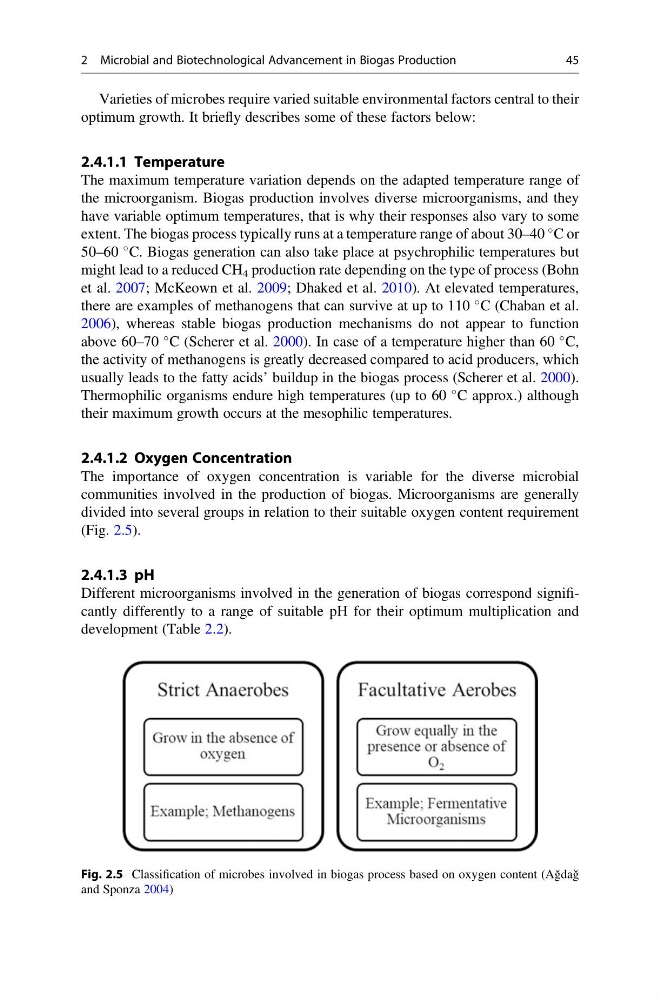
The importance of oxygen concentration is variable for the diverse microbial
communities involved in the production of biogas. Microorganisms are generally
divided into several groups in relation to their suitable oxygen content requirement
(Fig. 2.5).
2.4.1.3 pH
Different microorganisms involved in the generation of biogas correspond significantly differently to a range of suitable pH for their optimum multiplication and
development (Table 2.2).
Fig. 2.5 Classification of microbes involved in biogas process based on oxygen content (Ağdağ
and Sponza 2004)
2 Microbial and Biotechnological Advancement in Biogas Production
45
optimum growth. It briefly describes some of these factors below:
2.4.1.1 Temperature
The maximum temperature variation depends on the adapted temperature range of
the microorganism. Biogas production involves diverse microorganisms, and they
have variable optimum temperatures, that is why their responses also vary to some
extent. The biogas process typically runs at a temperature range of about 30–40
C or
50–60
C. Biogas generation can also take place at psychrophilic temperatures but
might lead to a reduced CH 4 production rate depending on the type of process (Bohn
et al. 2007; McKeown et al. 2009; Dhaked et al. 2010). At elevated temperatures,
there are examples of methanogens that can survive at up to 110
C (Chaban et al.
2006), whereas stable biogas production mechanisms do not appear to function
above 60–70
C (Scherer et al. 2000). In case of a temperature higher than 60
C,
the activity of methanogens is greatly decreased compared to acid producers, which
usually leads to the fatty acids’ buildup in the biogas process (Scherer et al. 2000).
Thermophilic organisms endure high temperatures (up to 60
C approx.) although
their maximum growth occurs at the mesophilic temperatures.
2.4.1.2 Oxygen Concentration
The importance of oxygen concentration is variable for the diverse microbial
communities involved in the production of biogas. Microorganisms are generally
divided into several groups in relation to their suitable oxygen content requirement
(Fig. 2.5).
2.4.1.3 pH
Different microorganisms involved in the generation of biogas correspond significantly differently to a range of suitable pH for their optimum multiplication and
development (Table 2.2).
Fig. 2.5 Classification of microbes involved in biogas process based on oxygen content (Ağdağ
and Sponza 2004)
2 Microbial and Biotechnological Advancement in Biogas Production
45