

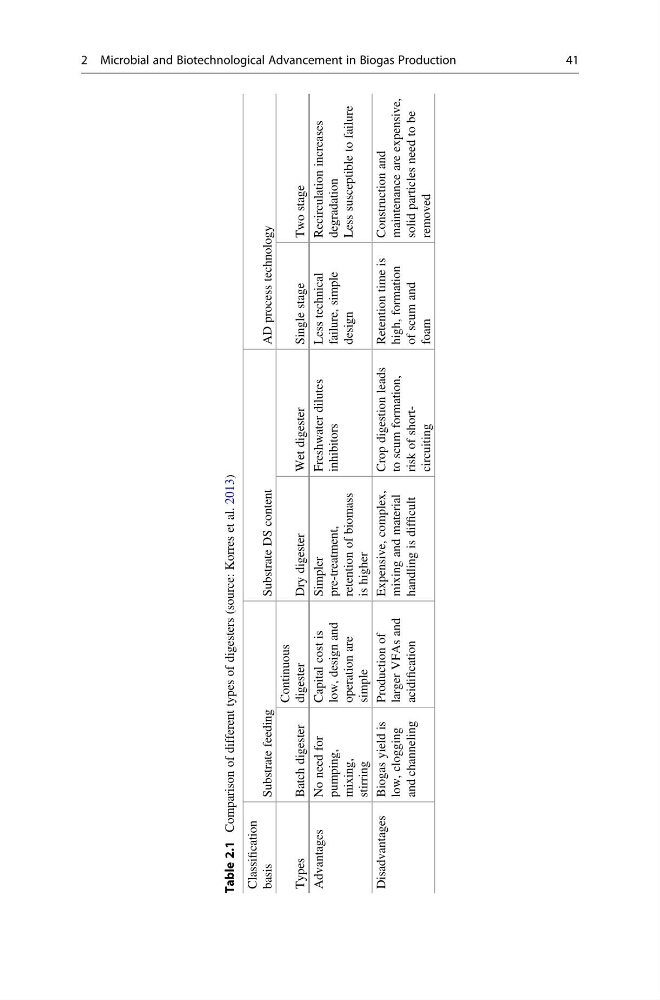
Table 2.1
Comparison of different types of digesters (source: Korres et al. 2013)
Classification
basis
Substrate feeding
Substrate DS content
AD process technology
Types
Batch digester
Continuous
digester
Dry digester
Wet digester
Single stage
Two stage
Advantages
No need for
pumping,
mixing,
stirring
Capital cost is
low, design and
operation are
simple
Simpler
pre-treatment,
retention of biomass
is higher
Freshwater dilutes
inhibitors
Less technical
failure, simple
design
Recirculation increases
degradation
Less susceptible to failure
Disadvantages Biogas yield is
low, clogging
and channeling
Production of
larger VFAs and
acidification
Expensive, complex,
mixing and material
handling is difficult
Crop digestion leads
to scum formation,
risk of shortcircuiting
Retention time is
high, formation
of scum and
foam
Construction and
maintenance are expensive,
solid particles need to be
removed
2 Microbial and Biotechnological Advancement in Biogas Production
41
Comparison of different types of digesters (source: Korres et al. 2013)
Classification
basis
Substrate feeding
Substrate DS content
AD process technology
Types
Batch digester
Continuous
digester
Dry digester
Wet digester
Single stage
Two stage
Advantages
No need for
pumping,
mixing,
stirring
Capital cost is
low, design and
operation are
simple
Simpler
pre-treatment,
retention of biomass
is higher
Freshwater dilutes
inhibitors
Less technical
failure, simple
design
Recirculation increases
degradation
Less susceptible to failure
Disadvantages Biogas yield is
low, clogging
and channeling
Production of
larger VFAs and
acidification
Expensive, complex,
mixing and material
handling is difficult
Crop digestion leads
to scum formation,
risk of shortcircuiting
Retention time is
high, formation
of scum and
foam
Construction and
maintenance are expensive,
solid particles need to be
removed
2 Microbial and Biotechnological Advancement in Biogas Production
41