

is usually carried out by hydrolyzing and methanogenic bacteria (Ji et al. 2013).
Clostridia,
β-Proteobacteria,
Methanomicrobia,
Thermoplasmata,
Methanobacteria are foremost classes of bacteria that are widely used in anaerobic
process (Shi et al. 2015, 2017). Several recalcitrant contaminants are not biodegradable under aerobic conditions but they are prone to degrade under anaerobic
conditions (Ghattas et al. 2017). During the depletion of oxygen in aerobic process,
nitrate can be utilized as optional electron acceptor by denitrifying bacteria which are
generally facultative anaerobes. Reduction of manganese and iron occurs under
redox potentials. Contaminants, like benzene, toluene, ethylbenzene and xylene
(BTEX), and carbon tetrachloride are degradable under these conditions (Boopathy
2002; Laban et al. 2010).
Sulfate reducing microbes use sulfate anions as alternate electron acceptor for the
degradation of chlorinated compounds and polycyclic aromatic substances
(Boopathy 2002; Bergmann et al. 2011). Methanogenesis comprises of biological
degradation of organic contaminants in the deficiency of inorganic electron acceptor
except carbon dioxide, such as halogenated aromatic compounds and triclosan
(Liang et al. 2011; Veetil et al. 2012). Acetogenic bacteria oxidize the reduced
organic fermentation products to substrates for methanogenesis. Halo respiring
bacteria which are independent growing microorganisms and inorganic electron
acceptor are capable to remove the halogenated organic contaminants (Holliger et
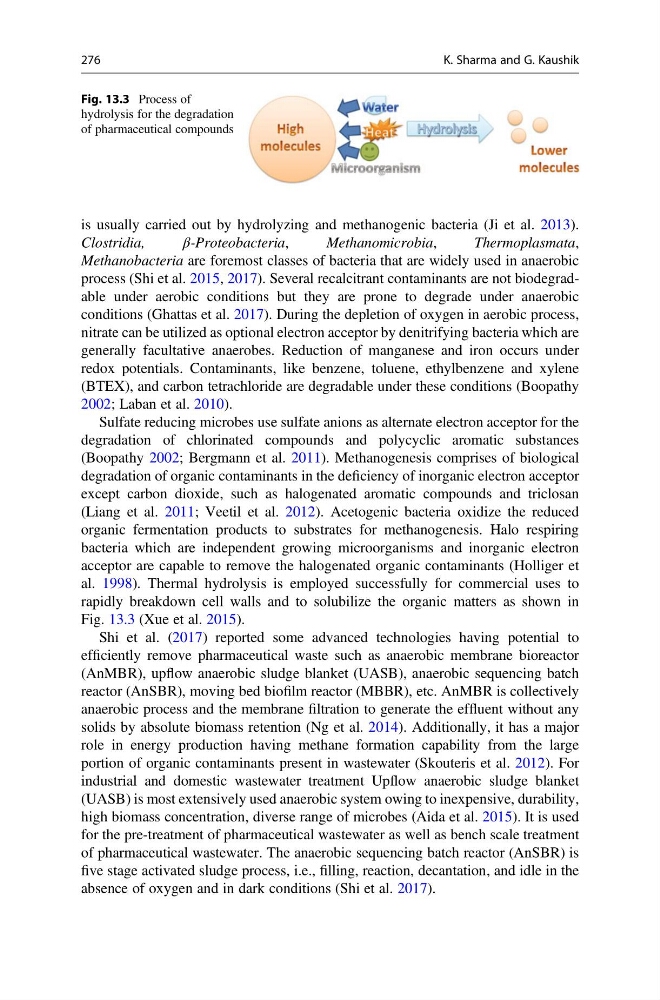
al. 1998). Thermal hydrolysis is employed successfully for commercial uses to
rapidly breakdown cell walls and to solubilize the organic matters as shown in
Fig. 13.3 (Xue et al. 2015).
Shi et al. (2017) reported some advanced technologies having potential to
efficiently remove pharmaceutical waste such as anaerobic membrane bioreactor
(AnMBR), upflow anaerobic sludge blanket (UASB), anaerobic sequencing batch
reactor (AnSBR), moving bed biofilm reactor (MBBR), etc. AnMBR is collectively
anaerobic process and the membrane filtration to generate the effluent without any
solids by absolute biomass retention (Ng et al. 2014). Additionally, it has a major
role in energy production having methane formation capability from the large
portion of organic contaminants present in wastewater (Skouteris et al. 2012). For
industrial and domestic wastewater treatment Upflow anaerobic sludge blanket
(UASB) is most extensively used anaerobic system owing to inexpensive, durability,
high biomass concentration, diverse range of microbes (Aida et al. 2015). It is used
for the pre-treatment of pharmaceutical wastewater as well as bench scale treatment
of pharmaceutical wastewater. The anaerobic sequencing batch reactor (AnSBR) is
five stage activated sludge process, i.e., filling, reaction, decantation, and idle in the
absence of oxygen and in dark conditions (Shi et al. 2017).
Fig. 13.3 Process of
hydrolysis for the degradation
of pharmaceutical compounds
276
K. Sharma and G. Kaushik
Clostridia,
β-Proteobacteria,
Methanomicrobia,
Thermoplasmata,
Methanobacteria are foremost classes of bacteria that are widely used in anaerobic
process (Shi et al. 2015, 2017). Several recalcitrant contaminants are not biodegradable under aerobic conditions but they are prone to degrade under anaerobic
conditions (Ghattas et al. 2017). During the depletion of oxygen in aerobic process,
nitrate can be utilized as optional electron acceptor by denitrifying bacteria which are
generally facultative anaerobes. Reduction of manganese and iron occurs under
redox potentials. Contaminants, like benzene, toluene, ethylbenzene and xylene
(BTEX), and carbon tetrachloride are degradable under these conditions (Boopathy
2002; Laban et al. 2010).
Sulfate reducing microbes use sulfate anions as alternate electron acceptor for the
degradation of chlorinated compounds and polycyclic aromatic substances
(Boopathy 2002; Bergmann et al. 2011). Methanogenesis comprises of biological
degradation of organic contaminants in the deficiency of inorganic electron acceptor
except carbon dioxide, such as halogenated aromatic compounds and triclosan
(Liang et al. 2011; Veetil et al. 2012). Acetogenic bacteria oxidize the reduced
organic fermentation products to substrates for methanogenesis. Halo respiring
bacteria which are independent growing microorganisms and inorganic electron
acceptor are capable to remove the halogenated organic contaminants (Holliger et
al. 1998). Thermal hydrolysis is employed successfully for commercial uses to
rapidly breakdown cell walls and to solubilize the organic matters as shown in
Fig. 13.3 (Xue et al. 2015).
Shi et al. (2017) reported some advanced technologies having potential to
efficiently remove pharmaceutical waste such as anaerobic membrane bioreactor
(AnMBR), upflow anaerobic sludge blanket (UASB), anaerobic sequencing batch
reactor (AnSBR), moving bed biofilm reactor (MBBR), etc. AnMBR is collectively
anaerobic process and the membrane filtration to generate the effluent without any
solids by absolute biomass retention (Ng et al. 2014). Additionally, it has a major
role in energy production having methane formation capability from the large
portion of organic contaminants present in wastewater (Skouteris et al. 2012). For
industrial and domestic wastewater treatment Upflow anaerobic sludge blanket
(UASB) is most extensively used anaerobic system owing to inexpensive, durability,
high biomass concentration, diverse range of microbes (Aida et al. 2015). It is used
for the pre-treatment of pharmaceutical wastewater as well as bench scale treatment
of pharmaceutical wastewater. The anaerobic sequencing batch reactor (AnSBR) is
five stage activated sludge process, i.e., filling, reaction, decantation, and idle in the
absence of oxygen and in dark conditions (Shi et al. 2017).
Fig. 13.3 Process of
hydrolysis for the degradation
of pharmaceutical compounds
276
K. Sharma and G. Kaushik