

commonly used are cigarettes, smokeless tobacco, cigars, and pipes (Iribarren et al.
1999). The quality of smoked cigarette and quitting smoking also have a role in oral
cancer risk as shown in studies that filtered cigarettes and smoking cessation
substantially lower risk of oral cancer (Kabat et al. 1994). The smoke emanating
from cigarettes has thousands of chemicals with around 60 of them carcinogens
(Table 10.1 lists some of the major components in the cigarette smoke). Cigarette
smokers have a lifetime increased risk for head and neck cancers (HNSCC) that are
5–25 fold increased over the general population (Andre et al. 1995). Those who quit
smoking are at the same level of risk as of a non-smoker 20 years after smoking
cessation. Risks of lung cancer and cancers of the upper respiratory tract increase
with increased consumption and duration of smoking. Incidences of laryngeal cancer
are strongly connected with exposure to tobacco smoke containing dozens of
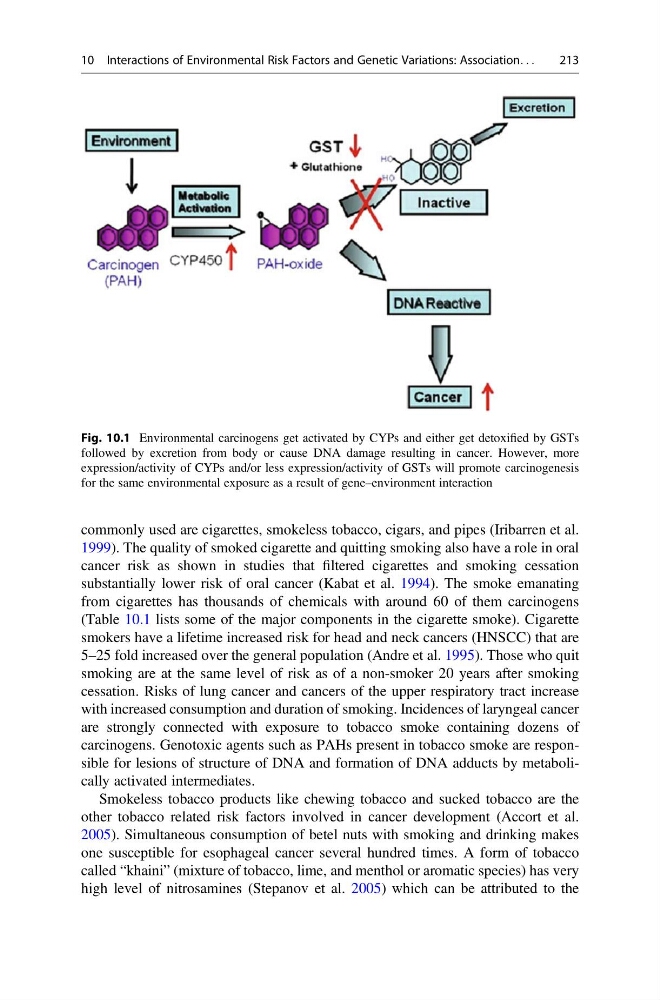
carcinogens. Genotoxic agents such as PAHs present in tobacco smoke are responsible for lesions of structure of DNA and formation of DNA adducts by metabolically activated intermediates.
Smokeless tobacco products like chewing tobacco and sucked tobacco are the
other tobacco related risk factors involved in cancer development (Accort et al.
2005). Simultaneous consumption of betel nuts with smoking and drinking makes
one susceptible for esophageal cancer several hundred times. A form of tobacco
called “khaini” (mixture of tobacco, lime, and menthol or aromatic species) has very
high level of nitrosamines (Stepanov et al. 2005) which can be attributed to the
Fig. 10.1 Environmental carcinogens get activated by CYPs and either get detoxified by GSTs
followed by excretion from body or cause DNA damage resulting in cancer. However, more
expression/activity of CYPs and/or less expression/activity of GSTs will promote carcinogenesis
for the same environmental exposure as a result of gene–environment interaction
10 Interactions of Environmental Risk Factors and Genetic Variations: Association. . .
213
1999). The quality of smoked cigarette and quitting smoking also have a role in oral
cancer risk as shown in studies that filtered cigarettes and smoking cessation
substantially lower risk of oral cancer (Kabat et al. 1994). The smoke emanating
from cigarettes has thousands of chemicals with around 60 of them carcinogens
(Table 10.1 lists some of the major components in the cigarette smoke). Cigarette
smokers have a lifetime increased risk for head and neck cancers (HNSCC) that are
5–25 fold increased over the general population (Andre et al. 1995). Those who quit
smoking are at the same level of risk as of a non-smoker 20 years after smoking
cessation. Risks of lung cancer and cancers of the upper respiratory tract increase
with increased consumption and duration of smoking. Incidences of laryngeal cancer
are strongly connected with exposure to tobacco smoke containing dozens of
carcinogens. Genotoxic agents such as PAHs present in tobacco smoke are responsible for lesions of structure of DNA and formation of DNA adducts by metabolically activated intermediates.
Smokeless tobacco products like chewing tobacco and sucked tobacco are the
other tobacco related risk factors involved in cancer development (Accort et al.
2005). Simultaneous consumption of betel nuts with smoking and drinking makes
one susceptible for esophageal cancer several hundred times. A form of tobacco
called “khaini” (mixture of tobacco, lime, and menthol or aromatic species) has very
high level of nitrosamines (Stepanov et al. 2005) which can be attributed to the
Fig. 10.1 Environmental carcinogens get activated by CYPs and either get detoxified by GSTs
followed by excretion from body or cause DNA damage resulting in cancer. However, more
expression/activity of CYPs and/or less expression/activity of GSTs will promote carcinogenesis
for the same environmental exposure as a result of gene–environment interaction
10 Interactions of Environmental Risk Factors and Genetic Variations: Association. . .
213