

Optical biosensors are more suitable for direct monitoring systems. An optical
biosensor is a compact analytical tool containing a biorecognition sensing element
integrated with an optical transducer system. The basic objective of an optical
biosensor is to produce a signal that is proportionate to the concentration of a
measured substance (analyte) (Damborsky et al. 2016). The optical biosensor can
use various biological materials, including enzymes, antibodies, antigens, receptors,
nucleic acids, whole cells, and tissues as biorecognition elements. Optical-based
biosensor is able to provide a direct, real-time, and label-free detection of many
biological and chemical substances (Fan et al. 2008, Bhatta et al. 2012). The surface
plasmon resonance (detailed in Sect. 9.2.4.2) or fluorescence that is integrated with
optical fiber is a most popular method available for optical-based biosensing (Caygill
et al. 2010).
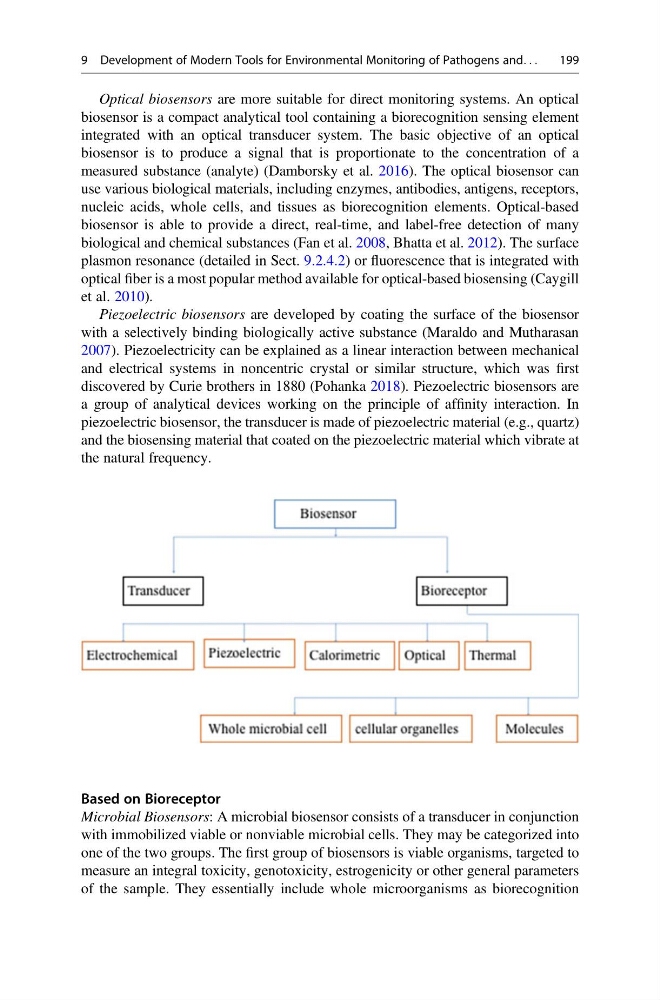
Piezoelectric biosensors are developed by coating the surface of the biosensor
with a selectively binding biologically active substance (Maraldo and Mutharasan
2007). Piezoelectricity can be explained as a linear interaction between mechanical
and electrical systems in noncentric crystal or similar structure, which was first
discovered by Curie brothers in 1880 (Pohanka 2018). Piezoelectric biosensors are
a group of analytical devices working on the principle of affinity interaction. In
piezoelectric biosensor, the transducer is made of piezoelectric material (e.g., quartz)
and the biosensing material that coated on the piezoelectric material which vibrate at
the natural frequency.
Based on Bioreceptor
Microbial Biosensors: A microbial biosensor consists of a transducer in conjunction
with immobilized viable or nonviable microbial cells. They may be categorized into
one of the two groups. The first group of biosensors is viable organisms, targeted to
measure an integral toxicity, genotoxicity, estrogenicity or other general parameters
of the sample. They essentially include whole microorganisms as biorecognition
9 Development of Modern Tools for Environmental Monitoring of Pathogens and. . .
199
biosensor is a compact analytical tool containing a biorecognition sensing element
integrated with an optical transducer system. The basic objective of an optical
biosensor is to produce a signal that is proportionate to the concentration of a
measured substance (analyte) (Damborsky et al. 2016). The optical biosensor can
use various biological materials, including enzymes, antibodies, antigens, receptors,
nucleic acids, whole cells, and tissues as biorecognition elements. Optical-based
biosensor is able to provide a direct, real-time, and label-free detection of many
biological and chemical substances (Fan et al. 2008, Bhatta et al. 2012). The surface
plasmon resonance (detailed in Sect. 9.2.4.2) or fluorescence that is integrated with
optical fiber is a most popular method available for optical-based biosensing (Caygill
et al. 2010).
Piezoelectric biosensors are developed by coating the surface of the biosensor
with a selectively binding biologically active substance (Maraldo and Mutharasan
2007). Piezoelectricity can be explained as a linear interaction between mechanical
and electrical systems in noncentric crystal or similar structure, which was first
discovered by Curie brothers in 1880 (Pohanka 2018). Piezoelectric biosensors are
a group of analytical devices working on the principle of affinity interaction. In
piezoelectric biosensor, the transducer is made of piezoelectric material (e.g., quartz)
and the biosensing material that coated on the piezoelectric material which vibrate at
the natural frequency.
Based on Bioreceptor
Microbial Biosensors: A microbial biosensor consists of a transducer in conjunction
with immobilized viable or nonviable microbial cells. They may be categorized into
one of the two groups. The first group of biosensors is viable organisms, targeted to
measure an integral toxicity, genotoxicity, estrogenicity or other general parameters
of the sample. They essentially include whole microorganisms as biorecognition
9 Development of Modern Tools for Environmental Monitoring of Pathogens and. . .
199