

devices that detect biochemical and physiological changes. A biosensor is defined by
the International Union of Pure and Applied Chemistry (IUPAC) as a self-contained
integrated device that is capable of providing specific quantitative or semiquantitative analytical information using a biological recognition element (biochemical
receptor), which is retained in direct spatial contact with a transduction element.
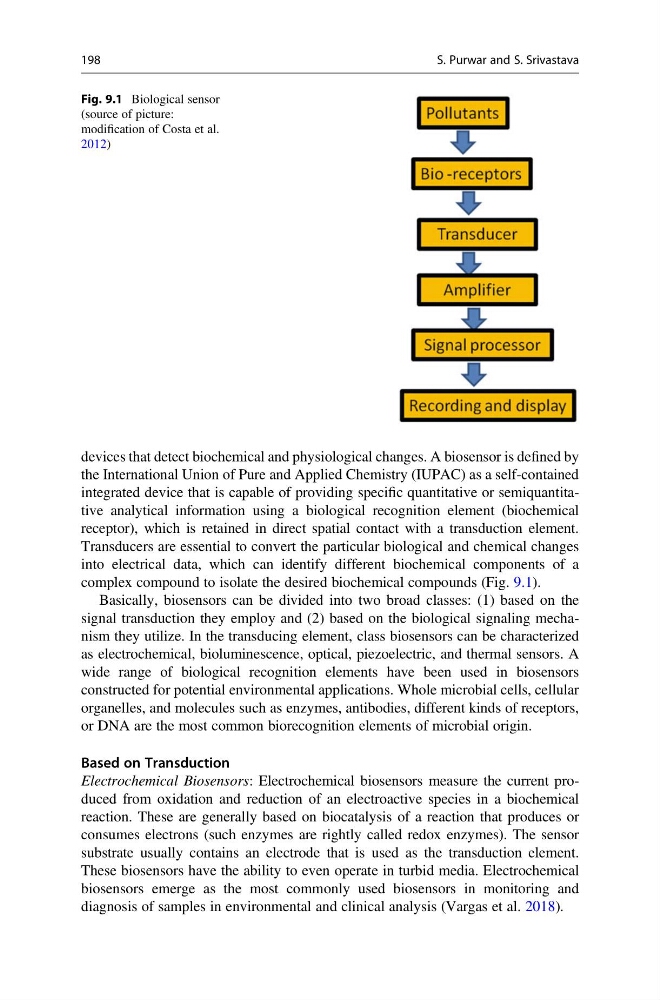
Transducers are essential to convert the particular biological and chemical changes
into electrical data, which can identify different biochemical components of a
complex compound to isolate the desired biochemical compounds (Fig. 9.1).
Basically, biosensors can be divided into two broad classes: (1) based on the
signal transduction they employ and (2) based on the biological signaling mechanism they utilize. In the transducing element, class biosensors can be characterized
as electrochemical, bioluminescence, optical, piezoelectric, and thermal sensors. A
wide range of biological recognition elements have been used in biosensors
constructed for potential environmental applications. Whole microbial cells, cellular
organelles, and molecules such as enzymes, antibodies, different kinds of receptors,
or DNA are the most common biorecognition elements of microbial origin.
Based on Transduction
Electrochemical Biosensors: Electrochemical biosensors measure the current produced from oxidation and reduction of an electroactive species in a biochemical
reaction. These are generally based on biocatalysis of a reaction that produces or
consumes electrons (such enzymes are rightly called redox enzymes). The sensor
substrate usually contains an electrode that is used as the transduction element.
These biosensors have the ability to even operate in turbid media. Electrochemical
biosensors emerge as the most commonly used biosensors in monitoring and
diagnosis of samples in environmental and clinical analysis (Vargas et al. 2018).
Fig. 9.1 Biological sensor
(source of picture:
modification of Costa et al.
2012)
198
S. Purwar and S. Srivastava
the International Union of Pure and Applied Chemistry (IUPAC) as a self-contained
integrated device that is capable of providing specific quantitative or semiquantitative analytical information using a biological recognition element (biochemical
receptor), which is retained in direct spatial contact with a transduction element.
Transducers are essential to convert the particular biological and chemical changes
into electrical data, which can identify different biochemical components of a
complex compound to isolate the desired biochemical compounds (Fig. 9.1).
Basically, biosensors can be divided into two broad classes: (1) based on the
signal transduction they employ and (2) based on the biological signaling mechanism they utilize. In the transducing element, class biosensors can be characterized
as electrochemical, bioluminescence, optical, piezoelectric, and thermal sensors. A
wide range of biological recognition elements have been used in biosensors
constructed for potential environmental applications. Whole microbial cells, cellular
organelles, and molecules such as enzymes, antibodies, different kinds of receptors,
or DNA are the most common biorecognition elements of microbial origin.
Based on Transduction
Electrochemical Biosensors: Electrochemical biosensors measure the current produced from oxidation and reduction of an electroactive species in a biochemical
reaction. These are generally based on biocatalysis of a reaction that produces or
consumes electrons (such enzymes are rightly called redox enzymes). The sensor
substrate usually contains an electrode that is used as the transduction element.
These biosensors have the ability to even operate in turbid media. Electrochemical
biosensors emerge as the most commonly used biosensors in monitoring and
diagnosis of samples in environmental and clinical analysis (Vargas et al. 2018).
Fig. 9.1 Biological sensor
(source of picture:
modification of Costa et al.
2012)
198
S. Purwar and S. Srivastava