

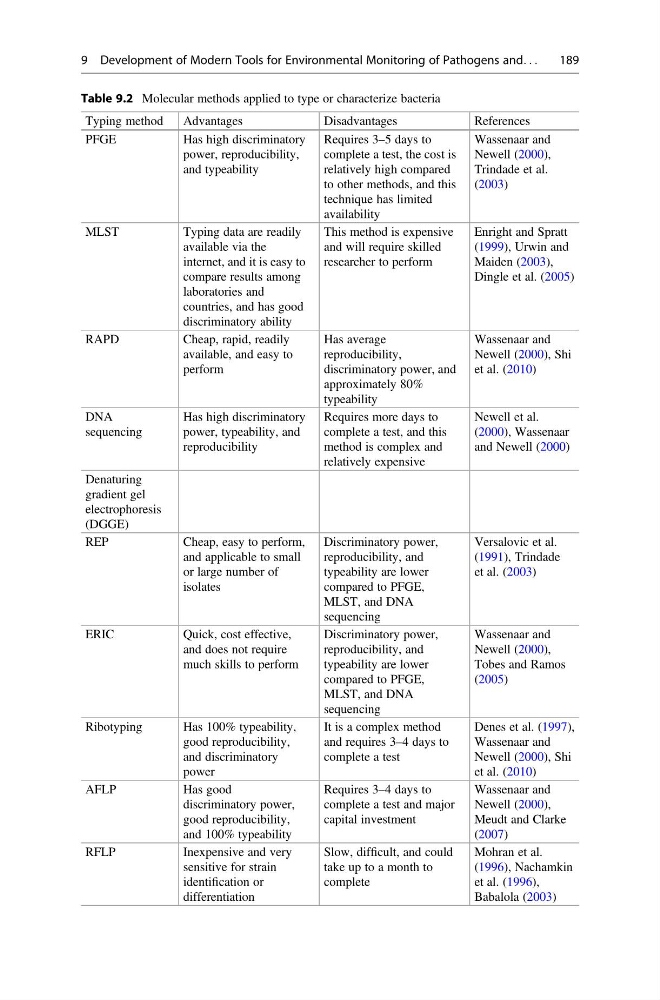
Table 9.2 Molecular methods applied to type or characterize bacteria
Typing method
Advantages
Disadvantages
References
PFGE
Has high discriminatory
power, reproducibility,
and typeability
Requires 3–5 days to
complete a test, the cost is
relatively high compared
to other methods, and this
technique has limited
availability
Wassenaar and
Newell (2000),
Trindade et al.
(2003)
MLST
Typing data are readily
available via the
internet, and it is easy to
compare results among
laboratories and
countries, and has good
discriminatory ability
This method is expensive
and will require skilled
researcher to perform
Enright and Spratt
(1999), Urwin and
Maiden (2003),
Dingle et al. (2005)
RAPD
Cheap, rapid, readily
available, and easy to
perform
Has average
reproducibility,
discriminatory power, and
approximately 80%
typeability
Wassenaar and
Newell (2000), Shi
et al. (2010)
DNA
sequencing
Has high discriminatory
power, typeability, and
reproducibility
Requires more days to
complete a test, and this
method is complex and
relatively expensive
Newell et al.
(2000), Wassenaar
and Newell (2000)
Denaturing
gradient gel
electrophoresis
(DGGE)
REP
Cheap, easy to perform,
and applicable to small
or large number of
isolates
Discriminatory power,
reproducibility, and
typeability are lower
compared to PFGE,
MLST, and DNA
sequencing
Versalovic et al.
(1991), Trindade
et al. (2003)
ERIC
Quick, cost effective,
and does not require
much skills to perform
Discriminatory power,
reproducibility, and
typeability are lower
compared to PFGE,
MLST, and DNA
sequencing
Wassenaar and
Newell (2000),
Tobes and Ramos
(2005)
Ribotyping
Has 100% typeability,
good reproducibility,
and discriminatory
power
It is a complex method
and requires 3–4 days to
complete a test
Denes et al. (1997),
Wassenaar and
Newell (2000), Shi
et al. (2010)
AFLP
Has good
discriminatory power,
good reproducibility,
and 100% typeability
Requires 3–4 days to
complete a test and major
capital investment
Wassenaar and
Newell (2000),
Meudt and Clarke
(2007)
RFLP
Inexpensive and very
sensitive for strain
identification or
differentiation
Slow, difficult, and could
take up to a month to
complete
Mohran et al.
(1996), Nachamkin
et al. (1996),
Babalola (2003)
9 Development of Modern Tools for Environmental Monitoring of Pathogens and. . .
189
Typing method
Advantages
Disadvantages
References
PFGE
Has high discriminatory
power, reproducibility,
and typeability
Requires 3–5 days to
complete a test, the cost is
relatively high compared
to other methods, and this
technique has limited
availability
Wassenaar and
Newell (2000),
Trindade et al.
(2003)
MLST
Typing data are readily
available via the
internet, and it is easy to
compare results among
laboratories and
countries, and has good
discriminatory ability
This method is expensive
and will require skilled
researcher to perform
Enright and Spratt
(1999), Urwin and
Maiden (2003),
Dingle et al. (2005)
RAPD
Cheap, rapid, readily
available, and easy to
perform
Has average
reproducibility,
discriminatory power, and
approximately 80%
typeability
Wassenaar and
Newell (2000), Shi
et al. (2010)
DNA
sequencing
Has high discriminatory
power, typeability, and
reproducibility
Requires more days to
complete a test, and this
method is complex and
relatively expensive
Newell et al.
(2000), Wassenaar
and Newell (2000)
Denaturing
gradient gel
electrophoresis
(DGGE)
REP
Cheap, easy to perform,
and applicable to small
or large number of
isolates
Discriminatory power,
reproducibility, and
typeability are lower
compared to PFGE,
MLST, and DNA
sequencing
Versalovic et al.
(1991), Trindade
et al. (2003)
ERIC
Quick, cost effective,
and does not require
much skills to perform
Discriminatory power,
reproducibility, and
typeability are lower
compared to PFGE,
MLST, and DNA
sequencing
Wassenaar and
Newell (2000),
Tobes and Ramos
(2005)
Ribotyping
Has 100% typeability,
good reproducibility,
and discriminatory
power
It is a complex method
and requires 3–4 days to
complete a test
Denes et al. (1997),
Wassenaar and
Newell (2000), Shi
et al. (2010)
AFLP
Has good
discriminatory power,
good reproducibility,
and 100% typeability
Requires 3–4 days to
complete a test and major
capital investment
Wassenaar and
Newell (2000),
Meudt and Clarke
(2007)
RFLP
Inexpensive and very
sensitive for strain
identification or
differentiation
Slow, difficult, and could
take up to a month to
complete
Mohran et al.
(1996), Nachamkin
et al. (1996),
Babalola (2003)
9 Development of Modern Tools for Environmental Monitoring of Pathogens and. . .
189