

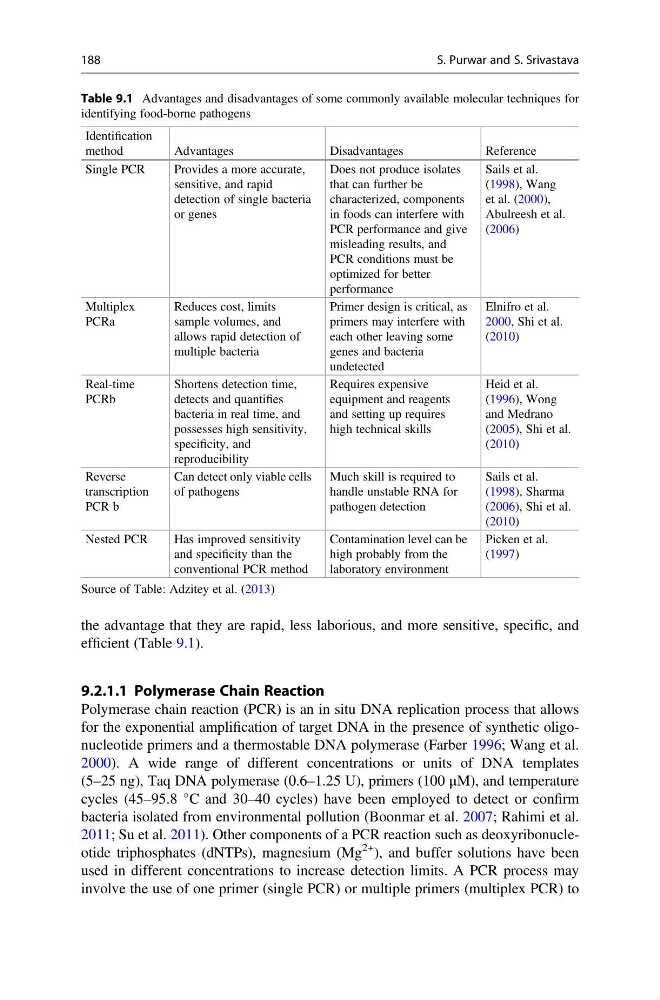
the advantage that they are rapid, less laborious, and more sensitive, specific, and
efficient (Table 9.1).
9.2.1.1 Polymerase Chain Reaction
Polymerase chain reaction (PCR) is an in situ DNA replication process that allows
for the exponential amplification of target DNA in the presence of synthetic oligonucleotide primers and a thermostable DNA polymerase (Farber 1996; Wang et al.
2000). A wide range of different concentrations or units of DNA templates
(5–25 ng), Taq DNA polymerase (0.6–1.25 U), primers (100 μM), and temperature
cycles (45–95.8
C and 30–40 cycles) have been employed to detect or confirm
bacteria isolated from environmental pollution (Boonmar et al. 2007; Rahimi et al.
2011; Su et al. 2011). Other components of a PCR reaction such as deoxyribonucleotide triphosphates (dNTPs), magnesium (Mg
2+ ), and buffer solutions have been
used in different concentrations to increase detection limits. A PCR process may
involve the use of one primer (single PCR) or multiple primers (multiplex PCR) to
Table 9.1 Advantages and disadvantages of some commonly available molecular techniques for
identifying food-borne pathogens
Identification
method
Advantages
Disadvantages
Reference
Single PCR
Provides a more accurate,
sensitive, and rapid
detection of single bacteria
or genes
Does not produce isolates
that can further be
characterized, components
in foods can interfere with
PCR performance and give
misleading results, and
PCR conditions must be
optimized for better
performance
Sails et al.
(1998), Wang
et al. (2000),
Abulreesh et al.
(2006)
Multiplex
PCRa
Reduces cost, limits
sample volumes, and
allows rapid detection of
multiple bacteria
Primer design is critical, as
primers may interfere with
each other leaving some
genes and bacteria
undetected
Elnifro et al.
2000, Shi et al.
(2010)
Real-time
PCRb
Shortens detection time,
detects and quantifies
bacteria in real time, and
possesses high sensitivity,
specificity, and
reproducibility
Requires expensive
equipment and reagents
and setting up requires
high technical skills
Heid et al.
(1996), Wong
and Medrano
(2005), Shi et al.
(2010)
Reverse
transcription
PCR b
Can detect only viable cells
of pathogens
Much skill is required to
handle unstable RNA for
pathogen detection
Sails et al.
(1998), Sharma
(2006), Shi et al.
(2010)
Nested PCR
Has improved sensitivity
and specificity than the
conventional PCR method
Contamination level can be
high probably from the
laboratory environment
Picken et al.
(1997)
Source of Table: Adzitey et al. (2013)
188
S. Purwar and S. Srivastava
efficient (Table 9.1).
9.2.1.1 Polymerase Chain Reaction
Polymerase chain reaction (PCR) is an in situ DNA replication process that allows
for the exponential amplification of target DNA in the presence of synthetic oligonucleotide primers and a thermostable DNA polymerase (Farber 1996; Wang et al.
2000). A wide range of different concentrations or units of DNA templates
(5–25 ng), Taq DNA polymerase (0.6–1.25 U), primers (100 μM), and temperature
cycles (45–95.8
C and 30–40 cycles) have been employed to detect or confirm
bacteria isolated from environmental pollution (Boonmar et al. 2007; Rahimi et al.
2011; Su et al. 2011). Other components of a PCR reaction such as deoxyribonucleotide triphosphates (dNTPs), magnesium (Mg
2+ ), and buffer solutions have been
used in different concentrations to increase detection limits. A PCR process may
involve the use of one primer (single PCR) or multiple primers (multiplex PCR) to
Table 9.1 Advantages and disadvantages of some commonly available molecular techniques for
identifying food-borne pathogens
Identification
method
Advantages
Disadvantages
Reference
Single PCR
Provides a more accurate,
sensitive, and rapid
detection of single bacteria
or genes
Does not produce isolates
that can further be
characterized, components
in foods can interfere with
PCR performance and give
misleading results, and
PCR conditions must be
optimized for better
performance
Sails et al.
(1998), Wang
et al. (2000),
Abulreesh et al.
(2006)
Multiplex
PCRa
Reduces cost, limits
sample volumes, and
allows rapid detection of
multiple bacteria
Primer design is critical, as
primers may interfere with
each other leaving some
genes and bacteria
undetected
Elnifro et al.
2000, Shi et al.
(2010)
Real-time
PCRb
Shortens detection time,
detects and quantifies
bacteria in real time, and
possesses high sensitivity,
specificity, and
reproducibility
Requires expensive
equipment and reagents
and setting up requires
high technical skills
Heid et al.
(1996), Wong
and Medrano
(2005), Shi et al.
(2010)
Reverse
transcription
PCR b
Can detect only viable cells
of pathogens
Much skill is required to
handle unstable RNA for
pathogen detection
Sails et al.
(1998), Sharma
(2006), Shi et al.
(2010)
Nested PCR
Has improved sensitivity
and specificity than the
conventional PCR method
Contamination level can be
high probably from the
laboratory environment
Picken et al.
(1997)
Source of Table: Adzitey et al. (2013)
188
S. Purwar and S. Srivastava